

What you need to know
Everything Policy analysts are exploring what the Founding Fathers might say about the evolution of our political system. In this brief, we consider modern political parties from the viewpoint of George Washington, leader of America’s armed forces during the Revolutionary War, presiding officer at the Constitutional Convention, and the first President of the United States.
What Was Washington’s Farewell Address?
Most of what we know about George Washington’s feelings about political parties comes from his Farewell Address, a letter he released explaining his decision not to seek a third term. One of the major worries he expressed in the letter concerned the potential for political parties to become central players in elections and policymaking. He wrote:
Let me now take a more comprehensive view and warn you in the most solemn manner against the baneful effects of the spirit of party, generally. [Political Parties] serve to organize faction, to give it an artificial and extraordinary force—to put in the place of the delegated will of the nation the will of a party; often a small but artful and enterprising minority of the community; and, according to the alternate triumphs of different parties, to make the public administration the mirror of the ill concerted and incongruous projects of faction, rather than the organ of consistent and wholesome plans digested by common councils and modified by mutual interests. However, combinations or associations of the above description may now and then answer popular ends, they are likely, in the course of time and things, to become potent engines by which cunning, ambitious, and unprincipled men will be enabled to subvert the power of the people and to usurp for themselves the reins of government, destroying afterwards the very engines which have lifted them to unjust dominion.
It is relatively easy to interpret that Washington’s view of party organizations was negative. Washington was suggesting that parties could be harmful to democracy, that they may likely pursue narrow, self-interested goals rather than the good of all, and that the worst thing that could happen to America is a political system dominated by political parties – which is a good way to describe modern American politics.
Washington was not alone in disliking political parties. In fact, the American Constitution was described by historian Richard Hofstadter as “a Constitution against parties,” meaning that the electoral rules and organization of the national government established by the Founding Fathers were designed to make it hard for an organized group to win enough seats in elections to control the policymaking process. However, as history illustrates, they behaved very differently while in office.
Was Washington Right?
Washington was writing at a time when there were few examples of functioning national democracies. The Founders’ understanding of politics and policymaking was incomplete. Some of the procedures set out in the original Constitution, such as having the losing candidate in a presidential election serve as Vice President, were revised almost immediately. Others, including giving state legislatures the power to select Senators, limiting voting rights to property-owning white males, or allowing slavery to continue, were revised over time.
Washington’s letter expresses the hope that Americans can arrive at an enduring consensus about national policy. However, 250 years of experience with democracy in America suggests that in a large, diverse nation, policy conflicts are inevitable. These conflicts are what drive party organization. By picking candidates and developing campaign platforms, parties transform elections into a choice between different ideas of what the government should do. As the famous political scientist E. E. Schattschneider once put it, “political parties created democracy and modern democracy is unthinkable save in terms of the parties.” All modern democracies have some form of political parties.
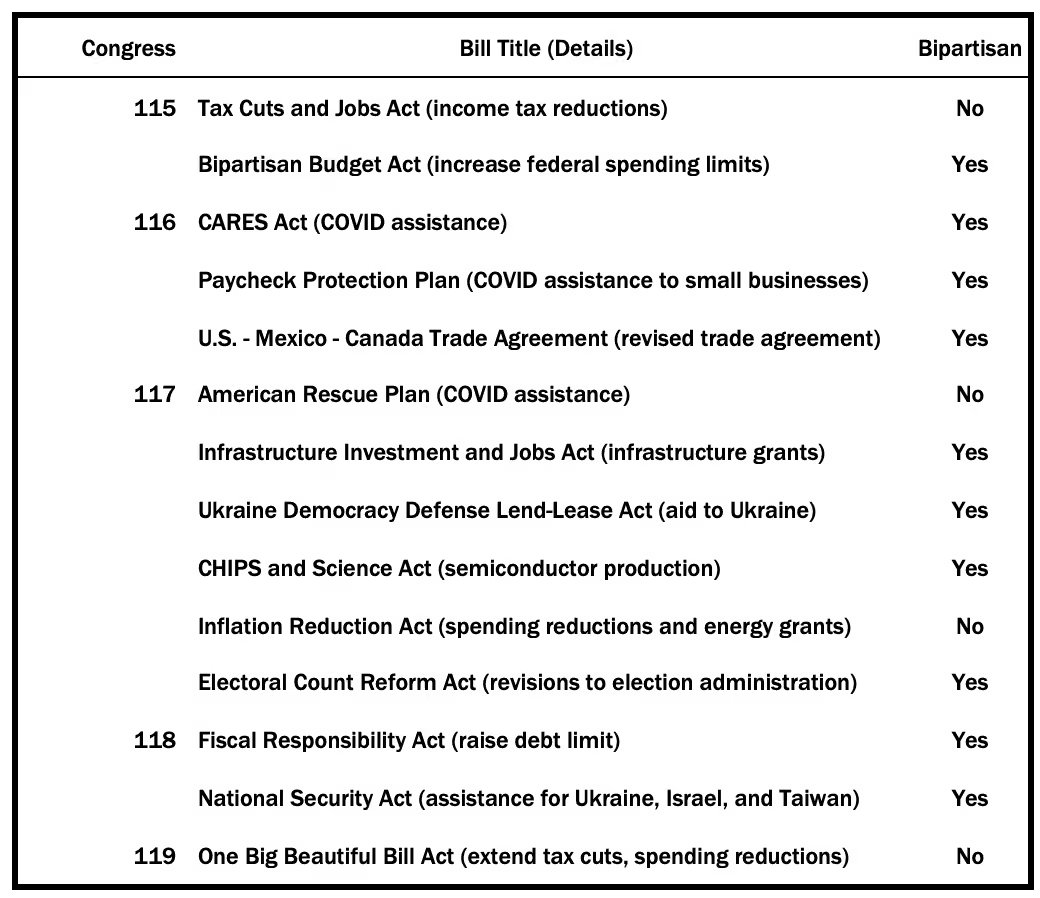
As we have discussed in many of our policy briefs, modern democracy is not perfect. Sometimes political parties exploit policy conflicts and forego compromise to win elections, which is exactly what Washington was worried about. At the same time, Washington did not anticipate that political parties could also help to build policy compromise, both before elections and in government. Modern political parties work to find candidates and campaign platforms that appeal to a large, diverse group of supporters. Even today, enacting important legislation in Congress often requires bipartisan negotiation between the congressional party caucuses. The table below compiles key legislation enacted during the last four congresses (2017 – 2026), at a time of high polarization between the Democratic and Republican parties. Even so, of the 14 bills in the table, 10 (71.4%) were enacted with significant support from both parties.
Political parties were compromise-makers even during Washington’s time. The same Founders who opposed parties at the Founding almost immediately began building these organizations after the Constitution was ratified. During the first Congress, party groupings (the Federalists and the Democratic-Republicans) emerged during debates on the permanent location of the U.S. Capital and whether the new national government would pay the debts incurred by state governments during the Revolutionary War. These new organizations were instrumental in executing a vote trade that enacted both proposals, solving a high-stakes problem for the new nation.
Ironically, the leaders of the new political parties were Alexander Hamilton and James Madison, both of whom helped Washington write his Farewell Address. In Washington’s time and in the modern era, political parties are not necessarily the source of political conflict. Instead, they reflect existing differences and may often be the mechanism by which compromise is reached.
The Takeaway
On leaving office, George Washington expressed concerns that the formation of political parties would make it harder to sustain a democratic system that worked for the good of all Americans.
What Washington did not anticipate was that throughout American history, Americans have often disagreed about the proper role of government in society. Modern political parties are organized around these disagreements, but for the most part, do not create them.
After 250 years, the evidence suggests that American political parties have sometimes operated as Washington feared, but at other times have been responsible for creating important policy compromises.
Enjoying this content? Support our mission through financial support.
Further reading
Hofstadter, R. (1969). The idea of a party system: the rise of legitimate opposition in the United States, 1780-1840. Univ of California Press.
Washington, G. (1796) The Address of General Washington to the People of America on His Declining the Presidency of the United States, https://tinyurl.com/4hapt5cy, accessed 6/4/26
Sources
Washington, G. (1796) The Address of General Washington to the People of America on His Declining the Presidency of the United States, https://tinyurl.com/4hapt5cy, accessed 6/4/26
Spalding, M. (1996). George Washington's farewell address. Wilson Quarterly, 20, 65-71.
Malanson, J. J. (2014). " If I Had It in His Hand-Writing I Would Burn It": Federalists and the Authorship Controversy over George Washington's Farewell Address, 1808–1859. Journal of the Early Republic, 34(2), 219-242.
Campbell, K. K., & Jamieson, K. H. (2026). Presidents creating the presidency: Deeds done in words. In Presidents Creating the Presidency. University of Chicago Press.
Chernow, R. (2010). Washington: A life. Penguin UK.
Hoadley, J. F. (2014). Origins of American Political Parties: 1789–1803. University Press of Kentucky.
Hofstadter, R. (1969). The idea of a party system: the rise of legitimate opposition in the United States, 1780-1840. Univ of California Press.
Schattschneider, E. (1951). Party government: American government in action. Routledge.
Contributors
William Bianco (Research Director) is Professor of Political Science at Indiana University and Founding Director of the Indiana Political Analytics Workshop. He received his PhD from the University of Rochester. His teaching focuses on first-year students and the Introduction to American Government class. He is the co-author of American Politics Today, an introductory textbook published by W. W. Norton now in its 9th edition, and authored a second textbook, American Politics: Strategy and Choice. His research program focuses on American politics, including Trust: Representatives and Constituents, as well as numerous articles. His op-eds have been published in the Washington Post, the Indianapolis Star, Newsday, and other venues.