


What you need to know
On January 25, 2025, President Trump issued an Executive Order stating that birthright citizenship would be denied to children of undocumented immigrants or temporary visitors to the U.S. On June 30, 2026, the U.S. Supreme Court held in Trump v. Barbara that the order was unconstitutional. In this brief, we discuss the background and implications of this decision:
- What is birthright citizenship?
- What did the Supreme Court say?
- How common is birthright citizenship in other nations?
What is birthright citizenship?
Across the globe, citizenship generally falls into one of two categories–either based on parents or the location of birth. Birthright citizenship means that babies born within the country's territory are granted citizenship upon birth. The alternative is that parental citizenship or legal resident status determines a baby’s citizenship.
Where did birthright citizenship come from?
The 14th Amendment to the U.S. Constitution begins: “All persons born or naturalized in the United States, and subject to the jurisdiction thereof, are citizens of the United States and of the State wherein they reside.” Passed after the Civil War, the 14th Amendment was intended to extend citizenship and other rights/protections to freed Black people.
Since then, the 14th Amendment has generally been understood to mean that anyone born within the territory of the United States (with some exceptions, such as children of diplomats) is automatically a citizen. A landmark 1898 Supreme Court decision, United States v. Wong Kim Ark, held that birthright citizenship extended to everyone regardless of race. Under current law and interpretation of the 14th Amendment, babies born to undocumented parents, as well as temporarily legal parents (including international students, guest workers, asylum seekers, and tourists), are given U.S. citizenship.
This view of the 14th Amendment was endorsed by a 5-4 majority of the Supreme Court in their recent decision. Justice Kavanaugh was among the dissenters on the constitutional question, but would have struck down President Trump’s executive order on statutory grounds (a law passed by Congress in 1940).
How common are births to undocumented parents?
One question in the debate over birthright citizenship is how many babies in the U.S. are born each year to noncitizens. The figure below uses U.S. Census data compiled by the Pew Research Center to show that in recent years, about 9 percent of births in the U.S. (about 320,000 in 2023) were to undocumented or temporarily legal parents.
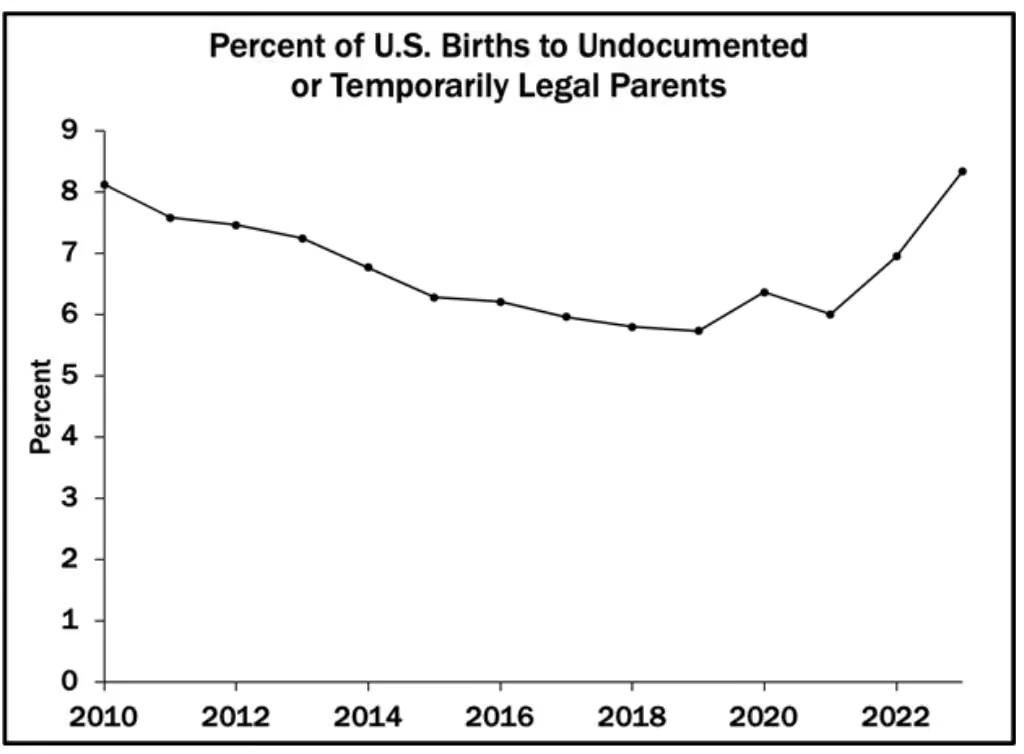
Most of these births (260,000) were to undocumented parents and would not be given citizenship under the Trump order. Due to the Supreme Court decision, unless the Constitution is changed, all babies born in the U.S. will continue to automatically be given citizenship (which has been true since the 14th Amendment was ratified in 1868).
Is birthright citizenship common in other countries?
The figure below reports on citizenship rules for the 38 industrialized democracies (including the U.S.) that are in the Organization for Economic Cooperation and Development (OECD).
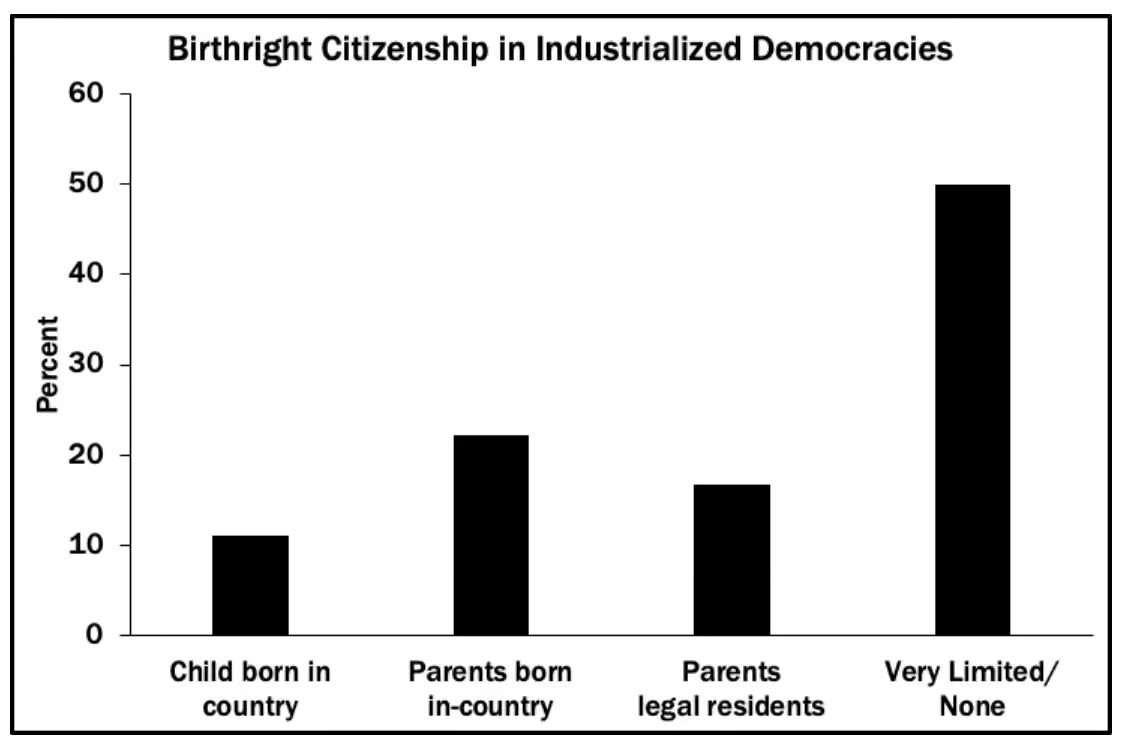
Only four OECD nations – the U.S., Canada, Costa Rica, and Mexico – have unrestricted birthright citizenship. Some other countries require that one or both parents be legal residents for a specified period or be born in the country. However, half of the OECD countries have no birthright citizenship.
The Takeaway
The recent Supreme Court decision means that current U.S. birthright citizenship remains a constitutional right.
The U.S. is one of a few industrialized countries with unrestricted birthright citizenship.
President Trump’s executive order would have eliminated citizenship for babies of undocumented parents, reducing birthright citizenship grants to noncitizens by about 80%.
Enjoying this content? Support our mission through financial support.
Further reading
Howe, A. (2026). Supreme Court strikes down Trump’s order ending birthright citizenship. https://tinyurl.com/2rwamb5d, accessed 07/03/26.
Jouvenal, J. (2026). Supreme Court upholds principle that almost all born on U.S. soil are American. https://tinyurl.com/mr2kjx5s, accessed 07/05/26.
Sources
García Hernández, C. C. (2026). Why the Supreme Court’s birthright-citizenship decision may depend on the meaning of “domicile”. https://tinyurl.com/3498m6zk, accessed 04/20/26.
The White House. (2025). Protecting The Meaning And Value Of American Citizenship. https://tinyurl.com/ydz5jrxr, accessed 04/23/25.
Fassel, J. S., & Fahmy, D. (2026). About 9% of U.S. births in 2023 were to unauthorized or temporary legal immigrant mothers. https://tinyurl.com/37yskyrf, accessed 04/20/26.
Desilver, D. (2026). U.S.-style birthright citizenship is uncommon around the world. Pew Research Center. https://tinyurl.com/4e9p42y6, accessed 04/21/26.
Globalcit. (2026). GLOBALCIT Citizenship Law Dataset – Modes of Acquisition of Citizenship. https://tinyurl.com/zu6hh8hm, accessed 04/24/26.
Supreme Court of the United States. (2026). Trump, President of the United States, et al. v. Barbara et al. 609 U.S. https://tinyurl.com/2rtw35ts, accessed 07/04/26.
National Constitution Center. (1866). 14th Amendment - Citizenship Rights, Equal Protection, Apportionment, Civil War Debt. https://tinyurl.com/5n9au8z3, accessed 07/06/26.
Contributors
Dr. David Canon received his PhD in Political Science from the University of Minnesota. He is Professor Emeritus at the University of Wisconsin, Madison. His research concerns Congress, elections, political careers, and race and representation.
Dr. William Bianco (Research Director) received his PhD in Political Science from the University of Rochester. He is Professor of Political Science and Director of the Indiana Political Analytics Workshop at Indiana University. His current research is on representation, political identities, and the politics of scientific research.