

What you need to know
Many depictions of Congress use data to show a decline in the number of bills enacted, concluding that Congress is “broken” and increasingly incapable of getting anything done. In this brief, we take a closer look at the data:
- We analyze legislative activity for every Congress from the late 1980s through the mid-2020s
- Distinguish between major legislation and other types of proposals, including ceremonial bills, technical corrections, and appropriations
- Reassess whether Congress is more or less productive than raw bill counts suggest
The Basics
A “congress” refers to the two-year legislative period aligned with the elected terms of House members. We are currently in the 119th Congress, which began on January 3, 2025.
While our focus is on enactments, it is also true that enacting new laws does not necessarily signify progress or forward movement. For example, the goals of legislation may be opposed by many citizens; a bill’s policy outcomes may ultimately differ from expectations; or circumstances may change, so that the programs funded by a bill may no longer be needed. Congressional repeals of laws or regulations may also increase government efficiency or citizen satisfaction. These factors will be discussed in later briefs.
Even when considering only enactments, legislative activity is not easy to measure. Since 1987, only about 2.4% of bills introduced have become law. Moreover, treating all enacted legislation as equivalent risks overstating Congress’ accomplishments, because many enacted bills are ceremonial, commemorative, or administrative in nature. These include the naming of federal facilities, designations of special days or months, technical corrections to existing statutes, and appropriations (spending) bills, which must be enacted annually. Of the 8259 bills enacted between 1987 and 2024, 3145 (almost 40%) were in one of these four categories. Have these types of bills become more or less common over time?
What does legislative activity look like over time?
Figure 1 shows the number of bills enacted from the 100th Congress (1987–1988) through the most recently completed Congress (118th). We present both the total count and an adjusted count that excludes all non-major bills, as described earlier.
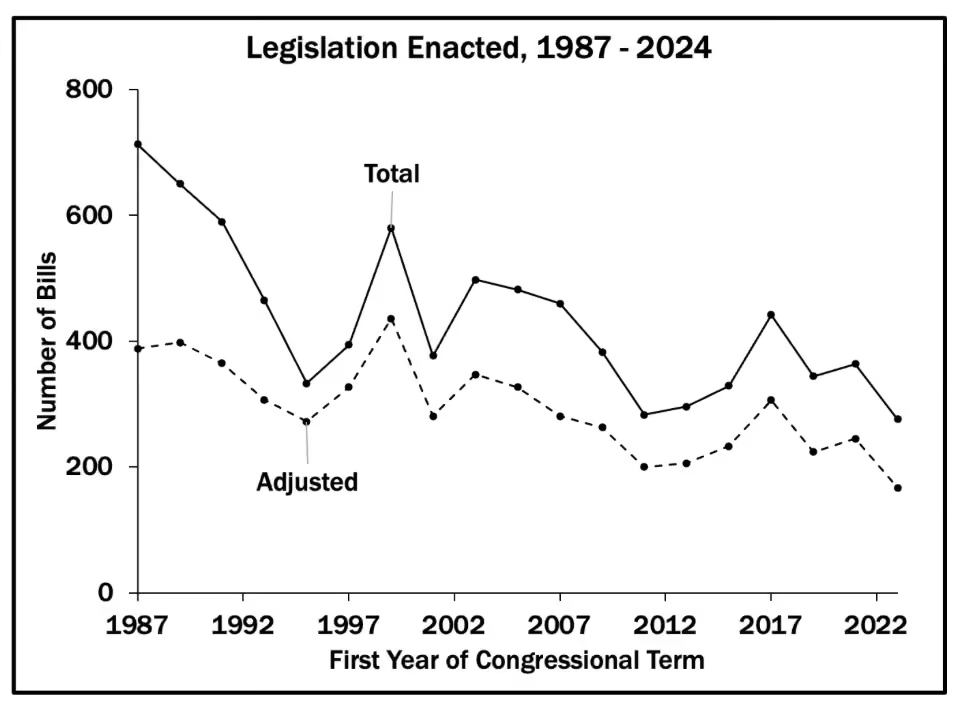
Although back in the late 80’s and early 90’s there was a meaningful difference between the overall number of bills enacted versus those considered non-major bills, the two trend lines follow a similar trajectory of how legislative enactments have slowly declined over time. The top (solid) line shows total enactments, which have declined from 713 in the 100th (1987-88) Congress to 276 in the 118th (2023-2024) Congress, a substantial decline of 437 laws. Data like this is featured in analyses concluding that congressional productivity is at an all-time low.
Examining the adjusted total, which excludes all non-major bills, suggests a less dramatic conclusion. Using this data, total enactments have declined at a much slower pace from 388 bills to 164 (a difference of 214), or about one-half less than the calculation based on total enactments.
The Takeaway
Raw counts of total enacted legislation can misrepresent the extent to which Congress has become less productive over time.
By subtracting minor and technical bills from total counts and accounting for the marked decline in the most recent Congress (the 118th), a different picture emerges, one where the decline over the last 40 years is smaller than in media reports.
While these data highlight the dangers of evaluating congressional productivity by relying on raw bill counts, it does not address whether Congress is addressing the right issues, whether the legislation enacted by the House and Senate will work as intended, or whether increased focus on repealing bills and regulations would lead to better outcomes.
Enjoying this content? Support our mission through financial support.
Further reading
GovTrack. (2026). Historical Statistics about Legislation in the U.S. Congress. https://tinyurl.com/2s4d73ax, accessed 02/03/26.
Howell, W., Adler, S., Cameron, C., & Riemann, C. (2000). Divided Government and the Legislative Productivity of Congress, 1945-94. Legislative Studies Quarterly, 25(2), 285-312. https://tinyurl.com/2uxdppyk, accessed 02/03/26.
Sources
Library of Congress. (2026). Congress.gov. https://www.congress.gov, accessed 02/03/26.
Contributors
Lindsey Cormack (Content Lead) is an Associate Professor of Political Science at Stevens Institute of Technology and the Director of the Diplomacy Lab. She received her PhD from New York University. Her research explores congressional communication, civic education, and electoral systems. Lindsey is the creator of DCInbox, a comprehensive digital archive of Congress-to-constituent e-newsletters, and the author of How to Raise a Citizen (And Why It’s Up to You to Do It) and Congress and U.S. Veterans: From the GI Bill to the VA Crisis. Her work has been featured in The New York Times, The Washington Post, Bloomberg Businessweek, Big Think, and more. With a drive for connecting academic insights to real-world challenges, she collaborates with schools, communities, and parent groups to enhance civic participation and understanding.
William Bianco (Research Director) is Professor of Political Science at Indiana University and Founding Director of the Indiana Political Analytics Workshop. He received his PhD from the University of Rochester. His teaching focuses on first-year students and the Introduction to American Government course, with an emphasis on quantitative literacy. He is the co-author of American Politics Today, an introductory textbook published by W. W. Norton, now in its 8th edition, and authored a second textbook, American Politics: Strategy and Choice. His research program is on American politics, including Trust: Representatives and Constituents, and numerous articles. He was also the PI or Co-PI for seven National Science Foundation grants and a current grant from the Russell Sage Foundation on the sources of inequalities in federal COVID assistance programs. His op-eds have been published in The Washington Post, Indianapolis Star, Newsday, and other venues.