


What you need to know
Since June 2025, President Trump has ordered National Guard Troops to several large American cities, deploying them under national rather than state control. Where does the President’s authority come from? What is the history of federalizing the National Guard
- The President has broad authority to federalize National Guard troops during times of insurrection or emergency.
- Since the 1960s, Presidents have federalized National Guard troops at least seven times, each time taking control of troops within their home state.
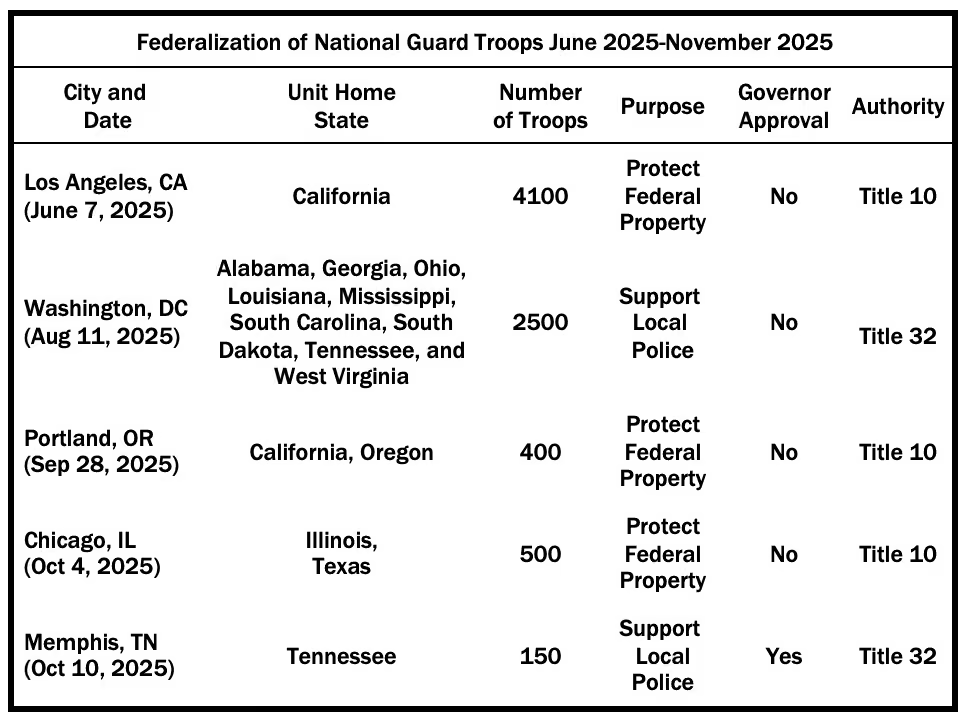
- President Trump has federalized National Guard troops five times in 2025, three of which involved sending troops from another state.
Authority for Federalizing the National Guard
Under both the Constitution and federal law, the President has extensive authority to federalize National Guard troops.
Article I, Section 8 of the Constitution authorizes Congress “To provide for calling forth the Militia to execute the Laws of the Union, suppress Insurrections, and repel Invasions.” The Insurrection Act of 1807 also authorizes the President to deploy the National Guard or active-duty military to suppress civil disorder and rebellion.
After the Civil War, federal troops were used for law enforcement in many Southern states until Congress passed the Posse Comitatus Act of 1878, which prohibited the use of federal troops (including the Guard) for domestic law enforcement unless the Insurrection Act was invoked.
History of National Guard Deployments Since World War II
In 1952, Congress passed a new Armed Forces Reserve Act that authorizes the President to take federal control of any state National Guard unit for up to two years. Under Title 32 of the Act, units may be activated while remaining under state control, typically for disaster relief or training. The President can also activate Guard units under Title 10 to protect federal property and personnel, placing them under federal control.
The key difference between these provisions is that units activated under Title 10 are considered military forces, meaning they cannot engage in law enforcement unless the President also invokes the Insurrection Act.
During the Civil Rights Era, Title 10 authority was invoked at least seven times, including the 1957-58 desegregation of Little Rock, Arkansas, schools and the 1963 integration of the University of Alabama. Though the Governors of these Southern states opposed the federalization of their National Guard, the President invoked the Insurrection Act and federalized troops within the State under Title 10.
What are the Courts saying?
In Los Angeles, Portland, and Chicago, troops have been federalized under Title 10 and placed under direct Presidential control. In Washington, DC, and Memphis, troops have been federalized under Title 32. The Title 32 deployments are less controversial: the Tennessee Governor has approved the deployments in Memphis, and the President has unique authority in the District of Columbia. However, the Title 10 deployments are the subject of court cases. One key question is whether troops in Los Angeles, Portland, and Chicago are being used for law enforcement, as the President has not invoked the Insurrection Act. These cases are likely to be resolved by a future Supreme Court decision.
The Takeaway
Though rarely invoked, Presidents have the authority to federalize and take control of National Guard Troops even against the wishes of a state’s Governor.
As of November 2025, President Trump has federalized the National Guard five times.
The Supreme Court will likely decide the constitutionality of President Trump’s actions.
Enjoying this content? Support our mission through financial support.
Further reading
National Guard. (2025). Federalizations of the Guard for Domestic Missions through 2025. Available at https://tinyurl.com/n9x6jbz2, accessed 11/6/25.
Palme, C. C., LaCroix, H., & Berkovits, S. (2025). Guardians at the Gate: A Three-Way Debate on the Role of Active Military, National Guard, and Law Enforcement for Border Operations. Journal of Homeland Security and Emergency Management, accessed 11/20/25.
Sources
Gamio, Lazaro, and Chirs Hippensteel. (2025). How and Where the National Guard Has Deployed to U.S. Cities. The New York Times, October 27, 2025. https://tinyurl.com/tpx9wk5x, accessed 11/6/25.
National Guard. (2025). Federalizations of the Guard for Domestic Missions through 2025. Available at https://tinyurl.com/n9x6jbz2, accessed 11/6/25.
Nunn, Joseph, and Elizabeth Goitein. (2022). Guide to Invocations of the Insurrection Act. Brennan Center for Justice. https://tinyurl.com/4f565sf4, accessed 11/6/25.
Contributors
Robert Holahan (Content Lead) is Associate Professor of Political Science at Binghamton University (SUNY). He holds a PhD in Political Science from Indiana University where his advisor was Nobel Laureate Elinor Ostrom. His research focuses on natural resource policy, particularly in domestic oil and gas production, but also extends into international environmental policy. He was PI on a National Science Foundation grant that utilized a 3000-person mail-based survey, several internet-based surveys, and a series of laboratory economics experiments to better understand Americans’ perspectives on energy production issues like oil drilling and wind farm development.
William Bianco (Research Director) is Professor of Political Science at Indiana University and Founding Director of the Indiana Political Analytics Workshop. He received his PhD from the University of Rochester. His teaching focuses on first-year students and the Introduction to American Government class, emphasizing quantitative literacy. He is the co-author of American Politics Today, an introductory textbook published by W. W. Norton now in its 8th edition, and authored a second textbook, American Politics: Strategy and Choice. His research program is on American politics, including Trust: Representatives and Constituents and numerous articles. He was also the PI or Co-PI for seven National Science Foundation grants and a current grant from the Russell Sage Foundation on the sources of inequalities in federal COVID assistance programs. His op-eds have been published in the Washington Post, the Indianapolis Star, Newsday, and other venues.