

What you need to know
Housing affordability has become one of the most widely discussed economic challenges in the United States. Over the past decade, home prices have risen faster than incomes. Lawmakers in the 119th Congress are debating new policies to address rising costs and limited housing supply. These debates highlight a core question in American government: What role should the federal government play in solving economic and social challenges? In this brief, we:
- Describe trends in housing affordability across the country.
- Outline what Congress is currently proposing to address the problem
What does housing affordability look like across the U.S.?
Nationally, home prices have risen faster than incomes. In 2000, the median home price was $165,000; in 2024, it was $419,000. In contrast, median household income stood at $72,000 in 2000 and rose slightly to $84,000 by 2020 (all data are inflation-adjusted to 2026 dollars). Taken together, these data imply that home prices rose by nearly 250% over 24 years, while median annual household income only increased by about 17%.
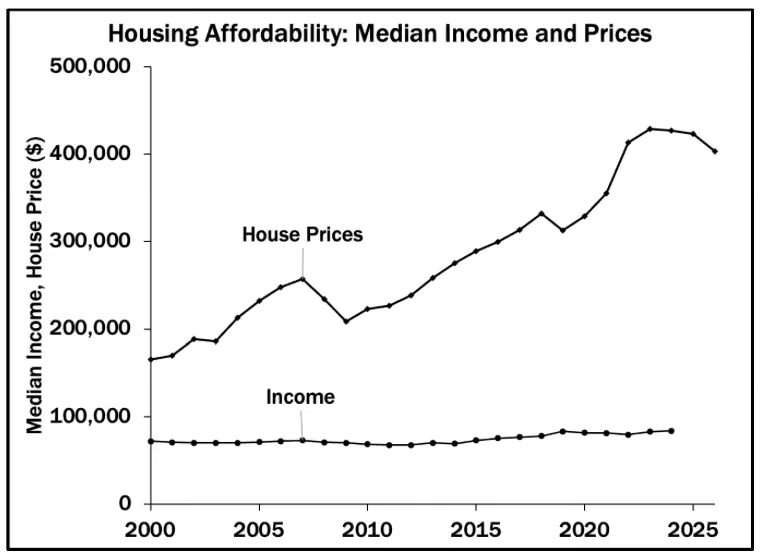
The growing gap between prices and income means that, on average, households must devote a larger share of their income to housing than they did in the past.
Going deeper, the next chart plots 2024 median house prices and income across all 50 states and the District of Columbia.
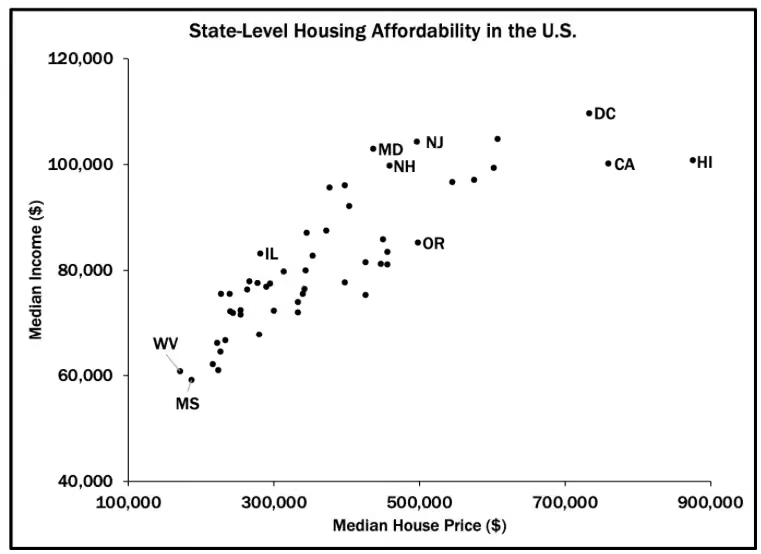
Across the 50 states, there is wide variation in the relationship between income and house prices. Some states (California, the District of Columbia, and Hawaii) have the highest home prices, but also the highest median incomes. Whereas some other states (New Hampshire, Maryland, and New Jersey) have relatively high incomes but lower housing prices. Put another way, housing affordability in states with income and housing data similar to California may be more of a political issue than in a state like New Jersey.
There is a similar variation across states with lower housing prices. Illinois, for example, has about the same median income as Oregon, even though its median house price is almost 50% lower.
If we could go deeper into each state, we would see similar differences between urban and rural communities, with higher incomes and housing prices in big cities than in small towns. Even so, it is likely that some similar-sized communities would have similar incomes but very different housing prices.
What is Congress doing about housing affordability?
In the 119th Congress, housing affordability has emerged as a rare area of bipartisan concern, though lawmakers differ on how to solve the problem.
A major recent development is the bipartisan passage of H.R. 6644, the 21st Century ROAD to Housing Act, in both the House and the Senate, though they have enacted slightly different versions that need to be reconciled before going to the President for his signature or veto. This proposal is the most comprehensive federal housing package to see a vote in years.
The bill focuses on ways to increase the overall housing supply in the U.S. by making it possible to build more homes faster through reducing regulatory barriers and expanding financing options for builders. The legislation also updates federal housing block grant programs for affordable housing programs by increasing funding from about $1.3 billion to $5 billion annually. Some provisions make it easier for individuals and families to enter the housing market, such as down payment assistance and increased access to federally backed mortgage programs. Most analyses show that these policy changes will have some impact on housing affordability for those who qualify, but are unlikely to produce major changes.
The debate over solutions to housing affordability reflects broader ideological divisions in Congress and throughout America. Many Republicans focus on regulation and supply constraints, arguing that there are too many rules that slow construction and make building homes more expensive. For those with that perspective, policies that reduce regulation to increase supply and lower prices are preferable. In contrast, many Democrats emphasize government investment and assistance, claiming that federal funding is needed to support affordable housing development and that programs should help lower-income families access housing.
The Takeaway
Housing affordability has declined in many American communities because home prices are rising faster than incomes. The extent of these changes varies across states and communities in each state.
Lawmakers differ on why and what to do about it. These debates reflect a fundamental tension in American government: should the government play a role in addressing housing affordability, or should this issue be left to market forces and the American people?
Enjoying this content? Support our mission through financial support.
Further reading
Joint Center for Housing Studies of Harvard University. (2025). The State of the Nation’s Housing 2025. https://tinyurl.com/2s8hz5er, accessed 05/11/26.
Feiveson, L., Levinson, A., & Wertz, S. S. (2024). Rent, House Prices, and Demographics. U.S. Department of the Treasury. https://tinyurl.com/2drpax8m, accessed 05/11/26.
Sources
Joint Center for Housing Studies of Harvard University. (2025). The State of the Nation’s Housing 2025. https://tinyurl.com/2s8hz5er, accessed 05/11/26.
National Association of Realtors. (2025). First-Time Home Buyer Share Falls to Historic Low of 21%, Median Age Rises to 40. https://tinyurl.com/2s47y3wd, accessed 05/11/26.
Carpenter, J. (2025). First-Time Home Buyers Are Older Than Ever. The New York Times. https://tinyurl.com/2a6ukdke, accessed 05/11/26.
U.S. House of Representatives. (2025). H.R. 6644 - 21st Century ROAD to Housing Act. Congress.gov. https://tinyurl.com/htfwexsd, accessed 05/11/26.
U.S. House of Representatives. (2026). H.R. 7034 - To amend the Internal Revenue Code of 1986 to eliminate the dollar limitations on the exclusion of gain from sales of principal residences, and for other purposes. Congress.gov. https://tinyurl.com/35cn559d, accessed 05/11/26.
Rauber, M. (2025). Outdated Tax Rules Are Freezing the Housing Market– and It’s About to Get Way Worse. National Association of Realtors. https://tinyurl.com/yc23efk7, accessed 05/11/26.
FRED. (2025). Real Median Household Income in the United States. https://tinyurl.com/yy77ru3r, accessed 05/11/26.
FRED. (2026). Median Sales Price of Houses Sold for the United States. https://tinyurl.com/34m97x6p, accessed 05/11/26.
U.S. Census Bureau. (2026). Selected Economic Characteristics, American Community Survey, 2024: ACS 1-Year Estimates Data Profiles, Table DP03. https://tinyurl.com/mv44w8pn, accessed 04/10/26.
U.S. Census Bureau. (2026). Selected Housing Characteristics, American Community Survey, 2024: ACS 1-Year Estimates Data Profiles, Table DP04. https://tinyurl.com/cny2aku5, accessed 04/10/26.
Contributors
Lindsey Cormack (Content Lead) is an Associate Professor of Political Science at Stevens Institute of Technology and the Director of DCinbox, a comprehensive digital archive of Congress-to-constituent e-newsletters. She received her PhD from New York University. Her research explores congressional communication, civic education, and electoral systems. Lindsey is the author of How to Raise a Citizen (And Why It’s Up to You to Do It) and Congress and U.S. Veterans: From the GI Bill to the VA Crisis. Her work has been featured in The New York Times, The Washington Post, Bloomberg Businessweek, Big Think, and more. With a drive for connecting academic insights to real-world challenges, she collaborates with schools, communities, and parent groups to enhance civic participation and understanding.
William Bianco (Research Director) is Professor of Political Science at Indiana University and Founding Director of the Indiana Political Analytics Workshop. He received his PhD from the University of Rochester. His teaching focuses on first-year students and the Introduction to American Government class, emphasizing quantitative literacy. He is the co-author of American Politics Today, an introductory textbook published by W. W. Norton, now in its 8th edition, and authored a second textbook, American Politics: Strategy and Choice. His research program is on American politics, including Trust: Representatives and Constituents and numerous articles. He was also the PI or Co-PI for seven National Science Foundation grants and a current grant from the Russell Sage Foundation on the sources of inequalities in federal COVID assistance programs. His op-eds have been published in The Washington Post, Indianapolis Star, Newsday, and other venues.