.avif)


What you need to know
The question, “is America a democracy, or is it a republic?” surfaces frequently in political discussions, social media arguments, and even classroom conversations. But framing the issue as an either-or choice misunderstands how the American political system actually works. At its core, the distinction is not about choosing one label over the other, but about understanding how different principles are operationalized in America’s political system. Rather than choosing between the two labels, it is more accurate to say that the United States is a democratic republic. In this brief, we:
- Explain how democratic principles operate in the U.S. system
- Describe how republic institutions structure American government
- What this setup means about how public opinion translates into policy
What is democracy?
Democracy is best understood as a system based on majority rule, where political outcomes reflect the preferences of the majority of voters. In its most direct form (direct democracy), citizens vote on policies themselves, and majority decisions become law. This system operates in a few settings, such as small-town meetings or statewide ballot initiatives.
The most visible form of majority rule in the U.S. is elections to local offices, state legislatures, Congress, or Governorships, where the winning candidate is the one with the most votes (a majority if there are only two candidates). Some states (like Georgia) require the winner to capture a majority of votes cast. If they don’t, a runoff election is held between the two vote-getters.
Majority rule is also fundamental to policymaking in government. In Congress, state legislatures, and city or county councils, establishing a new policy requires a majority vote. In courts, panels of judges often decide cases through majority decisions.
What is a republic?
A republic is a system in which citizens govern through representatives rather than making policy decisions directly. Instead of voting on every law themselves, citizens elect officials who deliberate and act on their behalf. This representative structure is considered by many as essential in a country as large and populous as the United States. With more than 330 million people, it would be impractical for citizens to vote directly on most national policies. Democratically electing representatives allows the government to function efficiently while still maintaining public accountability.
However, because citizens in a republic have no direct way to control policy outcomes, a majority of citizens may prefer a particular policy outcome, however the government can do something different. There are many ways that this disparity can arise. For example, the U.S. Senate gives equal representation to states regardless of population, meaning low-population states have proportionally more influence. Senate rules also require 60 votes (not a majority, 51) to move to end debate on legislative proposals. The Electoral College means that presidential elections are decided by state-based electors rather than by a direct national vote, so the loser may actually receive more votes than the winner, as happened in 2000 and 2016. And national majorities may be concentrated in a few high-population states. If so, public opinion may look very different in other parts of the country.
Similar non-majoritarian elements are present at the state level. The Constitution's Guarantee Clause, found in Article IV, Section 4, mandates that the federal government ensure that every state maintains a "republican form of government," meaning that states must have a democratic electoral process in which the people choose representatives, rather than state-level monarchies or dictatorships. However, states are free to decide how to implement their own democratic republics.
Does the difference between direct democracy and a republic matter?
It does. When we see a policy outcome at the federal level that runs counter to what a majority of citizens want, it is easy to think that something is wrong – that the government should always do what a majority of citizens want. But America’s government is structured to put roadblocks in front of majority control. For example, the rules favoring low-population states in the Senate were explicitly chosen to prevent high-population (urban) states from implementing policies that would help big cities and hurt rural areas. Enacting such policies requires Senators from high-population states to compromise with their rural colleagues.
Another implication of America being a republic is that changes in government policy often lag behind changes in public opinion. For example, the figure below shows that public opinion polling on the legalization of cannabis has shown increasing support for legalization, but until recently, this change has outpaced state-level legalization decisions. Yet even now, when there is a strong national majority favoring legalization, cannabis is still illegal in about a third of U.S. states.
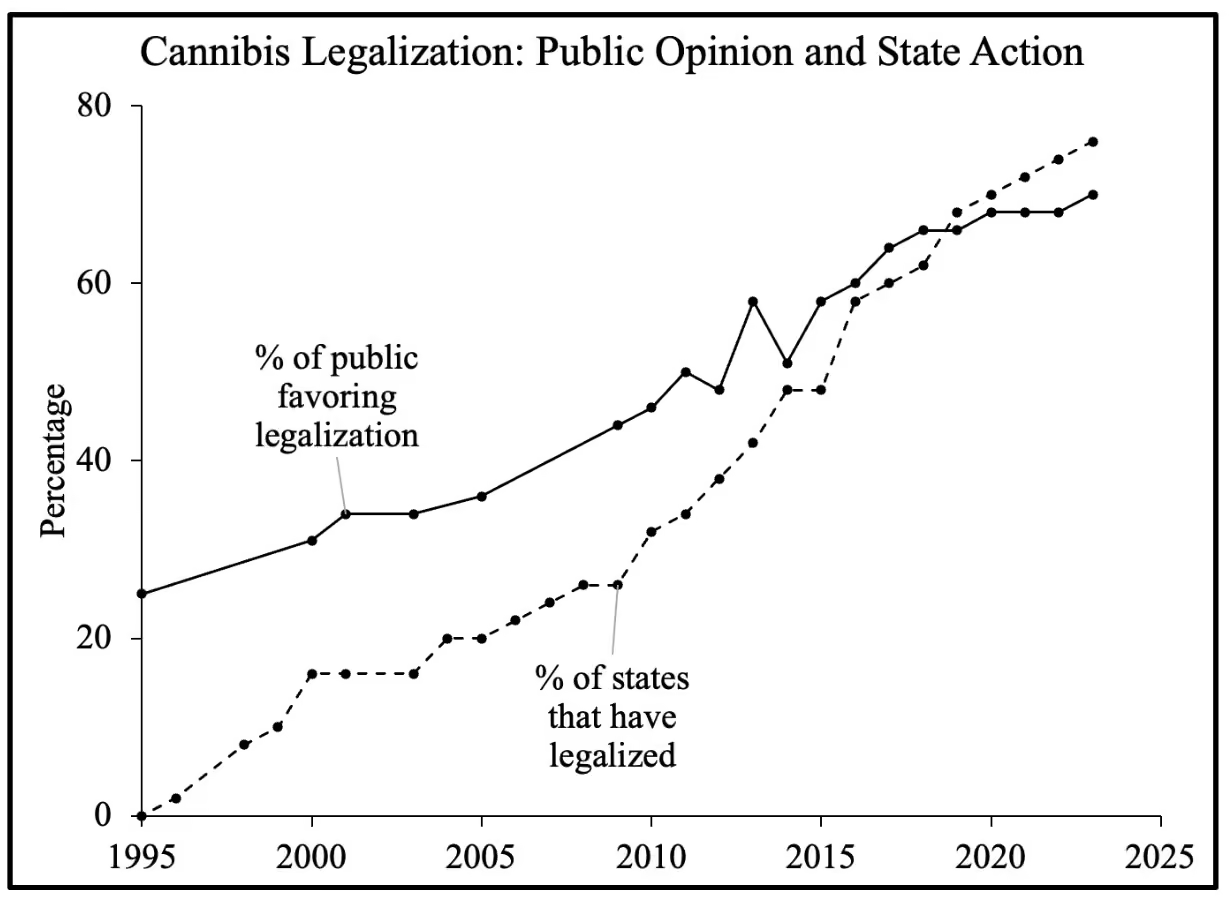
The gap between public opinion and state action reflects the role of state-level republic institutions and federalism, the division of power between national and state governments. States have the authority to set many of their own policies, meaning that national majorities do not automatically produce uniform national outcomes. In this way, the system allows different majorities to exist at different levels. This pattern is not unique to cannabis policy. Other issues, such as education policy, voting laws, access to healthcare and gun regulations, also vary across states, even when national opinion leans in a particular direction.
Why did the founders favor a democratically selected representative republic system?
The founders were influenced by political historians and thinkers who worried that pure democracy could become unstable or oppressive. In Federalist No. 10, James Madison argued that representative government could help control the dangers of faction, which are groups pursuing their own interests at the expense of others. Madison believed a large republic would make it harder for narrow factions to dominate the political system. The constitutional design reflects these concerns. Power is divided among the three branches of government, authority is shared between federal and state governments, and elections occur at different intervals. These institutional arrangements were intended to balance democratic responsiveness with political stability.
Why do people still argue about the terms today?
Much of the confusion surrounding the democracy-versus-republic debate comes from using the terms as opposites. But they simply describe different aspects of the same system.
Democracy emphasizes majority rule. Republic emphasizes the institutions that organize and constrain that rule. Democratic principles explain how citizens select leaders and express political preferences. Republic institutions explain how those leaders govern and implement policy.
Understanding both concepts helps us see how the American government balances popular participation with representative decision-making and helps explain why public opinion does not always translate directly into policy outcomes.
The Takeaway
The United States is best understood as a democratic republic, combining democratic principles of majority rule and citizen participation with republic institutions that govern through elected representatives.
Enjoying this content? Support our mission through financial support.
Further reading
Madison, J. (1787). The Federalist Papers: No. 10. https://tinyurl.com/2tpewcsu, accessed 04/20/26.
Colonial Williamsburg. (2024). Was the United States Founded as a Republic or a Democracy? https://tinyurl.com/4anmnbs7, accessed 04/20/26.
Matsusaka, J. (2025). Direct Democracy and Ballot Measures. Center for Effective Government. https://tinyurl.com/4998kpmv, accessed 04/20/26.
Sources
Madison, J. (1787). The Federalist Papers: No. 10. https://tinyurl.com/2tpewcsu, accessed 04/20/26.
Madison, J. (1787). The U.S. Constitution. https://tinyurl.com/2tmmp999, accessed 04/20/26.
Congress.gov. (2024). Meaning of a Republican Form of Government. https://tinyurl.com/bdanxkt9, accessed 04/20/26.
Bill of Rights Institute. (2026). Essay: Republican Government. https://tinyurl.com/5n7btysx, accessed 04/20/26.
McCarthy, J. (2025). Americans Much More Positive About Progress on Drugs. https://tinyurl.com/475ynuk2, accessed 04/20/26.
Wilber, D. M. (2024). Reefer: Madness or Medicine? Taking sides on the medical use of marijuana. Roper Center for Public Opinion Research. https://tinyurl.com/37yxss8z, accessed 04/20/26.
Contributors
Lindsey Cormack (Content Lead) is an Associate Professor of Political Science at Stevens Institute of Technology and the Director of the Diplomacy Lab. She received her PhD from New York University. Her research explores congressional communication, civic education, and electoral systems. Lindsey is the creator of DCInbox, a comprehensive digital archive of Congress-to-constituent e-newsletters, and the author of How to Raise a Citizen (And Why It’s Up to You to Do It) and Congress and U.S. Veterans: From the GI Bill to the VA Crisis. Her work has been featured in The New York Times, The Washington Post, Bloomberg Businessweek, Big Think, and more. With a drive for connecting academic insights to real-world challenges, she collaborates with schools, communities, and parent groups to enhance civic participation and understanding.
William Bianco (Research Director) is Professor of Political Science at Indiana University and Founding Director of the Indiana Political Analytics Workshop. He received his PhD from the University of Rochester. His teaching focuses on first-year students and the Introduction to American Government class, emphasizing quantitative literacy. He is the co-author of American Politics Today, an introductory textbook published by W. W. Norton, now in its 8th edition, and authored a second textbook, American Politics: Strategy and Choice. His research program is on American politics, including Trust: Representatives and Constituents and numerous articles. He was also the PI or Co-PI for seven National Science Foundation grants and a current grant from the Russell Sage Foundation on the sources of inequalities in federal COVID assistance programs. His op-eds have been published in The Washington Post, Indianapolis Star, Newsday, and other venues.