


What you need to know
Healthcare is an issue that affects every American. Even so, Americans disagree on issues such as whether access to health care is a right and how much the government should intervene in health care markets. One important issue in health policy is the implications of a single-payer system, in which the federal government would play a central role in providing healthcare to all Americans. This brief considers one example of a single-payer system, the so-called Medicare for All.
What would Medicare for All do?
Medicare for All is a proposal to create a national health insurance program run by the federal government. The 2025 Senate bill, S. 1506, was introduced by Sen. Bernie Sanders, and the House version, H.R. 3069, was introduced by Rep. Pramila Jayapal. Versions of both bills have been introduced before, but have never been brought to a vote in the House or the Senate.
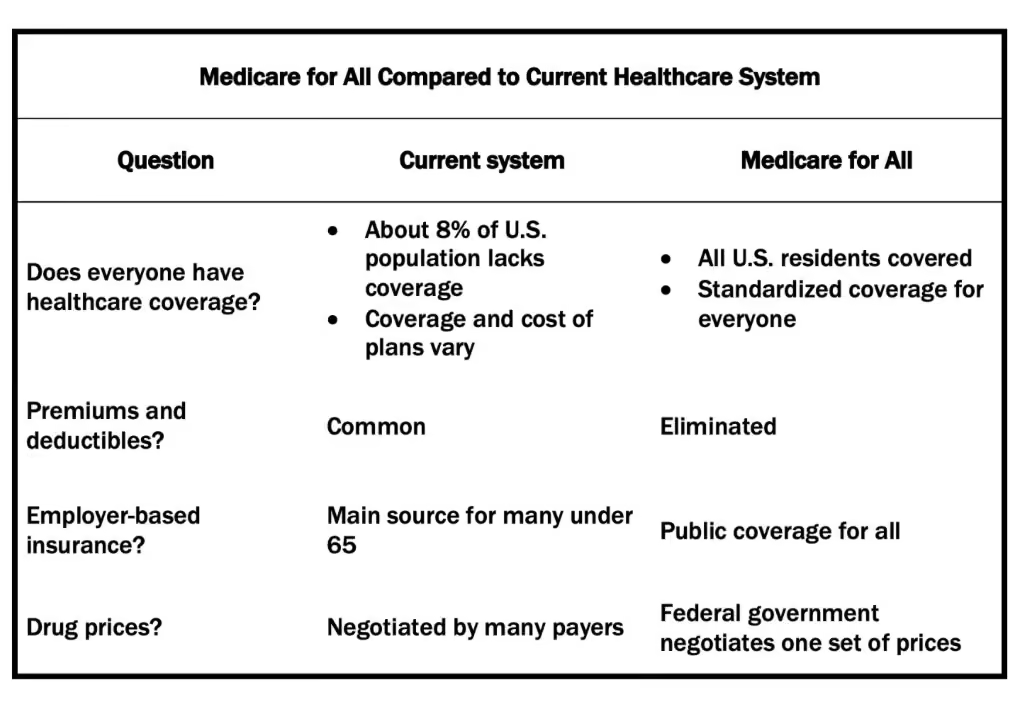
The current Medicare program provides healthcare (medical care, dental, vision, and prescription drugs) to older Americans. Recipients pay insurance premiums to gain different levels of coverage, and Medicare payments are subject to deductibles. In the proposals mentioned, Medicare for All would cover all U.S. residents, eliminate premiums and most out-of-pocket charges for covered care, and include benefits such as hospital care, prescription drugs, mental health care, dental, vision, reproductive care, and long-term care (nursing home) services. Private insurance would exist only for benefits not covered by the public plan.
Currently, families and employers pay for health care through premiums, deductibles, wages, taxes, and out-of-pocket bills. The system is costly. In 2024, U.S. health spending reached $5.3 trillion, or $15,474 per person, and accounted for 18.0% of GDP. The U.S. also spends far more per person (roughly double) than peer nations. For more details, see our brief.
Medicare for All would eliminate patient payments for services, moving much of today’s private and employer-paid health spending onto the federal budget. The government would collect additional taxes to fund the program and disperse funds to doctors, hospitals, and other providers as payment for services to patients. One model of a Medicare for All program is the health care system run by the U.S. Veterans Administration (see our brief).
Supporters argue that Medicare for All could reduce waste by cutting costs associated with insurance billing, marketing and advertising, claims processing, and plan-by-plan administration. The federal government might also have greater leverage as the sole provider of healthcare to negotiate lower prices with drug manufacturers, as discussed in our brief.
What would happen to private insurance under Medicare for All?
Employer-sponsored insurance is the largest source of coverage for people in America under age 65. As of March 2025, 165.6 million people under 65 have employer-sponsored insurance, including both employees and their families.
Medicare for All would disrupt this system, as most employer-sponsored and private plans that duplicate the public benefit would end or become supplemental. Opponents to the proposal argue that millions would lose plans they chose, negotiated through a union, or learned how to use, and that the loss of private insurance choice would be concerning because “one-size-fits-all” coverage would not be suitable in many circumstances. Other potential concerns include a reduction of investment into health care innovation, ongoing quality of services, access to specialty areas, and an increase in the time it might take to receive treatment.
And there are potential deeper issues: Medicare for All would provide the same health care coverage to all Americans. In doing so, it would eliminate options that many Americans currently choose, such as cheaper insurance with higher deductibles or more expensive coverage that gives greater access to a wider range of doctors. For details on these issues, see our brief.
Potential Access Benefits
One advantage of Medicare for All is that it would provide healthcare to all Americans. In 2024, 26.7 million people under age 65 were uninsured, up from 25.3 million in 2023. Moreover, 38.6% of uninsured adults report that they delay, skip, or do not get needed care or medication due to cost. Under Medicare for All, these individuals would have coverage and potentially put less strain on the overall health care system if these issues didn’t go unchecked, leading to more urgent and expensive treatment options. Additionally, not addressing health conditions early on can have a broader impact on workforce productivity and other outcomes.
Supporters often argue that the quality of healthcare should not depend on job type, income, state, age, or immigration status. They also point to people who technically have insurance but still face high deductibles, narrow networks, denied claims, or rising drug costs. So, under a system that includes everyone, access would be guaranteed, and those who currently forgo or delay care would be able to seek healthcare proactively and in times of medical need.
Paying for Medicare for All
The Congressional Budget Office (CBO) has not analyzed S. 1506. Still, its previous analysis of single-payer systems found that they would increase federal spending in 2030 by $1.5 trillion to $3.0 trillion, depending on the specifics. (The current federal budget for the fiscal year ending on September 30, 2026, is about $6 trillion.) The CBO also estimated that the total cost of providing healthcare to Americans in 2030 under a single-payer system could fall by $0.7 trillion or rise by $0.3 trillion, depending on the specifics of the program and whether health care usage would remain the same, decrease, or increase under the new system.
There are three important things to keep in mind about these estimates. First, the CBO’s estimates are sensitive to assumptions about how Americans’ health care consumption would change under Medicare for All. Unlimited access to healthcare (with no deductibles and no other limits) might lead to significantly higher consumption than the CBO estimates. It is also unclear whether a Medicare for All system would have lower administrative costs. For both reasons, the actual cost of Medicare for All might be much higher than predicted.
The second issue is that health care costs under a Medicare for All system would be distributed very differently from the current system. At present, many Americans with employer-provided health insurance pay only a fraction of their actual health care costs, with employers picking up the rest. Depending on how the new taxes would be enacted to pay for Medicare for All, many Americans might pay more in taxes than they save on health care premiums.
Finally, while many countries with single-payer systems have lower health care costs than in America, many of these systems keep costs low by limiting access to services. In 2025, the OECD (Organization for Economic Co-operation and Development) analyzed appointment wait times for specialist medical care (such as knee replacement surgery) across selected countries that had market-based and single-payer health care systems. They reported the percentage of cases where waits were one year or longer, as shown in the figure below.
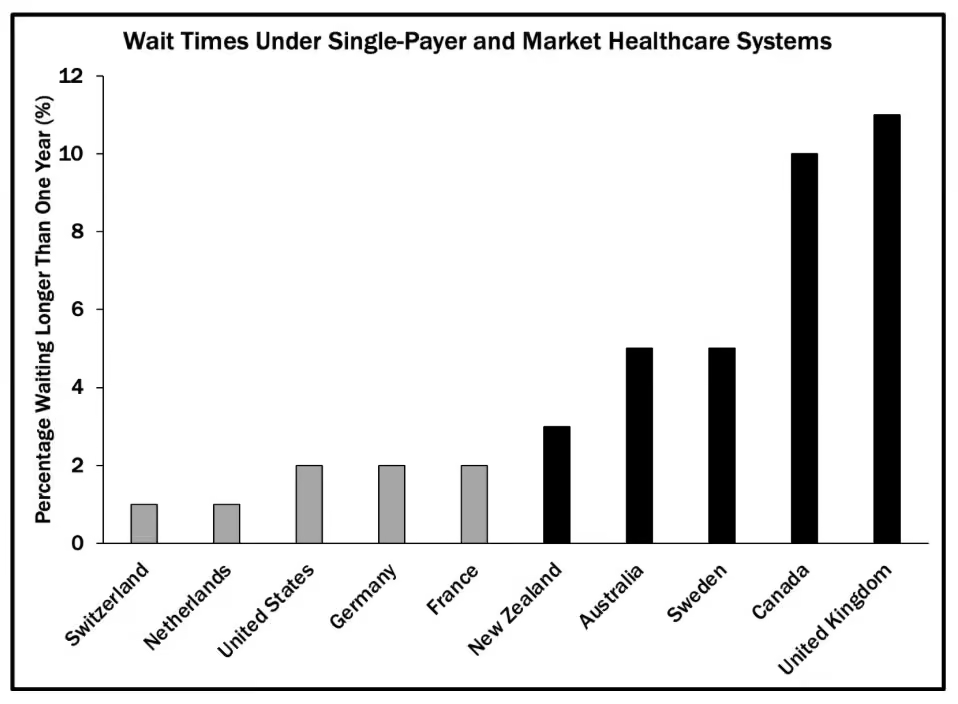
The chart shows that the percentage of wait times over a year is higher in single-payer systems (dark bars) compared to market-based systems (gray bars). Thus, the lower costs reported for existing single-payer systems must be weighed against the reduced availability of medical services in these systems.
The Takeaway
Medicare for All could create universal medical coverage. It would also free workers from relying on a job for insurance and instead have the government bear this responsibility. It could also reduce administrative and other costs of delivering healthcare to Americans.
These positive consequences of Medicare for All must be balanced against the potential for higher overall costs, longer wait times for treatment, and potential reduced quality of care.
Enjoying this content? Support our mission through financial support.
Further reading
Medicare.gov. (2025). Parts of Medicare. https://tinyurl.com/mprsn6sz, accessed 06/12/26.
Tolbert, J., Cervantes, S., Bell, C., & Damico, A. (2026). Key Facts about the Uninsured Population. https://tinyurl.com/3vffr53e, accessed 06/12/26.
Congressional Budget Office. (2020). How CBO Analyzes the Costs of Proposals for Single-Payer Health Care Systems That Are Based on Medicare’s Fee-for-Service Program. https://tinyurl.com/m85tbpcr, accessed 06/12/26.
Sources
Congress.gov. (2025). H.R.3069 - Medicare for All Act. https://tinyurl.com/2hj8zwy6, accessed 06/12/26.
Congressional Budget Office. (2020). How CBO Analyzes the Costs of Proposals for Single-Payer Health Care Systems That Are Based on Medicare’s Fee-for-Service Program. https://tinyurl.com/m85tbpcr, accessed 06/12/26.
Centers for Medicare & Medicaid Services. (2026). NHE Fact Sheet. https://tinyurl.com/57656y6k, accessed 06/12/26.
Congress.gov. (2025). S.1506 - Medicare for All Act. https://tinyurl.com/4kvh8xzh, accessed 06/12/26.
Telesford, I., Cotter, L., Wager, E., & Cox, C. (2026). How does health spending in the U.S. compare to other countries? https://tinyurl.com/4tbx9zeh, accessed 06/12/26.
OECD (2026) OECD Health Statistics Database. https://tinyurl.com/bmccznrj, accessed 7/20/26
Contributors
Lindsey Cormack (Content Lead) is an Associate Professor of Political Science at Stevens Institute of Technology and the Director of DCinbox, a comprehensive digital archive of Congress-to-constituent e-newsletters. She received her PhD from New York University. Her research explores congressional communication, civic education, and electoral systems. Lindsey is the author of How to Raise a Citizen (And Why It’s Up to You to Do It) and Congress and U.S. Veterans: From the GI Bill to the VA Crisis. Her work has been featured in The New York Times, The Washington Post, Bloomberg Businessweek, Big Think, and more. With a drive for connecting academic insights to real-world challenges, she collaborates with schools, communities, and parent groups to enhance civic participation and understanding.
William Bianco (Research Director) is Professor of Political Science at Indiana University and Founding Director of the Indiana Political Analytics Workshop. He received his PhD from the University of Rochester. His teaching focuses on first-year students and the Introduction to American Government class, emphasizing quantitative literacy. He is the co-author of American Politics Today, an introductory textbook published by W. W. Norton, now in its 8th edition, and authored a second textbook, American Politics: Strategy and Choice. His research program is on American politics, including Trust: Representatives and Constituents and numerous articles. He was also the PI or Co-PI for seven National Science Foundation grants and a current grant from the Russell Sage Foundation on the sources of inequalities in federal COVID assistance programs. His op-eds have been published in The Washington Post, Indianapolis Star, Newsday, and other venues.