


What you need to know
This policy brief is the first in a series investigating potential new legislative initiatives in the 120th Congress, which will take office in January 2027.
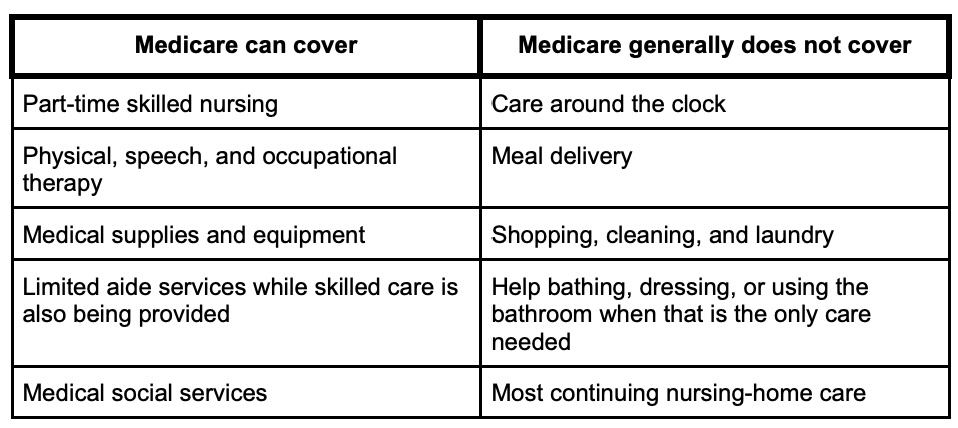
Most Americans would rather get health care at home than move into an institution such as an assisted living facility. Currently, qualified recipients can have Medicare pay for a nurse or therapist in a facility, but it generally does not pay someone who helps an older adult bathe, dress, or cook as a form of long-term, in-home care. Congress has attempted to change how home health care is delivered and reimbursed under the Medicare program, and a few pieces of legislation appear poised to be introduced in the upcoming 120th Congress on this topic.
In this brief, we:
- Explain what Medicare currently covers at home
- Compare plans that may return in the 120th Congress
- Consider the benefits and drawbacks of these proposals
What does Medicare cover at home?
More than three million people on Medicare receive home health care each year. Most are recovering from a hospital stay. Since the COVID-19 pandemic, Medicare has allowed some heart and lung rehab programs to run virtually or at home. Medicare also covers nursing, therapy, medical supplies, and limited help from an aide. This care is usually short-term. Medicare does not normally pay for around-the-clock care, delivered meals, cleaning, or help with daily tasks when those are the only services needed. It also does not pay for most long nursing-home stays.
Each year, the federal Centers for Medicare & Medicaid Services (CMS) sets new payment rates for the home health agencies that provide care to Medicare recipients. In June 2025, CMS proposed the largest cut since its founding: a 6.4% payment cut for 2026. Home health agencies and lawmakers from both parties pushed back. In its final rule, issued on November 28, 2025, CMS lowered the cut to 1.3%. This reduction in funds has left both Democrats and Republicans responsible for developing plans to help older constituents and their families.
What might Congress propose?
The broadest idea being talked about in Congress is some form of an affordable home care guarantee for people with Medicare. In May 2026, Senator Ron Wyden and sixteen other senators asked Senate Finance Committee staff to develop such a plan. They want to make home care easier to get, reduce the need to become poor enough for Medicaid (which is how many of the gaps in end-of-life care are currently met), and improve care job opportunities. The announcement did not state who would qualify, how many hours Medicare would cover, or how the benefit would be financed, but it speaks to what might be on the agenda in the coming years.
Another option is the Well-Being Insurance for Seniors to be at Home (WISH) Act, which was introduced in 2025 by Representatives Tom Suozzi (D-NY) and John Moolenaar (R-MI). It would create federal insurance for very long periods of care. A person with a serious disability would qualify after an income-based waiting period of one to five years. The benefit would cover six hours of paid help each day.
Congress could also expand care one service at a time. The Sustainable Cardiopulmonary Rehabilitation Services in the Home Act, sponsored by both Republicans and Democrats, would permanently let Medicare pay for cardiac and pulmonary rehab delivered at home; this measure was introduced in 2025, but had not moved through Congress. The John W. Walsh Alpha-1 Home Infusion Act would let Medicare pay for at-home infusions for people with the genetic lung and liver condition Alpha-1 antitrypsin deficiency; this proposal was also introduced in 2025, but has yet to see movement. And another potential law is the Medicare Home Health Accessibility Act that would permit Medicare to cover in-home occupational therapy even if it was not simultaneously necessary for a person to also be receiving physical therapy, which is currently the only way Medicare can cover this sort of therapy.
Would home health care be a way for Congress to save money?
In 2025, full-time nonmedical home care had a national median annual cost of about $80,080. A private nursing-home room costs about $129,575. Supporters of more in-home Medicare systems say public coverage could protect savings, ease the load on unpaid relatives, help people avoid institutions, and for some patients, home care may cost less than a nursing home.
But new in-home benefits would not always save the government money. Many people now rely on unpaid relatives or pay for care themselves. Moving those costs to Medicare could raise federal spending even when home care costs less per person. Congress would need to decide who qualifies, how many hours are covered, whether income affects the benefit, whether relatives can be paid, and how Medicare and Medicaid split the bill. Fraud and quality rules would also matter, as a number of states have recently come under scrutiny for insufficient verification measures for paid provisions for relative care, usually through Medicaid.
The Takeaway
Medicare covers limited medical care at home but not most long-term personal care.
A home-care guarantee would close a major gap in Medicare coverage but also create a large new federal entitlement program.
Even though home care is less expensive than assisted living facilities, adding this benefit to Medicare would likely increase the cost of the program.
Enjoying this content? Support our mission through financial support.
Further reading
United States Senate. (2026). Delivering an Affordable Home Care Guarantee for American Families. https://tinyurl.com/4v2bffdf, accessed 08/17/26.
Centers for Medicare & Medicaid Services. (2025). Medicare & Home Health Care. https://tinyurl.com/23h3wvsr, accessed 08/17/26.
Medicare.gov. (2026). Home health services. https://tinyurl.com/4apv56jb, accessed 08/17/26.
Sources
Business Wire. (2026). CareScout Releases 2025 Cost of Care Survey Results. https://tinyurl.com/292j7bpd, accessed 08/17/26.
Medicare.gov. (2026). Long-term care. https://tinyurl.com/mvar58nv, accessed 08/17/26.
U.S. Department of Health and Human Services. (2026). States Have Missed Some Opportunities to Improve Medicaid Managed Care Organizations’ Provider Fraud Referrals. https://tinyurl.com/4dk2643r, accessed 08/17/26.
Lankford, K. (2024). Does Medicare cover home health care? AARP. https://tinyurl.com/4xu8yvhr, accessed 08/17/26.
Mohamed, M., Burns, A., & O’Malley Watts, M. (2026). Medicaid Home Care (HCBS) in 2025. KFF. https://tinyurl.com/5n888hsf, accessed 08/17/26.
Rep. Joyce, J. [R-PA-13]. (2025). H. R. 783 - Sustainable Cardiopulmonary Rehabilitation Services in the Home Act. Congress.gov. https://tinyurl.com/4bmwbp78, accessed 08/17/26.
Rep. Smucker, L. [R-PA-11]. (2025). H. R. 2013 - Medicare Home Health Accessibility Act. Congress.gov. https://tinyurl.com/2uy93n76, accessed 08/17/26.
Rep. Suozzi, T. R. [D-NY-3]. (2025). H. R. 2082 - WISH Act. Congress.gov. https://tinyurl.com/3mubpx8a, accessed 08/17/26.
MedPAC. (2026). A Data Book: Health care spending and the Medicare program. Post-acute care. https://tinyurl.com/ydw2cw44, accessed 08/17/26.
Pew Research Center (2026) Most older adults who live at home want to age in place, but they aren’t entirely confident they’ll get to, https://tinyurl.com/25v6jxh8, accessed 9/22/26.
Contributors
Lindsey Cormack (Content Lead) is an Associate Professor of Political Science at Stevens Institute of Technology and the Director of DCinbox, a comprehensive digital archive of Congress-to-constituent e-newsletters. She received her PhD from New York University. Her research explores congressional communication, civic education, and electoral systems. Lindsey is the author of How to Raise a Citizen (And Why It’s Up to You to Do It) and Congress and U.S. Veterans: From the GI Bill to the VA Crisis. Her work has been featured in The New York Times, The Washington Post, Bloomberg Businessweek, Big Think, and more. With a drive for connecting academic insights to real-world challenges, she collaborates with schools, communities, and parent groups to enhance civic participation and understanding.
William Bianco (Research Director) is Professor of Political Science at Indiana University and Founding Director of the Indiana Political Analytics Workshop. He received his PhD from the University of Rochester. His teaching focuses on first-year students and the Introduction to American Government class, emphasizing quantitative literacy. He is the co-author of American Politics Today, an introductory textbook published by W. W. Norton, now in its 8th edition, and authored a second textbook, American Politics: Strategy and Choice. His research program is on American politics, including Trust: Representatives and Constituents and numerous articles. He was also the PI or Co-PI for seven National Science Foundation grants and a current grant from the Russell Sage Foundation on the sources of inequalities in federal COVID assistance programs. His op-eds have been published in The Washington Post, Indianapolis Star, Newsday, and other venues.


