


What you need to know
The United States crossed another challenging fiscal warning sign on August 18, 2026, when our national debt passed $40 trillion. What, realistically, might lawmakers do about it? In this brief, we:
- Explain what is driving the debt and the deficit higher
- Look at why the congressional budget process has struggled to constrain deficits
- Examine proposals that could become starting points for policy change in the 120th Congress
Why is the U.S. debt growing?
Simply put, the U.S. federal government has continued to spend more than it takes in through tax and fee revenues, resulting in annual deficits that add to our nation’s overall accumulated debt. On top of adding more debt, the U.S. must pay annual interest on existing debt. The graphs below show the U.S. annual deficit and overall debt for the last 40 years:
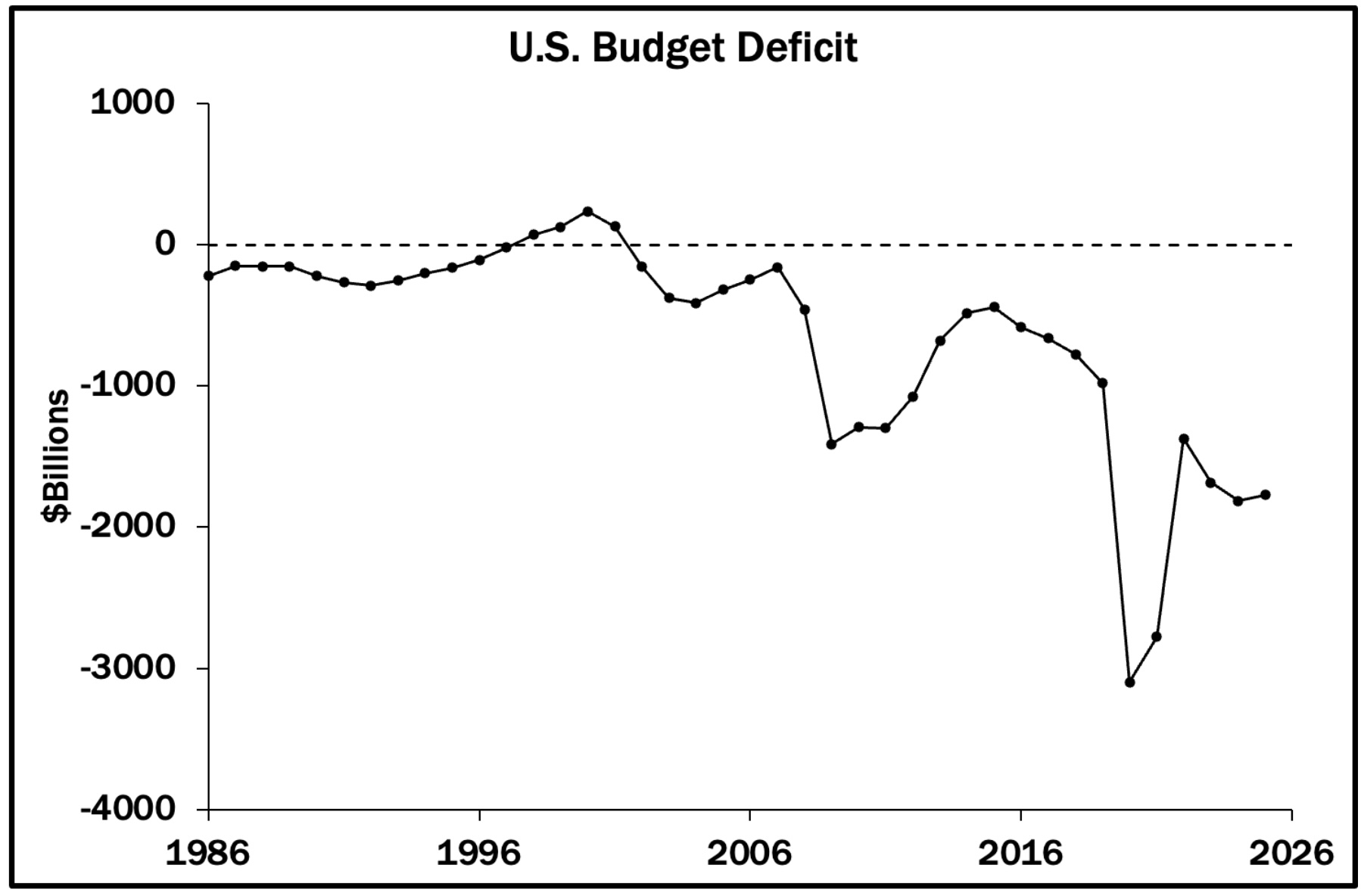
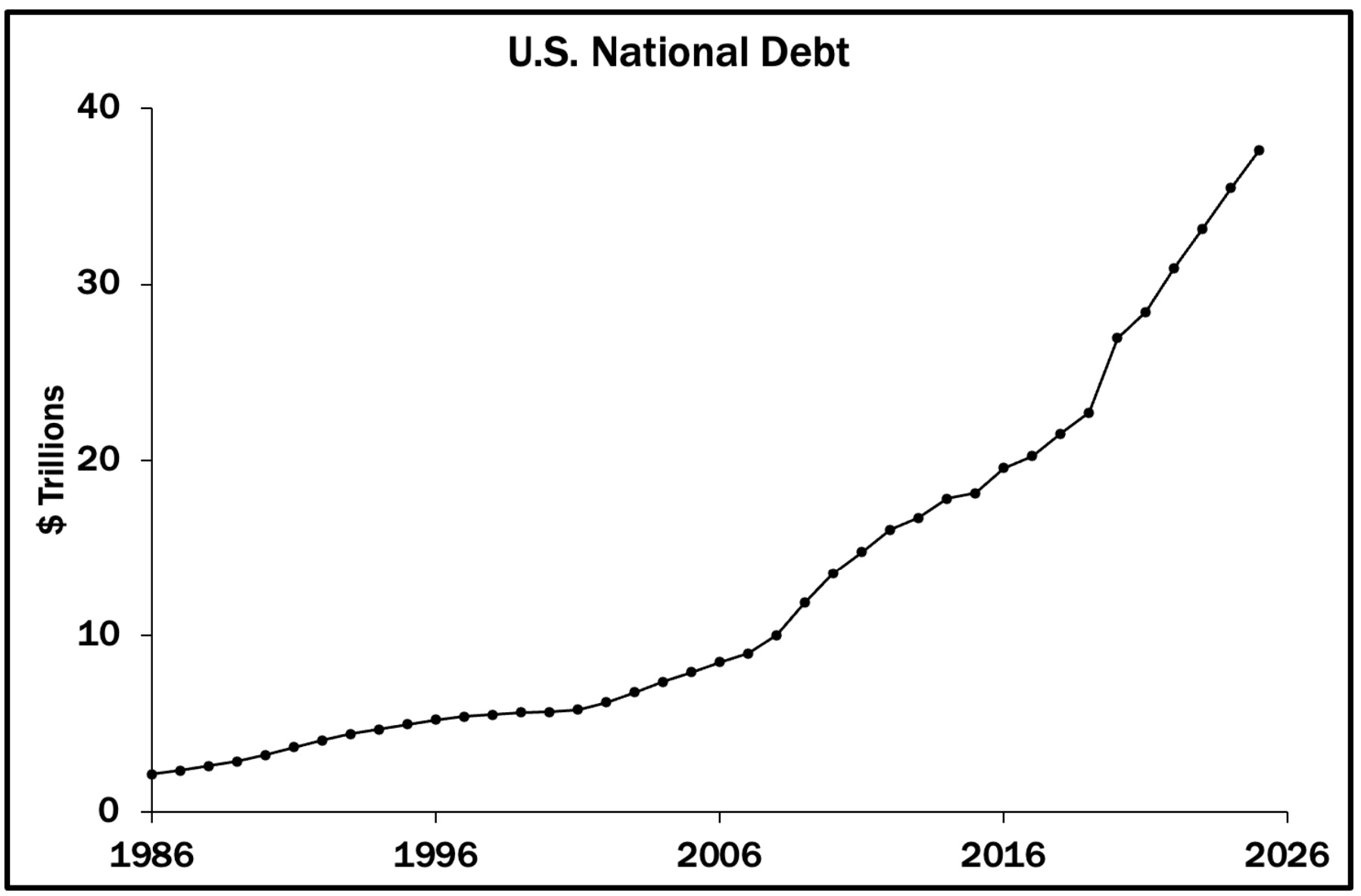
For 2026, the Congressional Budget Office (CBO) projects a $1.9 trillion deficit, which is 5.8% of our gross domestic product (GDP). These estimates rise to $3.1 trillion, or 6.7% of GDP, by 2036. During that time, annual interest costs alone are projected to double from about $1.0 trillion to $2.1 trillion.
Most federal spending is not reconsidered each year. Instead, mandatory federal programs such as Social Security and Medicare largely run according to formulas in existing law. In 2026, CBO estimates mandatory outlays at about $4.5 trillion and discretionary spending at about $1.9 trillion. Within the next 10 years, surpluses in both Social Security’s retirement trust fund and Medicare’s Hospital Insurance trust fund are set to run out, meaning that large deficit reductions are difficult to achieve if lawmakers rule out both major benefit changes and significant new revenue.
Why does the budget process struggle to control deficits?
These projections of higher debt and possible insolvency for some government programs are not new, and Congress has sometimes reached partial solutions in the past. But today's budgeting process makes deficit control harder.
Congress created the modern budget process in 1974 after President Richard Nixon attempted to withhold money Congress had appropriated by passing the Congressional Budget and Impoundment Control Act of 1974. The Act created the House and Senate Budget Committees, the Congressional Budget Office, annual budget resolutions, and the reconciliation process.
A budget resolution is a congressional blueprint for spending. Its limits are enforced through congressional rules that can be waived, and Congress does not always adopt a resolution. From 2006 to 2025, it did so only nine times. Reconciliation has become a major route for passing tax and spending legislation with a simple Senate majority. This can reduce or increase deficits; the CBO estimated the 2025 reconciliation law, sometimes called the One Big Beautiful Bill, increased deficits by about $3.4 trillion over 10 years relative to its January 2025 baseline. There is no requirement to balance the budget, and whichever party controls Congress has incentives to get what it wants done, knowing that if it is out of power in the future, the problem becomes the other party's. If they are in power in the future, they often rationalize spending today by arguing that either general prosperity or future policy choices will address any potential negative consequences of adding to the debt.
What policies might the 120th Congress try to pass?
Each year there are some legislators focused on deficit reduction, and some introduced bills in the 119th Congress that may be revisited once the new Congress is sworn in. Many of these bills have been sponsored by both Democrats and Republicans.
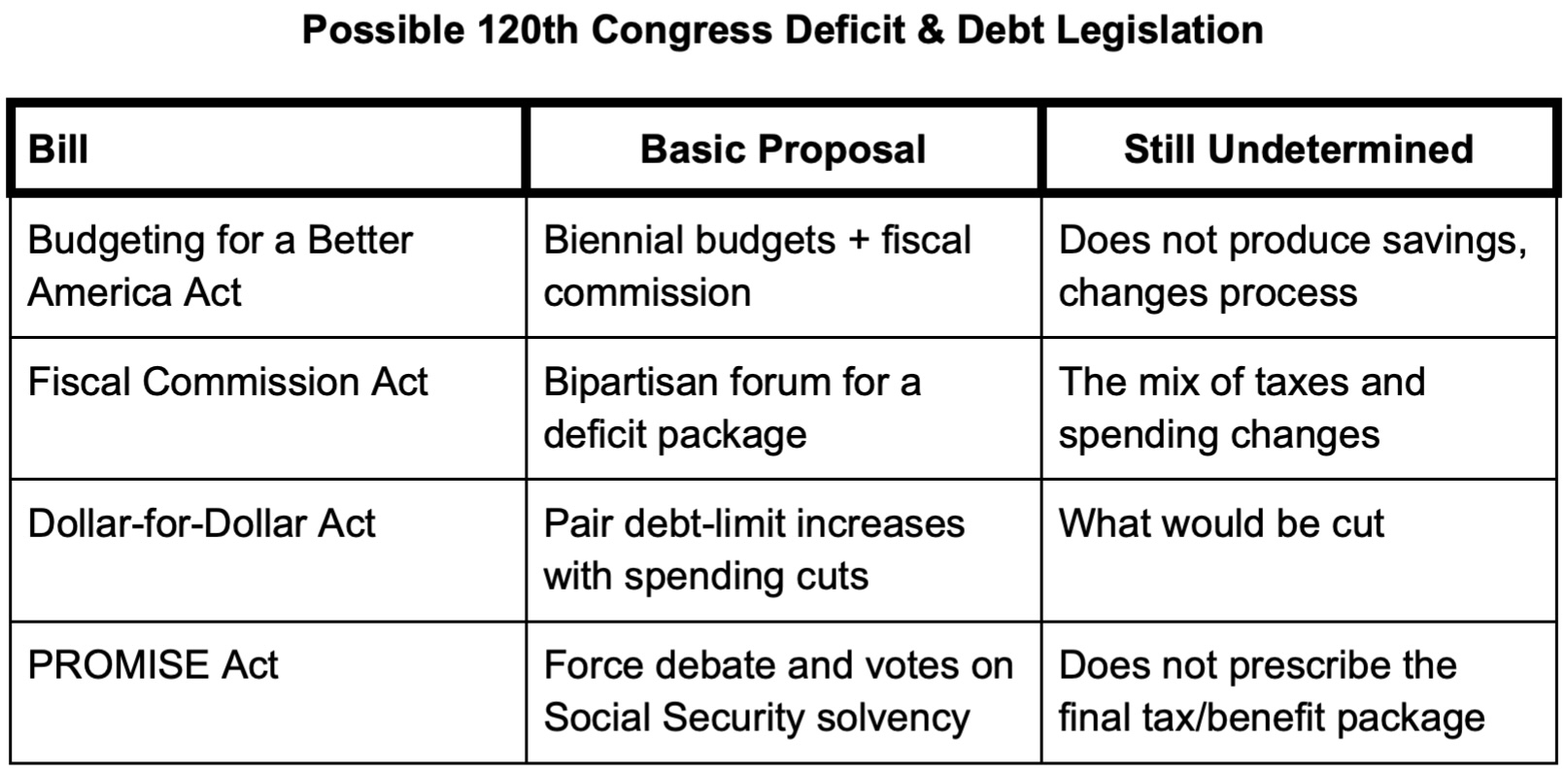
The bipartisan Budgeting for a Better America Act is one potential option. It would move Congress to a two-year budget framework, create an 18-member bipartisan fiscal commission, require more long-range fiscal information, and ask the commission to develop a plan that brings the deficit to 3% of GDP within 10 years.
Other proposals like the bipartisan Senate Fiscal Commission Act would establish a commission on fiscal responsibility. The bipartisan PROMISE Act would start a process requiring Congress to consider a proposal designed to keep the Social Security trust funds solvent for at least 50 years. The Dollar-for-Dollar Deficit Reduction Act would require a debt-limit increase or suspension to be matched by spending reductions over the following decade. The debt ceiling, the amount of debt U.S. legislators have approved for the U.S. to take on, is currently $41.1 trillion, and the Bipartisan Policy Center estimates it could be reached again between late winter and mid-summer 2027.
Would these plans actually reduce the deficit?
Though each of these bills is targeted at deficit reduction, a target, commission, or new budget calendar only matters if Congress ultimately changes spending or taxes. CBO’s deficit-reduction options show that large savings are only available through significant changes to Medicare, Medicaid, Social Security, defense, other discretionary programs, and the tax code. Every option imposes costs on someone, which means agreement will be more difficult about what programs to cut or change to save costs.
The Takeaway
The 120th Congress is likely to face deficit reduction because debt, interest costs, a potential new debt-limit deadline, and trust-fund deadlines are converging.
Budget-process reform currently has clearer bipartisan support than any specific package of tax increases or benefit cuts.
The hardest question is not whether deficits should fall, but which taxes, benefits, or federal services lawmakers will change, and that will depend on who is elected to Congress and what compromises legislators are willing to make.
Enjoying this content? Support our mission through financial support.
Further reading
Committee for a Responsible Federal Budget. (2026). Q&A: Gross Debt Versus Debt Held by the Public. https://tinyurl.com/3mzmz2mk, accessed 10/12/2026.
Saturno, J. V. (2025). The Impoundment Control Act of 1974: Background and Congressional Consideration of Recissions. Congress.gov. https://tinyurl.com/yjryhbyz, accessed 10/12/2026.
Sources
Committee for a Responsible Federal Budget. (2026). Q&A: Gross Debt Versus Debt Held by the Public. https://tinyurl.com/3mzmz2mk, accessed 10/12/2026.
Congressional Budget Office. (2026). The Budget and Economic Outlook: 2026 - 2036. https://tinyurl.com/3rcr69ae, accessed 10/12/2026.
Peter G. Peterson Foundation. (2026). Interest Costs on the National Debt. https://tinyurl.com/3fcpe46m, accessed 10/12/2026.
Congressional Budget Office. (2026). An Analysis of Spending Proposals in the President’s 2027 Budget. https://tinyurl.com/4husuj7y, accessed 10/12/2026.
Congress.gov. (2026). Medicare: Insolvency Projections. https://tinyurl.com/bde6js23, accessed 10/12/2026.
Social Security Administration. (2026). A Summary of the 2026 Annual Reports. https://tinyurl.com/368kacmn, accessed 10/12/2026.
Aherne, D. C., & Lynch, M. S. (2025). Reconciliation Instructions in the House and Senate FY2025 Budget Resolutions: In Brief. Congress.gov. https://tinyurl.com/3vduh9mn, accessed 10/12/2026.
Congressional Budget Office. (2025). Estimated Budgetary Effects of Public Law 119-21, to Provide for Reconciliation Pursuant to Title II of H. Con. Res. 14, Relative to CBO’s January 2025 Baseline. https://tinyurl.com/3xvuzf5p, accessed 10/12/2026.
Quakenbush, C., Till, A., & Akabas, S. (2026). When Will We Reach the Debt Limit (Again)? Bipartisan Policy Center. https://tinyurl.com/2k7puwzy, accessed 10/12/2026.
Congress.gov. (2026). H.R.9452 - Budgeting for a Better America Act. https://tinyurl.com/888hv5s3, accessed 10/12/2026.
Congress.gov. (2026). S.4012 - Fiscal Commission Act. https://tinyurl.com/yzk58muz, accessed 10/12/2026.
Congress.gov. (2026). S.4173 - Dollar-for-Dollar Deficit Reduction Act. https://tinyurl.com/hkw4x7a7, accessed 10/12/2026.
Congress.gov. (2026). S.4979 - PROMISE Act of 2026. https://tinyurl.com/5bxu8jhs, accessed 10/12/2026.
Contributors
Lindsey Cormack (Content Lead) is Associate Professor of Political Science at Stevens Institute of Technology and the Director of DCinbox, a comprehensive digital archive of Congress-to-constituent e-newsletters. She received her PhD from New York University. Her research explores congressional communication, civic education, and electoral systems. Lindsey is the author of How to Raise a Citizen (And Why It’s Up to You to Do It) and Congress and U.S. Veterans: From the GI Bill to the VA Crisis. She is also the host of Government that Doesn’t Suck!. Her work has been featured in The New York Times, The Washington Post, Bloomberg Businessweek, Big Think, and more. With a drive for connecting academic insights to real-world challenges, she collaborates with schools, communities, and parent groups to enhance civic participation and understanding.
William Bianco (Research Director) is Professor of Political Science at Indiana University and Founding Director of the Indiana Political Analytics Workshop. He received his PhD from the University of Rochester. His teaching focuses on first-year students and the Introduction to American Government class, emphasizing quantitative literacy. He is the co-author of American Politics Today, an introductory textbook published by W. W. Norton, now in its 8th edition, and authored a second textbook, American Politics: Strategy and Choice. His research program is on American politics, including Trust: Representatives and Constituents and numerous articles. He was also the PI or Co-PI for seven National Science Foundation grants and a current grant from the Russell Sage Foundation on the sources of inequalities in federal COVID assistance programs. His op-eds have been published in The Washington Post, Indianapolis Star, Newsday, and other venues.