


What you need to know
Many countries have some form of national service where citizens perform duties for their country. Some of these programs are mandatory – such as military service in certain nations – while others are voluntary – such as educational and poverty-reduction initiatives. In either case, the goal of national service is to support the community and foster national unity. Despite widespread agreement over these abstract goals, there is disagreement over how national service programs should be designed and what types of civic outcomes they should prioritize. In this brief, we:
- Describe national service programs
- Explore national service in the U.S.
- Outline arguments for and against national service
What is national service and how common is it?
National service refers to government programs through which citizens (typically young adults) perform duties for their country. Some nations have mandatory national service (also called “compulsory service”), in which citizens are required to participate. In other countries, including the U.S., national service opportunities are voluntary.
Estimates suggest that roughly 60-85 countries have had some form of compulsory national service over the last decade. Many more countries provide voluntary national service opportunities for their citizens.
Most nations with mandatory national service require citizens to serve in the military. These include countries like Brazil, Iran, Israel, Russia, South Korea, Thailand, and Turkey. Other countries have military conscription laws on the books, but do not enforce them.
The nature of mandatory military service differs across countries. The required length of service, for example, ranges anywhere from 18 weeks to 8 years. In some nations, only men are required to serve, while in others, women are also required. Some countries allow citizens to opt out of military service and instead perform other types of public work.
Only a handful of countries have non-military national service requirements. In Rwanda, for example, every citizen aged 18 to 65 must take part in a community cleanup on the last Saturday of each month. The program’s name – Umuganda, which translates to “coming together in common purpose” – speaks to the general motivation behind such initiatives: uniting citizens around shared civic goals.
Other nations, including the U.S., have programs that allow citizens to participate in voluntary public service. These programs are generally short-term, paid public service or military positions.
What does national service look like in the U.S.?
The United States does not have mandatory national service like some other countries, but it does have several voluntary national service programs.
- AmeriCorps houses a range of programs through which volunteers work to address poverty, the environment, education, and other communal needs.
- AmeriCorps Seniors is a similar program for volunteers over the age of 55 who help with academic tutoring, elderly care, disaster relief, and other civic initiatives.
- The Peace Corps is America’s primary outward-facing program, with participants volunteering abroad to help communities in other nations.
- Teach for America trains college graduates to teach in resource-challenged school districts.
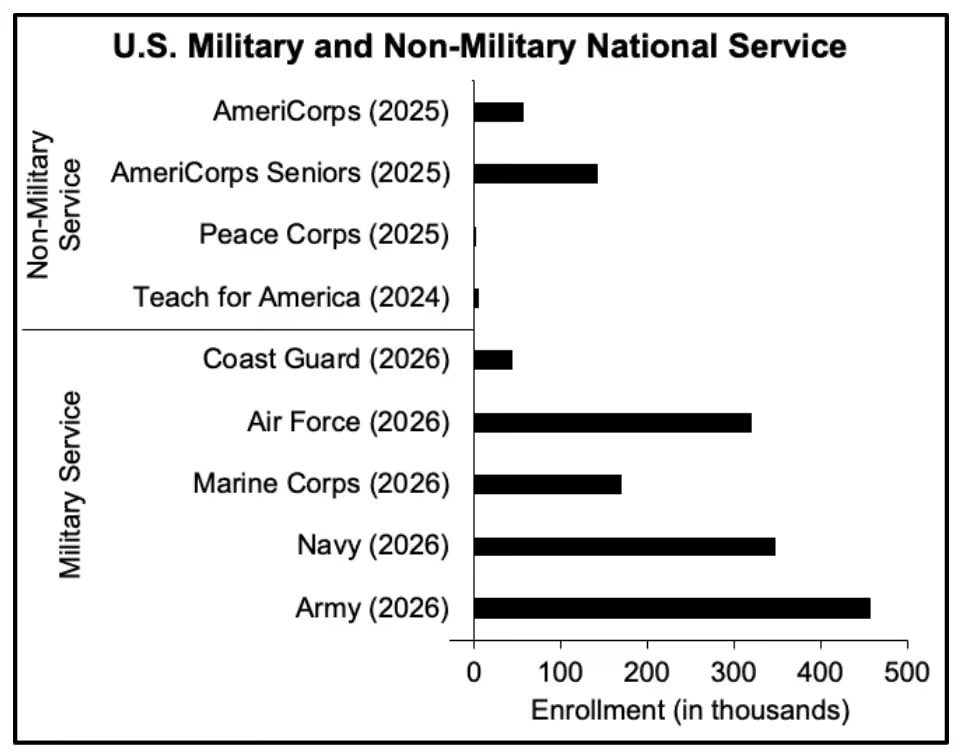
The voluntary nature of these service programs means that participation is relatively low. This can be seen in the chart below, which shows the estimated number of volunteers in each program in the most recent year for which data is available The chart also shows the number of people participating in national military service. Military service is far more common than non-military service.
Currently, military participation in the U.S. is entirely voluntary, though eligible citizens (men aged 18-25) must register for the Selective Service. In times of war, a draft could be instituted, making military service mandatory for selected citizens. The last American draft was in 1973 during the Vietnam War.
What are the arguments for and against national service?
The main logic behind national service, whether voluntary or mandatory, is that public service is an important part of responsible citizenship. National service programs embody the spirit of President John F. Kennedy’s famous call for citizens to “ask not what your country can do for you – ask what you can do for your country”.
There are also a variety of benefits of national service that advocates point to. National service programs can contribute directly to the community, improving public infrastructure, educational and health outcomes, and other public goods. In the case of military service, compulsory participation can contribute to national security.
National service programs may also foster social cohesion by uniting participants around communal goals, often across regional, racial, class, religious, and political divides. Participation in service programs might increase trust in civic institutions and create a sense of national unity. Some advocates have suggested compulsory national service as a remedy to the deep polarization afflicting American society.
Other stated benefits of national service are more personal. Since many programs focus on young adults, they may help participants mature into adulthood, develop skills, and find a career they are passionate about.
The main arguments against national service tend to focus on mandatory service requirements. Some critics argue that volunteerism is a more authentic and beneficial form of civic engagement than requiring citizens to participate. Critics also argue that compulsory service infringes on Americans’ right to liberty.
Advocates and skeptics alike also disagree over which types of national service are most valuable and what goals these programs should pursue. Should national service programs focus on military participation, civic investments, or both? For programs that give back to the community, which communities should be prioritized, and what outcomes – like educational improvement, environmental protection, or poverty reduction – are most worthy of pursuing?
The Takeaway
National service is a common practice aimed at cultivating civic identity, fostering communal ties, and contributing to society. These are generally uncontroversial goals.
Disagreements persist over whether such service should be mandatory or voluntary, how to design national service programs, and what types of problems they should focus on.
The case of national service requirements demonstrates how citizens often share widely agreed-upon goals but can disagree over how to achieve those goals in practice. Moving from abstract values to policy design and implementation can be quite tricky.
Enjoying this content? Support our mission through financial support.
Further reading
Dionne, E. J., Jr., & Drogosz, K. M. (2003). The Promise of National Service: A (Very) Brief History of an Idea. Brookings Institution. https://tinyurl.com/45ajmenr, accessed 08/07/26.
Encyclopedia Britannica. (2026). Mandatory National Service. https://tinyurl.com/dzvwfjxd, accessed 08/07/26.
Sources
AmeriCorps (2025a). About AmeriCorps. https://tinyurl.com/yu8eaaxw, accessed 06/02/25.
AmeriCorps (2025b). AmeriCorps Seniors. https://tinyurl.com/35et2aum, accessed 04/30/2025
Bandow, D. (2019). Mandatory Universal National Service: A Dystopian Vision for a Free Society. Cato Institute. https://tinyurl.com/mspx8p79, accessed 08/07/26.
Committee on Improving the Health, Safety, and Well-Being of Young Adults; Board on Children, Youth, and Families; Institute of Medicine; National Research Council; Bonnie, R. J., Stroud, C., & Breiner, H. (2015). Investing in the Health and Well-Being of Young Adults, Civic Engagement and National Service. National Academies Press. https://tinyurl.com/456y2ewd, accessed 08/07/26.
Department of Defense (2026). Strength Summary. https://tinyurl.com/75364t7p, accessed 08/25/26.
Mappr. (2026). Compulsory Military Service Around the World in 2026. https://tinyurl.com/2nd9zv9y, accessed 08/07/26.
National Commission on Military, National, and Public Service. (2018). Mandatory Service Around the Globe. Medium. https://tinyurl.com/mwdjmc2t, accessed 08/07/26.
National Commission on Military, National, and Public Service. (2020). Inspired to Serve: Final Report of the National Commission on Military, National, and Public Service. https://tinyurl.com/4yn54xpu, accessed 08/07/26.
Peace Corps (2025). Our Mission: Putting purpose, passion, and skills to work for America and the world. https://tinyurl.com/3j5z56b6, accessed 08/25/26.
Teach for America (2024). Teach for America. https://tinyurl.com/ydafe76f, accessed 08/25/26.
World Population Review. (2026). Countries with Mandatory Military Service 2026. https://tinyurl.com/y4d3ua34, accessed 08/07/26.
Contributors
Zachary Albert (Content Lead) is Assistant Professor of Politics at Brandeis University. He received his PhD from the University of Massachusetts Amherst. His research focuses on elections, political parties, and public policymaking in American politics. He is the author of Partisan Policy Networks (2025), Small Donors in US Politics (2026), and numerous peer-reviewed journal articles. He has also published op-eds and reports for the Brookings Institution, the Bipartisan Policy Center, The Conversation, and other venues. In the classroom, Albert teaches classes on American elections, political parties, public policy, and quantitative methods, in addition to running the Politics Department internship program.
William Bianco (Research Director) is Professor of Political Science at Indiana University and Founding Director of the Indiana Political Analytics Workshop. He received his PhD from the University of Rochester. His teaching focuses on first-year students and the Introduction to American Government class. He is the co-author of American Politics Today, an introductory textbook published by W. W. Norton now in its 9th edition, and authored a second textbook, American Politics: Strategy and Choice. His research program is on American politics, including Trust: Representatives and Constituents, and numerous articles. His op-eds have been published in the Washington Post, the Indianapolis Star, Newsday, and other venues.