


What you need to know
In November 2026, the U.S. will hold midterm congressional elections. Potential outcomes range from a continued Republican unified government (control of the Presidency, House, and Senate) to a divided government in which President Trump faces Democratic majorities in the House and/or Senate. This brief considers how predictions have changed since our last update in April 2026.
Why do midterm elections matter, and what usually happens in these elections?
As we discussed in our previous brief, midterm elections matter because they determine which party controls the House and Senate, giving it influence over everything from writing budgets to initiating impeachment proceedings. Although Republicans currently hold narrow majorities in the House and Senate, in almost every midterm, the President’s party loses seats.
What are current predictions for the 2026 midterms?
In our April 2026 update, we analyzed the district-by-district predictions from the Cook Political Report, an independent, mainstream, nonpartisan election-analysis organization. They use factors such as past presidential and congressional election returns and whether the race involves an incumbent running for reelection or is an open seat (no incumbent) to classify each district on a 7-point scale, from Safe Democratic to Safe Republican. Using their classification, over 360 of 435 seats are Safe Republican or Safe Democratic and are unlikely to change hands in 2026.
For this update, we also include a new set of predictions made by G. Elliot Morris, who runs the website Fifty Plus One. Although personally Morris has frequently published commentary critical of President Trump and the Republican Party, Morris’ predictions begin with the data used by the Cook report, but incorporate current survey data, including presidential approval, generic ballots (whether a respondent plans to vote for a Democrat or a Republican), and vote intention (whether a respondent is likely to vote).
The figure below shows how the Cook predictions (black lines) about the number of seats Democrats will control after the 2026 elections have evolved since our last update, and adds the Morris predictions (green lines), which were first released in August 2026. The dotted lines and bars capture the uncertainties in each forecast. We label the Cook predictions and the Morris predictions. The red line shows the number of seats needed for a majority: 218.
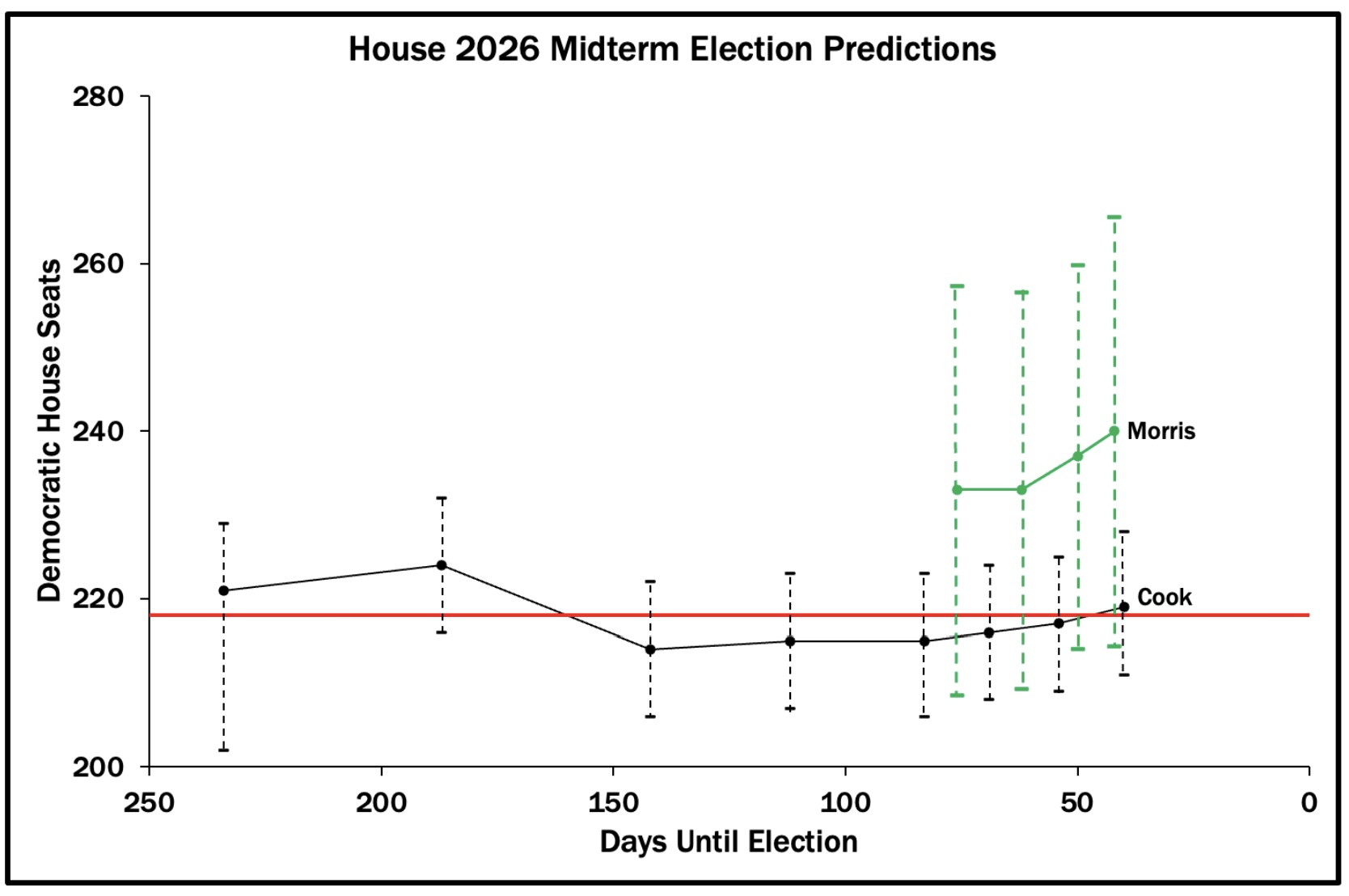
The Cook predictions have not changed much since April 2026, except for a small (about 10-seat) pro-Republican shift due to district changes resulting from the Supreme Court’s Voting Rights Act decision (for Everything Policy analysis, see here). Their model shows a very close race for House control with a slight advantage to Republicans.
Morris’ forecast is substantially, predicting a 34-seat gain for Democrats and a firm majority in the House. In essence, Morris is saying that if factors such as presidential approval, generic support for each party, and self-reported vote intentions work as they have in previous elections, they will shift votes and races toward Democratic candidates. Like any political survey, outcomes can skew based on a variety of factors, including demographics of survey participants, timing of national events, and other factors that affect our daily lives.
Why might Morris’ forecast be shedding light on a different outcome than the Cook Report? Some variables include President Trump’s recent popularity is trending relatively low, generic ballot questions indicating more support for Democrats, and Democrats say they are more likely to vote in the upcoming mid-term elections. All of these factors should advantage Democrats, if past patterns hold. Morris’ prediction includes these factors, while the Cook prediction does not.
At the same time, the uncertainty bars for the Morris results are larger than for the Cook predictions. This difference is because we can’t be sure how public opinion will shape vote decisions and election outcomes. For example, Democrats may say they are more likely to vote, but they may not follow through on Election Day.
What About The Senate?
The same difference in predictions appears in Senate races: current Cook ratings of the 35 Senate races in 2026 give Democrats a predicted gain of a seat or two (bringing them to 49), while Morris' model currently predicts Democrats will wind up with 51 seats.
The Takeaway
As of October 2026, a seat-by-seat analysis using past election data predicts the 2026 House election will be very close. However, if we factor in current public opinion and assume these factors have the same impact as they have in the past, Democrats are favored to gain majority control.
Over the next two months, the two forecasts are likely to converge as new polls are incorporated into the Morris model and the Cook staff modify their ratings based on campaign events. However, it is still unclear which forecast will be most accurate.
Enjoying this content? Support our mission through financial support.
Further reading
Abramowitz, A. I. (2023). The generic ballot model and the 2022 midterm election. Polity, 55(3), 633-637.
Rudalevige, A. (2022). Presidents and Midterm Loss. Midterms and Mandates. Electoral Reassessment of Presidents and Parties, Edinburgh University Press, S, 17-53.
Sources
Cook (2026) CPR House Midterm Ratings. https://tinyurl.com/4pfvkzz5, accessed 9/4/26
Morris, G. Elliot (2026) 2026 Congressional Forecast. https://fiftyplusone.news/forecast/house, accessed 9/3/26
Contributors
William Bianco (Research Director) is Professor of Political Science at Indiana University and Founding Director of the Indiana Political Analytics Workshop. He received his PhD from the University of Rochester. His teaching focuses on first-year students and the Introduction to American Government class, emphasizing quantitative literacy. He is the co-author of American Politics Today, an introductory textbook published by W. W. Norton and now in its 8th edition, and he also authored a second textbook, American Politics: Strategy and Choice. His research program is on American politics, including Trust: Representatives and Constituents and numerous articles. He was also the PI or co-PI on seven National Science Foundation grants and currently holds a grant from the Russell Sage Foundation on the sources of inequalities in federal COVID assistance programs. His op-eds have been published in The Washington Post, Indianapolis Star, Newsday, and other venues.