

What you need to know
A common complaint about America’s elected officials is that they fail to implement easy, practical solutions to public policy problems. These concerns are part of the explanation for the continued decline in trust in government. In this brief, we explore the logic behind these complaints using a perennial public policy problem: federal budget deficits. Are elected officials ignoring the obvious, or is the situation more complex than it appears?
The Federal Budget Deficit
For fiscal year 2026 (the year ending September 30, 2026), the federal government is expected to collect approximately $5.3 trillion in taxes and spend $7 trillion on goods and services, leaving a budget deficit of about $1.7 trillion dollars.
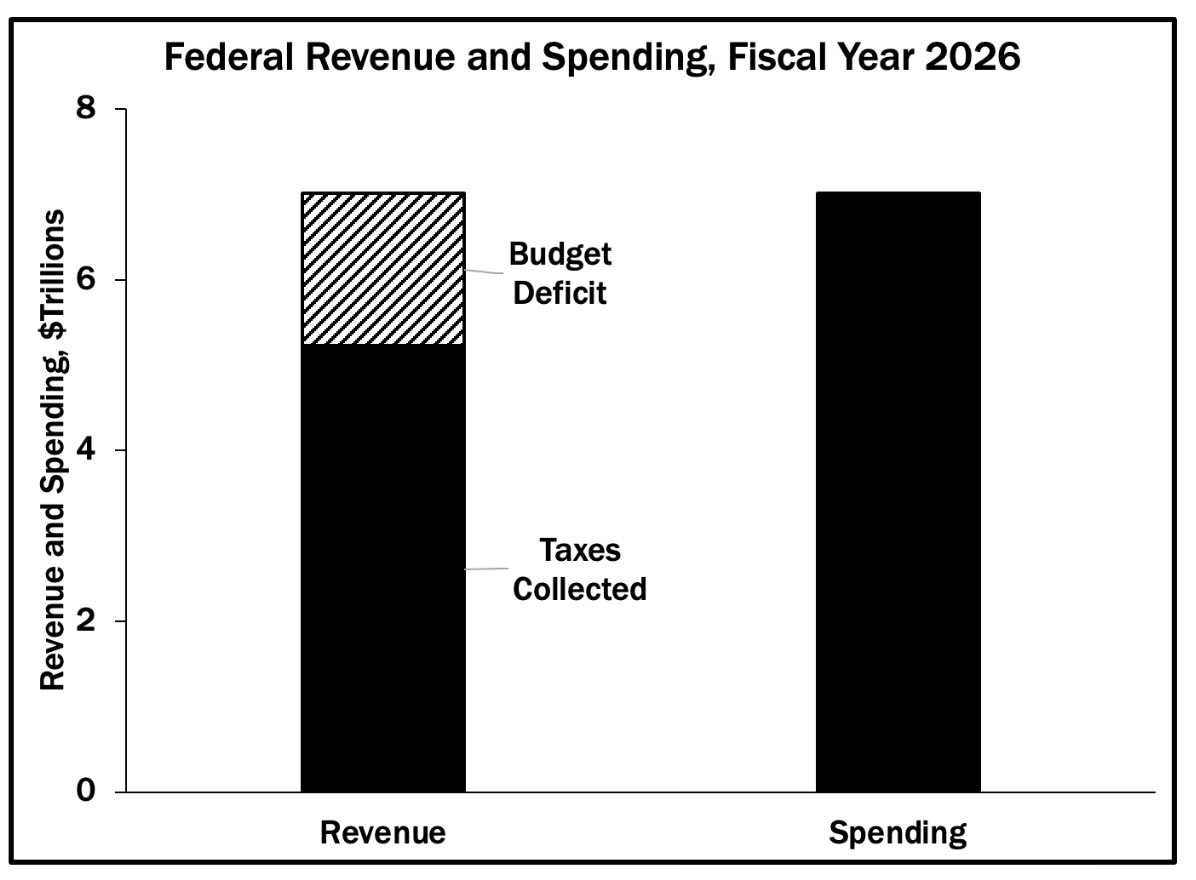
Currently, the U.S. national debt (the sum of all annual deficits) stands at almost $40 trillion, equal to the size of the U.S. annual GDP (Gross Domestic Product, or the size of the U.S. economy). As we discussed in a previous brief, while annual deficits and the national debt do not appear to have had major negative consequences thus far, the concern is that continuing budget deficits of this magnitude would likely, over time, significantly reduce economic growth and increase inflation, potentially causing a long-term recession or even economic collapse.
Despite these concerns, the federal budget has been in deficit for the last two decades. It has been over a decade since Congress enacted a deficit-reduction proposal, and there is little sign that these policies will change any time soon.
The Penny Plan
There are many proposals for addressing the federal deficit. One is the Penny Plan, which requires federal spending to be cut by 1% each year (one penny out of every dollar) until revenue and spending are in balance. There are different versions of the Penny Plan (our sources include one proposed by Senator Rand Paul), but most exempt Social Security, Medicare, Medicaid (old-age pensions, and health care for Seniors and the poor), and defense spending from cuts.
Implementing the Penny Plan will, over a relatively short time, reduce the federal budget deficit to zero. This model, however, assumes that revenue will continue to steadily rise as estimated by the nonpartisan Congressional Budget Office. The chart below compares spending under the Penny Plan to the CBO’s estimates of tax revenue over the next ten years.
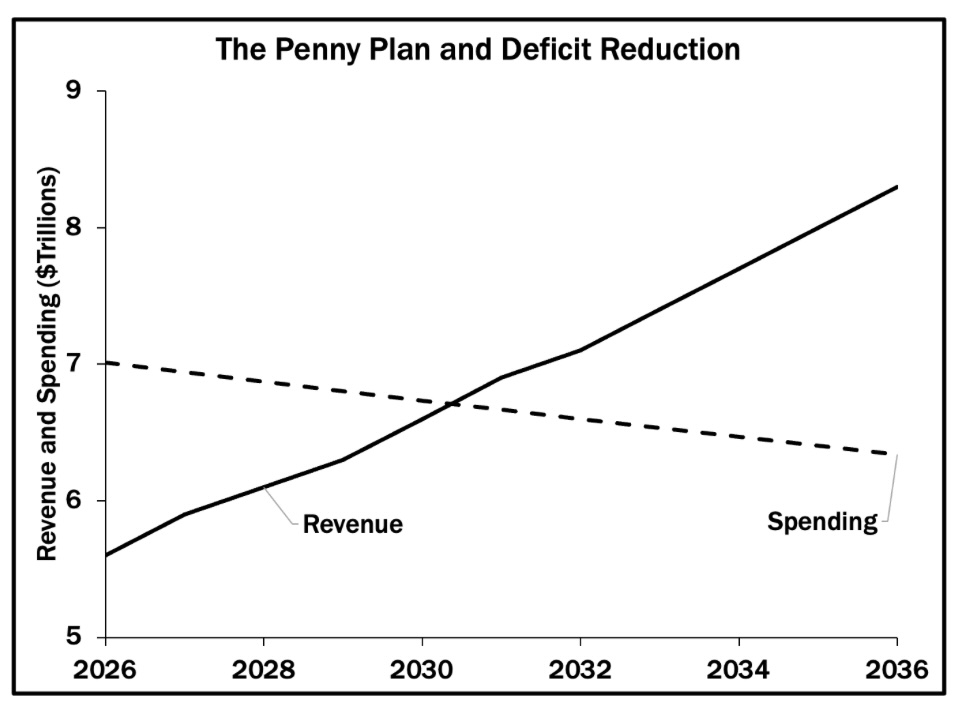
The Penny Plan exemplifies a common complaint about America’s government: why are problems allowed to continue when the solution seems easy? As the chart shows, after about five years and a 5% overall reduction in government spending, the Penny Plan would balance the federal budget. Many elected officials have warned about the dangers of continued budget deficits. Why have they overlooked this obvious solution?
The Problem: second-order consequences
The problem with many policy solutions is not that they won’t work – in the sense that they will fail to address the immediate problem. Rather, the difficulty is that implementing these solutions will have second-order consequences, creating new, sometimes unexpected, policy problems.
Consider the Penny Plan. Without any program changes, federal spending generally increases over time due to inflation, population growth, and rising costs of goods and services. New planes and ships can cost more than the items they replace; the cost of providing medical care may rise due to new technologies or growing populations needing care. Thus, a 1% overall reduction in spending may require larger cuts in federal government activities.
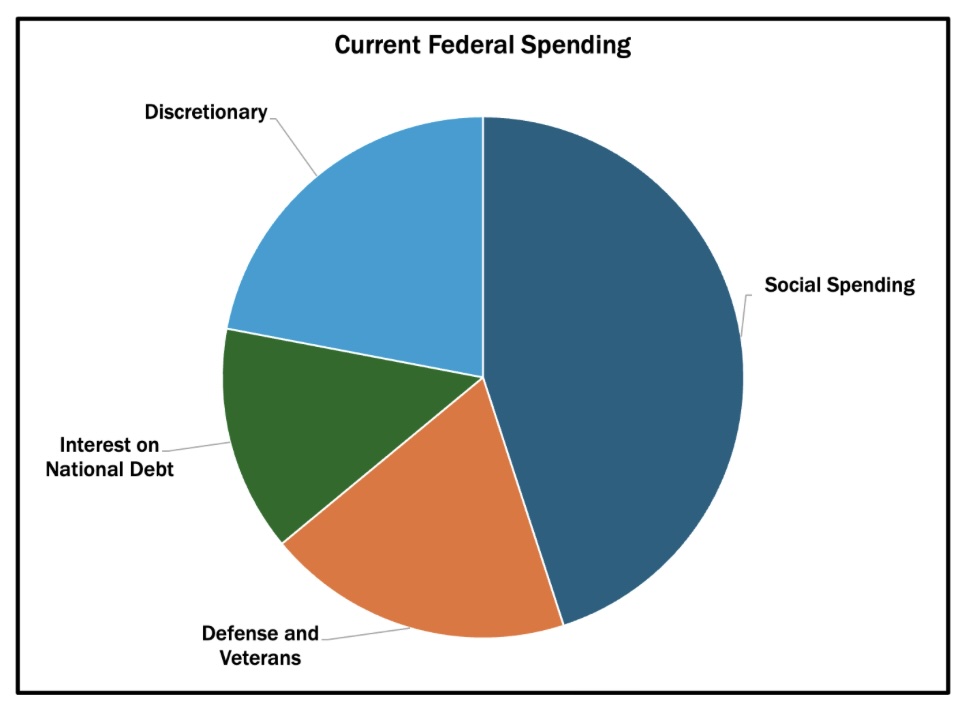
More broadly, because the Penny Plan exempts some of the largest parts of the federal budget from cuts, it requires larger spending cuts from the remaining programs to achieve an overall 1% reduction. The chart below uses data from the U.S. Department of the Treasury to divide federal spending into four categories: Social Spending (Social Security, Medicare, and Medicaid); Defense; Interest on the national debt; and Discretionary Spending (everything else the government does). Under the Penny Plan, the 1% cuts would come from only about a quarter of federal spending, the discretionary category.
The chart below shows the over-time impact on discretionary spending needed to balance the budget under the Penny Plan, assuming mandatory and defense spending increase as expected.
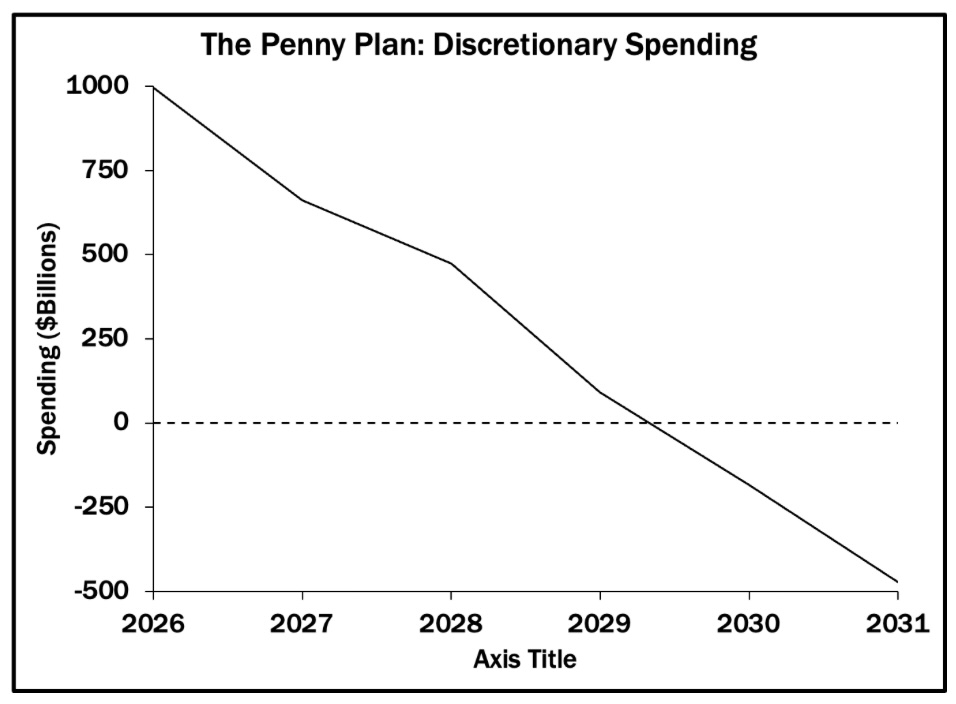
The chart reveals a fundamental problem with the Penny Plan: concentrating the 1% cuts on discretionary spending, coupled with expected increases in other programs, requires large cuts in most government programs, to the point that discretionary spending – everything the federal government does, other than defense, Social Security, Medicare, and Medicaid – is virtually eliminated after five years.
This chart may help explain some of the reasoning behind why there has been little effort by Congress to adopt the Penny Plan or other proposals to reduce the deficit. It is one thing to accept a relatively small (5%) overall spending reduction to balance the federal budget. It is a very different thing if these reductions translate into eliminating virtually all programs tied to discretionary spending that the federal government funds. Put another way, it is very difficult to balance the federal budget without raising taxes or cutting defense spending or social programs such as Social Security, Medicare, and Medicaid.
The Takeaway
The analysis presented here does not imply that the Penny Plan is a bad idea. Nor does it say that deficit reduction is impossible.
The key insight is that solutions to policy problems often have significant side effects. In the case of the Penny Plan, the budget is balanced by concentrating spending reductions on a small slice of federal programs. The result is large spending cuts on these programs compared to the overall reduction in federal spending.
Addressing the federal deficit, or solving other complex policy problems must begin with a complete understanding of the consequences of proposed solutions. Simple solutions often overlook these complexities.
Enjoying this content? Support our mission through financial support.
Further reading
Congressional Budget Office. (2025). Options for Reducing the Deficit: 2025 to 2034. https://tinyurl.com/4d8w7enc, accessed 05/29/26.
Gale, W. G., Berlin, I., & Thorpe, S. I. (2025). How should the US address long-term deficits? https://tinyurl.com/yut6jh2r, accessed 05/25/26.
Sources
Congressional Budget Office. (2026). The Budget and Economic Outlook: 2026 to 2036. https://tinyurl.com/35cz4ja9, accessed 05/30/26.
Fiscal Data. (2025). How much has the U.S. government spent this year? https://tinyurl.com/3s8pt62k, accessed 05/31/26.
Paul, R. (2025). Dr. Rand Paul Introduces Six Penny Plan to Balance the Federal Budget in Five Years. https://tinyurl.com/y2kwz5kd, accessed 05/31/26.
Contributors
William Bianco (Research Director) is Professor of Political Science at Indiana University and Founding Director of the Indiana Political Analytics Workshop. He received his PhD from the University of Rochester. His teaching focuses on first-year students and the Introduction to American Government class, emphasizing quantitative literacy. He is the co-author of American Politics Today, an introductory textbook published by W. W. Norton, now in its 8th edition, and authored a second textbook, American Politics: Strategy and Choice. His research program is on American politics, including Trust: Representatives and Constituents and numerous articles. He was also the PI or Co-PI for seven National Science Foundation grants and a current grant from the Russell Sage Foundation on the sources of inequalities in federal COVID assistance programs. His op-eds have been published in The Washington Post, Indianapolis Star, Newsday, and other venues.


