


What you need to know
One major sticking point at the Constitutional Convention was the representation of states. Small states sought a system that would grant them equal power in the legislature, while larger states desired proportional representation based on state population. The Great Compromise of 1787 resolved this impasse by creating a legislative branch with two chambers, the House and the Senate, that allowed for both population-based and state-based representation. This solution has had enduring consequences for American politics. In this brief, we:
- Outline debates over state representation at the Constitutional Convention
- Discuss the Great Compromise solution
- Explore the lasting impact of this hybrid system
What did the states want from the Constitutional Convention?
Many major controversies at the Constitutional Convention of 1787 pitted smaller states against larger ones. Unsurprisingly, small states sought state-based Congressional representation that would give them equal power with large states, as under the previous Articles of Confederation. Larger states preferred population-based apportionment that would give them more seats in Congress.
These Convention debates were guided by an early proposal known as the Virginia Plan. The plan envisioned a supreme national government with power divided among three branches: legislative, executive, and judicial. It also called for a bicameral, or two-chamber, legislative branch. Importantly, the Virginia Plan's architects wanted each chamber of Congress to have representation proportional to each state's population (or taxes). This would grant larger states more members – and more power.
In response to the Virginia Plan, other delegates – mostly from smaller states – put forward the New Jersey Plan. The Plan still called for a more powerful Congress and two additional branches, the judiciary and the executive, with the latter elected by Congress. Crucially, this Plan retained state-based representation in Congress, with each state granted an equal share of members regardless of size.
Thus, the debates behind the Virginia and New Jersey Plans were not just about state representation. They also reflected disagreement over federal versus state power (see our Federalism brief). In combination, these disagreements threatened to derail the Convention from the start.
How did the Great Compromise resolve these debates?
The solution that broke this stalemate became known as the Great Compromise (also the Connecticut Compromise or Sherman Compromise). It preserved the idea of a bicameral legislature while creating a hybrid system for allocating seats: the Senate would have two members from each state, while the House would have representatives in proportion to state population.
To appease slave states, each state would have one member in the House of Representatives for every 40,000 inhabitants, with three-fifths of a state’s slave population counting toward its total population. This proposal became known as the Three-Fifths Compromise. And to appease more populous states, the eventual Constitution specified that revenue bills must originate in the House, where larger states had more power.
The Great Compromise thus helped bridge the divide between states with competing interests. Apportioning House seats by population and giving each state two Senate seats meant both small and large states could support it. The bicameral design of Congress also helped ease concerns about an overly powerful federal government, as legislative power would be divided between the chambers.
Indeed, the Great Compromise appears in the first section of Article I of the U.S. Constitution, known as the Vesting Clause: “All legislative Powers herein granted shall be vested in a Congress of the United States, which shall consist of a Senate and a House of Representatives.”
How does this bicameral design impact American politics today?
The Constitutional design emerging from the Great Compromise has had long-lasting political effects. The table below compares the House of Representatives and the Senate on several relevant dimensions that affect representation and political outcomes.
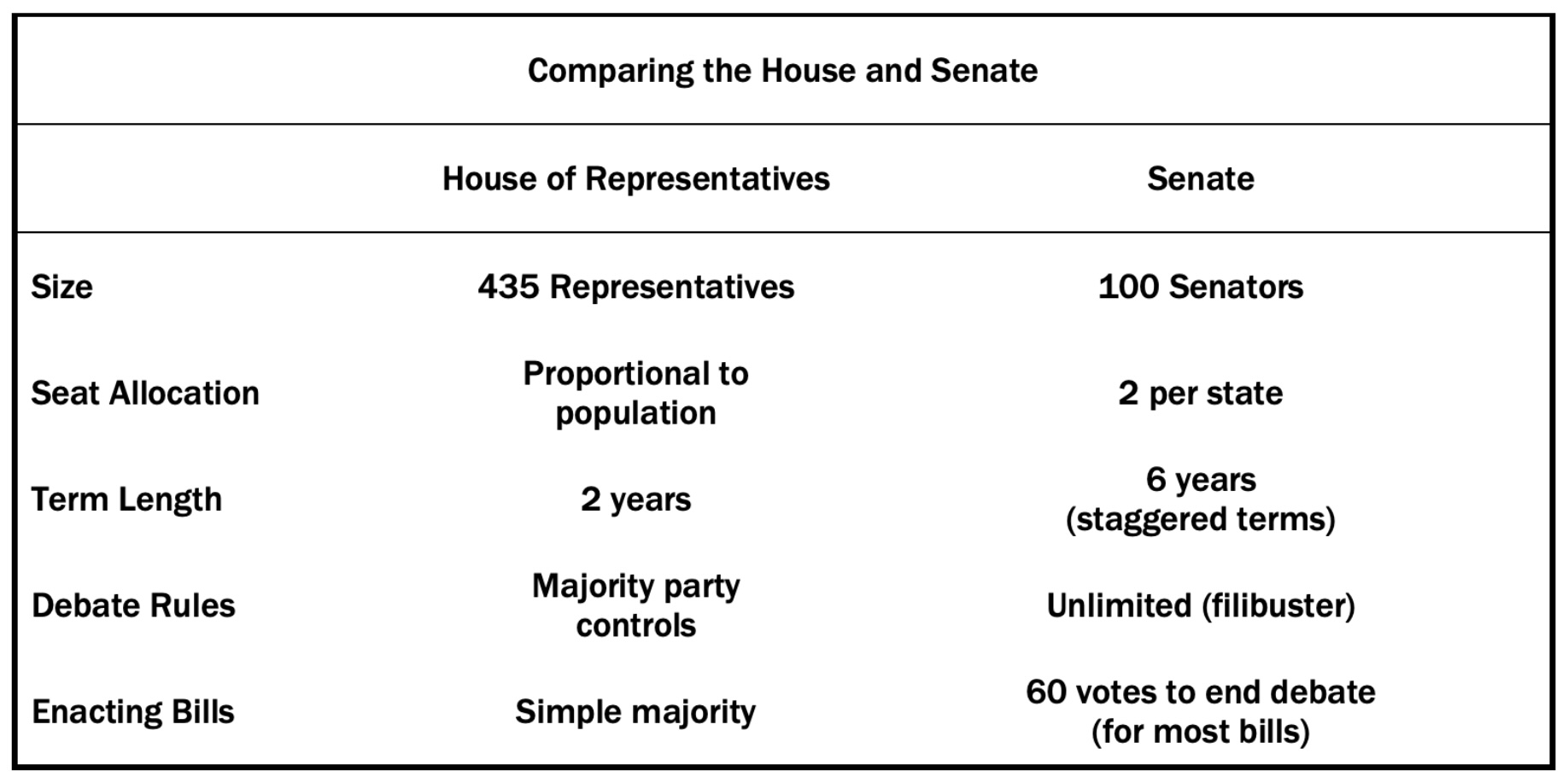
The most basic difference concerns the size of each chamber. The House has 435 Representatives while the Senate has 100 Senators. The House's larger size gives individual members less relative power, while each Senator has more power in their chamber.
This outcome is by design: the Founders envisioned the Senate as a more deliberative, responsible body that would act, in the words of Federalist No. 63, “as a defense to the people against their own temporary errors and delusions.” Members of the House would be more closely connected to the people via smaller districts and more frequent elections, while the Senate would serve as a check against popular passions.
Indeed, until the 17th Amendment in 1913, state legislatures rather than voters selected Senators. And Senators serve longer, six-year terms that insulate them, to a greater degree, from temporary swings in public opinion. In these ways, the Senate was designed to be more countermajoritarian than the House.
The Senate's countermajoritarian design also manifests in other ways. Political parties, for example, play a stronger role in bringing together their large caucuses in the House, whereas they are weaker in the Senate.
Individual Senators can also hold the floor for an unlimited amount of time, known as filibustering. This can prevent a bill from proceeding unless 60 Senators agree to invoke what is referred to as cloture and end the filibuster. Thus, most bills require a “supermajority” to proceed in the Senate, whereas a simple majority is all that’s needed in the House.
All of these factors impact representation and governance. Based on population, each citizen in Wyoming, the smallest state, has roughly 67 times the voting power of each citizen in California, the largest state.
The bicameral legislature also enables divided government, with one party holding a majority in the House and the other in the Senate. Combined with the Senate's supermajority requirements, this makes legislative gridlock a strong possibility in many cases. Legislation that does pass tends to be bipartisan.
The Takeaway
The Great Compromise created a bicameral legislature that balanced large- and small-state power. This initial decision gave rise to the House and Senate as we know them today.
This story highlights how political compromises can be contentious affairs, but also how they can have long-lasting effects on American politics.
Enjoying this content? Support our mission through financial support.
Further reading
Constitution Annotated. (2024). Artl.S1.2.3 The Great Compromise of the Constitutional Convention. https://tinyurl.com/527n5nc5, accessed 08/25/26.
Encyclopaedia Britannica. (2026). Congress of the United States. https://tinyurl.com/kvcxhpj6, accessed 08/25/26.
Sources
Binder, S. A. (2003). Stalemate: Causes and Consequences of Legislative Gridlock. Brookings Institution Press. https://tinyurl.com/4am6cky6, accessed 08/25/26.
Dougherty, K. L., & Hitefield, A. A. (2023). The Effects of the Great Compromise on the Constitutional Convention of 1787. American Politics Research, 52(2), 170-181. https://tinyurl.com/45dfk4ky, accessed 08/25/26.
Eicholz, H. L. (2006). Three-Fifths Compromise. Center for the Study of Federalism. https://tinyurl.com/mr4ce8ck, accessed 08/25/26.
Evans, C. L. (2024). Senate Countermajoritarianism. American Political Science Review, 119(2), 585–602. https://tinyurl.com/535pa5xt, accessed 08/25/26.
Grapski, C. (2003). New Jersey Plan. Center for the Study of Federalism. https://tinyurl.com/rra6u9hj, accessed 08/25/26.
Grapski, C. (2006). Virginia Plan. Center for the Study of Federalism. https://tinyurl.com/msnp685n, accessed 08/25/26.
Johnson, R., & Miller, L. L. (2022). The Conservative Policy Bias of US Senate Malapportionment. PS: Political Science & Politics, 56(1), 10–17. https://tinyurl.com/ycs872aa, accessed 08/25/26.
Krehbiel, K. (1998). Pivotal Politics: A Theory of U.S. Lawmaking. University of Chicago Press. https://tinyurl.com/39h8t36a, accessed 08/25/26.
Lee, F. E., & Oppenheimer, B. I. (1999). Sizing up the Senate: The Unequal Consequences of Equal Representation. University of Chicago Press. https://tinyurl.com/59y94589, accessed 08/25/26.
Madison, J. (1788). The Federalist Papers No. 63: The Senate Continued. The Avalon Project. https://tinyurl.com/anrwvzvn, accessed 08/25/26.
Smith, T. E. (2006). Connecticut Compromise. Center for the Study of Federalism. https://tinyurl.com/uemm7t8h, accessed 08/25/26.
Contributors
Zachary Albert (Content Lead) is Assistant Professor of Politics at Brandeis University. He received his PhD from the University of Massachusetts Amherst. His research focuses on elections, political parties, and public policymaking in American politics. He is the author of Partisan Policy Networks (2025), Small Donors in US Politics (2026), and numerous peer-reviewed journal articles. He has also published op-eds and reports for the Brookings Institution, the Bipartisan Policy Center, The Conversation, and other venues. In the classroom, Albert teaches classes on American elections, political parties, public policy, and quantitative methods, in addition to running the Politics Department internship program.
William Bianco (Research Director) is Professor of Political Science at Indiana University and Founding Director of the Indiana Political Analytics Workshop. He received his PhD from the University of Rochester. His teaching focuses on first-year students and the Introduction to American Government class. He is the co-author of American Politics Today, an introductory textbook published by W. W. Norton now in its 9th edition, and authored a second textbook, American Politics: Strategy and Choice. His research program is on American politics, including Trust: Representatives and Constituents, and numerous articles. His op-eds have been published in the Washington Post, the Indianapolis Star, Newsday, and other venues.