

What you need to know
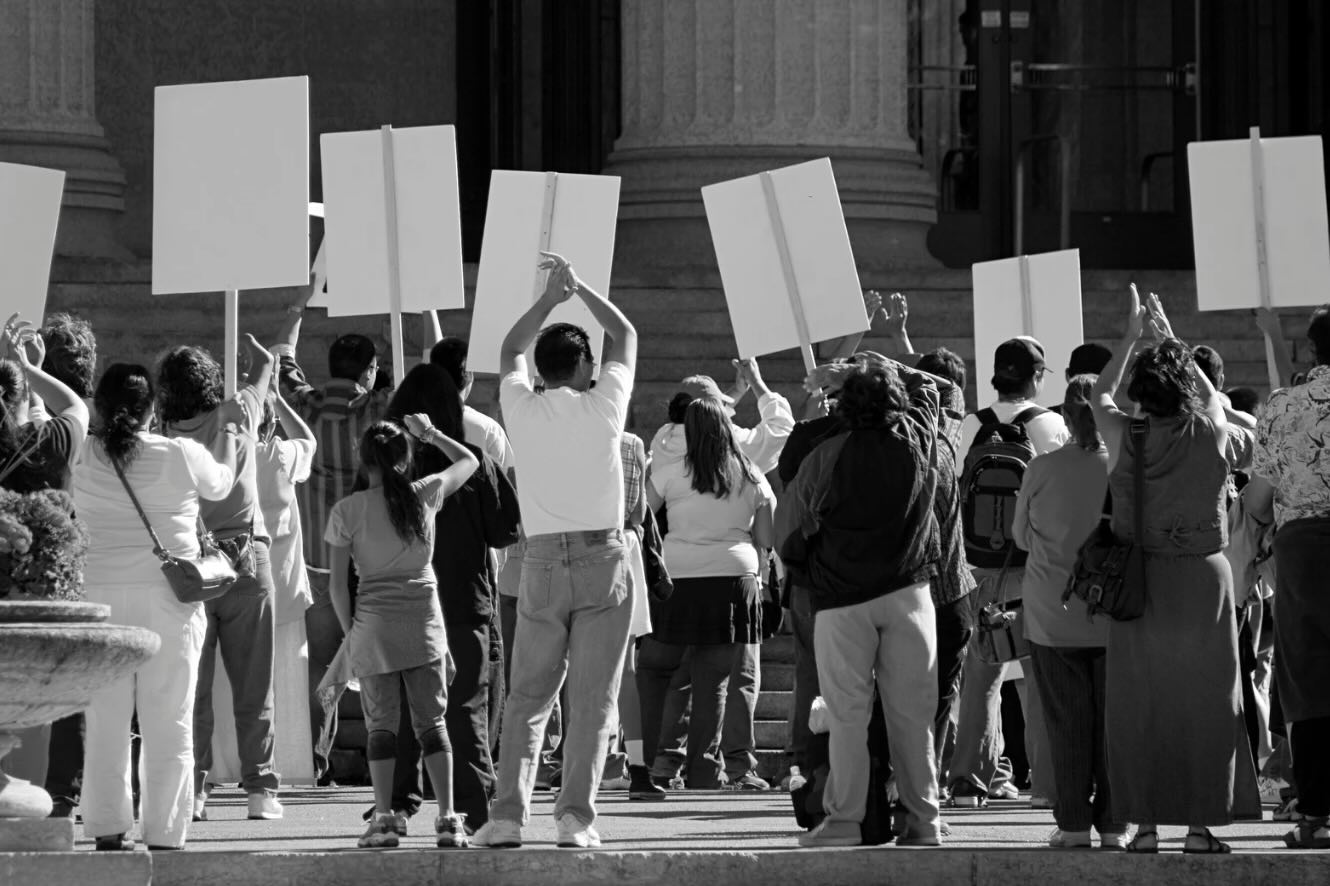
Protest has long shaped American politics. Our very revolution at the Founding was started as a protest movement. However, the right to protest is constrained by judicial decisions and federal, state, and local laws. So, what exactly are your rights? Where do they stop? And who decides?
Why does the right to protest matter?
Protests are an important tactic for groups interested in policy change. Protests can raise public awareness, shift opinions, and provide greater visibility into the impacts of maintaining the status quo. Many significant policy changes, including the abolition of slavery, the expansion of voting rights to women and minorities, the abolition of Jim Crow laws, the right to organize unions, and the end of the Vietnam War, were accompanied by major protest movements.
At the same time, even fully legal protests, such as picketing or sit-ins, can make everyday life more difficult for everyone. Other tactics seen in recent protests, such as blocking traffic, restricting student access to buildings on college campuses, and impeding law enforcement, are generally illegal. As with other civil liberties, the right to protest must be balanced against the government’s ability to maintain public order and the rights of non-protestors to continue their daily activities unimpeded.
What does the Constitution say?
The right to protest comes primarily from the First Amendment to the United States Constitution. This Amendment protects the rights of people to gather publicly, express views, hold signs, chant, march, and advocate for political change. The content of such protests need not be considered good by all audiences. Controversial expression, including burning the flag and engaging in potentially offensive protest activity at military funerals, is protected when conducted lawfully in public spaces.
But the First Amendment does not protect all speech in all places at all times. Courts have long recognized that governments may impose reasonable restrictions, particularly to protect public safety and order. In the 1919 case Schenck v. United States, the Supreme Court ruled that speech creating a “clear and present danger” could be restricted
In 1969, this standard was changed by the unanimous ruling in Brandenburg v. Ohio, which held that speech can be prohibited if it is "directed at inciting or producing imminent lawless action” or "likely to incite or produce such action." This remains the key standard today. Additionally, the right to freedom of speech does not protect vandalism, property destruction, assault, trespassing in restricted areas, blocking emergency vehicles, or physically preventing others from entering buildings.
How can governments regulate protests?
Governments may impose time, place, and manner restrictions. These restrictions must be content-neutral, meaning they do not target a particular viewpoint; instead, they apply to all forms of protest activity. In addition, laws must be narrowly tailored to serve a significant government interest (e.g., by not permitting amplified sound at protests in public parks), and they should leave open alternative means of communicating a protest message or action.
Courts have historically divided spaces into three main categories:
- Traditional public forums like parks, sidewalks, and streets.
- Designated public forums, spaces that the government opens for expression, like city-run municipal theaters and meeting spaces at state universities.
- Nonpublic forums such as military bases, prisons, and government offices.
Traditional public forums are where people enjoy the strongest speech protections. Designated public forums enjoy similar levels of protection when open for these activities on specific days or times. In non-public forums, the government can impose stricter controls owing to the activities typically occurring there.
In Hague v. CIO, the Court in 1939 affirmed that streets and parks are historically open to public assembly after enforcement of a New Jersey statute shut down a recruitment drive on public streets run by the Committee for Industrial Organization. But not all government property is open for protest. In Adderley v. Florida, decided in 1966, the Court upheld trespass convictions for protesters blocking a jail driveway.
How do federal, state, and local laws differ?
Protests in places such as national parks or near federal buildings are governed by federal regulations that may require permits to assemble for large gatherings and impose security perimeters around government facilities.
State and local rules may also require permits, and demonstrations, such as parades that block traffic flow, often require advance notice and permitting. States and cities can also regulate an event's noise level, prohibit sound amplification, prohibit the proposed route or location, and impose curfews to set an end time. Like limitations on federal protest restrictions, permit systems cannot be used to suppress unpopular viewpoints.
The Takeaway
The Constitution strongly protects peaceful protest in public spaces, but governments may impose content-neutral time, place, and manner limits, and the specific rules vary depending on whether you are on federal land, state property, or city streets.
A key distinction runs through all protest law: the Constitution protects speech and peaceful assembly, but it does not protect criminal conduct. Much of the controversy around protests arises when these two categories overlap in real-world events.
Enjoying this content? Support our mission through financial support.
Further reading
Congress.gov. (1791). U.S. Constitution - First Amendment. https://tinyurl.com/3tdtwxy4, accessed 03/17/26.
United States Courts. (2024). What Does Free Speech Mean? https://tinyurl.com/223h424e, accessed 03/17/26.
Sources
Congress.gov. (1791). U.S. Constitution - First Amendment. https://tinyurl.com/3tdtwxy4, accessed 03/17/26.
Oyez. (2026). Schneck v. United States. https://tinyurl.com/mrxxcjrt, accessed 03/17/26.
Oyez. (2026). Brandenburg v. Ohio. https://tinyurl.com/4hsuvms4, accessed 03/17/26.
Institute for Constitutional Advocacy and Protection. (2017). Relevant Constitutional Principles. https://tinyurl.com/5au4eurn, accessed 03/17/26.
Oyez. (2026). Hague v. Committee for Industrial Organization. https://tinyurl.com/mr32uaaw, accessed 03/17/26.
Oyez. (2026). Adderley v. Florida. https://tinyurl.com/mwr9uzd, accessed 03/17/26
Contributors
Lindsey Cormack (Content Lead) is an Associate Professor of Political Science at Stevens Institute of Technology and the Director of the Diplomacy Lab. She received her PhD from New York University. Her research explores congressional communication, civic education, and electoral systems. Lindsey is the creator of DCInbox, a comprehensive digital archive of Congress-to-constituent e-newsletters, and the author of How to Raise a Citizen (And Why It’s Up to You to Do It) and Congress and U.S. Veterans: From the GI Bill to the VA Crisis. Her work has been featured in The New York Times, The Washington Post, Bloomberg Businessweek, Big Think, and more. With a drive for connecting academic insights to real-world challenges, she collaborates with schools, communities, and parent groups to enhance civic participation and understanding.
William Bianco (Research Director) is Professor of Political Science at Indiana University and Founding Director of the Indiana Political Analytics Workshop. He received his PhD from the University of Rochester. His teaching focuses on first-year students and the Introduction to American Government class, emphasizing quantitative literacy. He is the co-author of American Politics Today, an introductory textbook published by W. W. Norton, now in its 8th edition, and authored a second textbook, American Politics: Strategy and Choice. His research program is on American politics, including Trust: Representatives and Constituents and numerous articles. He was also the PI or Co-PI for seven National Science Foundation grants and a current grant from the Russell Sage Foundation on the sources of inequalities in federal COVID assistance programs. His op-eds have been published in The Washington Post, Indianapolis Star, Newsday, and other venues.


