

What you need to know
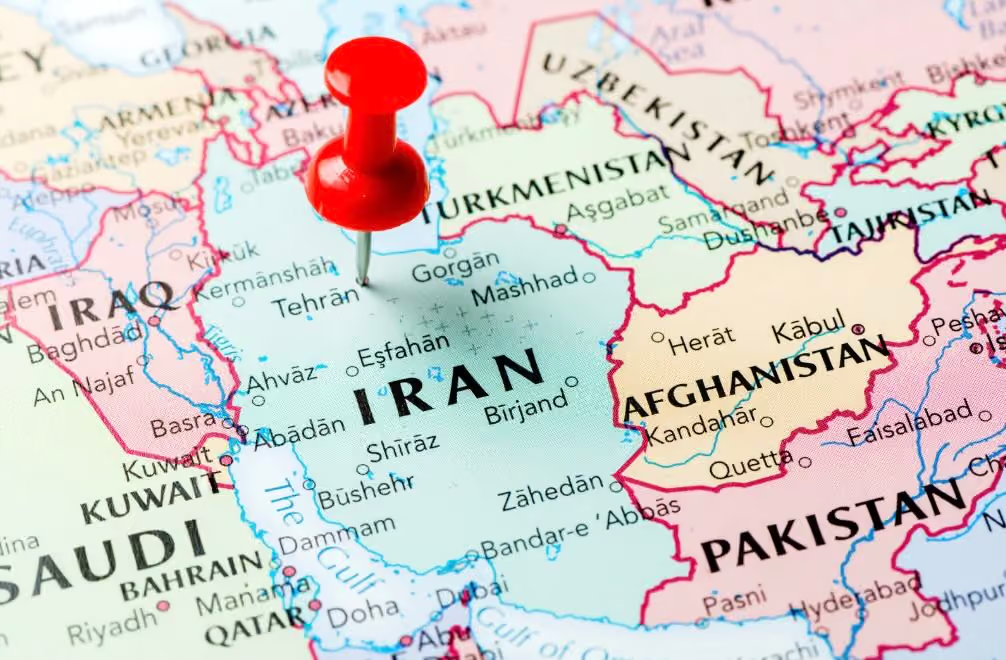
Recent U.S. and Israeli strikes, called Operation Epic Fury, targeted Iranian nuclear facilities, military assets, and senior leadership. In this brief, we outline the main arguments offered in support of and against U.S. military action.
Arguments for the strikes
Supporters of the strikes place it in the context of nearly five decades of hostility between the United States and the Islamic Republic of Iran. Since the 1979 revolution, when Iranian students seized the U.S. Embassy and held 52 Americans hostage, the relationship has been defined by tension.
For decades, U.S. officials, intelligence agencies, and Presidents from both parties have viewed the Iranian regime as a major state sponsor of terrorism. Iran has long provided funding, arms, training, and strategic direction to a network of militant groups that have attacked many countries, including the U.S. and Israel.
In addition, U.S. officials across multiple administrations have maintained that Iran is working to develop a nuclear weapon, and that these efforts cannot be allowed to succeed. Proponents of military action argue that a nuclear-armed Iran would pose a direct threat to Israel and U.S. allies in the Gulf, potentially trigger a regional arms race, increase the risks of broader nuclear proliferation, and strengthen Iran’s leverage over global oil markets.
Declining economic conditions in Iran prompted mass protests that escalated into calls to replace the current system of government, which is based on Sharia (Islamic) law and dominated by religious leaders. One goal of the attacks is to cause enough damage and disruption that citizens could overthrow the government and replace it with one more sympathetic to U.S. interests.
Arguments against the strikes
The arguments against military strikes highlight uncertainties and possible unintended consequences of U.S. intervention. Consider attacks against the leadership in Iran, including one that resulted in the death of Supreme Leader Ali Khamenei. In Iran, the Supreme Leader is both a political head of state and a religious authority. Removing him alters the balance of power, but it does not render Iran leaderless, nor does it ensure a transition to a democratic government controlled by the Iranian people. Some citizens of Iran have long opposed the regime’s repression and human rights abuses. Others view foreign intervention as an attack on national sovereignty or religious authority. As a result, the attacks could wind up increasing support for the regime.
Critics warn that killing senior leadership still leaves intact powerful clerical institutions, military commanders, and security forces that will be in charge of state responses in ways that are likely to be violent domestically and abroad. Iran has already launched retaliatory drone and missile attacks against U.S. interests in the region, as well as civilian targets in countries neighboring Iran.
Iran sits at the center of a region responsible for a large share of global oil production, with oil tankers traveling through the narrow Straits of Hormuz. For example, China receives about 25% of its oil imports from sources in the Middle East. Also, about half of the world’s supply of urea, a feedstock for fertilizer, travels through the Straits. Iranian officials have long threatened to block the Straits in the event of hostilities. While the United States has offered to escort ships through the Straits, it is unclear whether safe passage can be maintained. At present, ship travel appears to be much less than normal. If this disruption continues, it might cause significant economic hardship throughout the world.
Finally, it is possible that the attacks from U.S. air and sea forces will not be sufficient to disable the Iranian state, motivate regime change, or prevent Iranian retaliation in the Middle East and elsewhere. At that point, U.S. decision-makers would face a stark choice: admit sustained goals have not been met and withdraw, continue the operation at an estimated cost of $1-5 billion per day, or begin preparations to send ground forces for a direct attack.
What happens next?
Article I, Section 8 of the Constitution gives Congress the authority to declare war. While presidents may use force in many circumstances without explicit congressional action, prolonged offensive engagement traditionally requires congressional authorization. Current members of Congress argue that military campaigns of this scale demand public debate and legislative approval.
In the coming days, Congress is expected to debate and vote on a War Powers Resolution that would direct the president to seek formal authorization or to terminate hostilities. This process may clarify U.S. objectives and shape public opinion on the operation.
The Takeaway
Military actions against Iran have the potential to create a new Iranian government that is more responsive to its people, eliminate the dangers of Iranian nuclear proliferation, and end Iranian funding of terrorist organizations throughout the world.
At the same time, the attacks raise serious concerns about regional security, nuclear proliferation, terrorism, oil markets, and the risk of prolonged conflict.
The path forward is complex and uncertain. It is unclear whether the operation’s goals are achievable or whether the outcome will be dominated by unintended consequences.
Enjoying this content? Support our mission through financial support.
Further reading
CFR Editors. (2026). The Islamic Republic of Iran’s Power Centers. https://tinyurl.com/y9wbn79b, accessed 03/09/26.
Thomas, C. (2025). Iran: Background and U.S. Policy. https://tinyurl.com/jxyshk5p, accessed 03/09/26.
Sources
The White House. (2026). Peace Through Strength: President Trump Launches Operation Epic Fury to Crush Iranian Regime, End Nuclear Threat. https://tinyurl.com/ys4b46zv, accessed 03/09/26.
Congress.gov. (2018). Artl.S8.C11.2.1 Overview of Declare War Clause. https://tinyurl.com/yc6jvndy, accessed 03/09/26.
The White House. (2026). 74 Times President Trump Has Made Clear That Iran Cannot Have a Nuclear Weapon. https://tinyurl.com/2n7dafcm, accessed 03/09/26.
Office of the Historian. (2019). The Iranian Hostage Crisis. https://tinyurl.com/mrx54krk, accessed 03/09/26.
Maloney, S., Rabinovich, I., Karlin, M., Felbab-Brown, V., Williams, S. T., Grewal, S., Heydemann, S., Rand, D. H., Aydıntaşbaş, A., Kirişci, K., Amr, H., Stelzenmüller, C., Baev, P. K., Pifer, S., Hass, R., Madan, T., Kuok, L., O’Hanlon, M. E., Talmadge, C., Rovner, J., Gross, S., Galston, W. A., & Anderson, S. R. (2026). After the strike: The danger of war in Iran. https://tinyurl.com/mpu3apyf, accessed 03/09/26.
DCinbox. (2026). DCinbox. https://www.dcinbox.com/, accessed 03/09/26.
Contributors
Lindsey Cormack (Content Lead) is an Associate Professor of Political Science at Stevens Institute of Technology and the Director of the Diplomacy Lab. She received her PhD from New York University. Her research explores congressional communication, civic education, and electoral systems. Lindsey is the creator of DCInbox, a comprehensive digital archive of Congress-to-constituent e-newsletters, and the author of How to Raise a Citizen (And Why It’s Up to You to Do It) and Congress and U.S. Veterans: From the GI Bill to the VA Crisis. Her work has been featured in The New York Times, The Washington Post, Bloomberg Businessweek, Big Think, and more. With a drive for connecting academic insights to real-world challenges, she collaborates with schools, communities, and parent groups to enhance civic participation and understanding.
William Bianco (Research Director) is Professor of Political Science at Indiana University and Founding Director of the Indiana Political Analytics Workshop. He received his PhD from the University of Rochester. His teaching focuses on first-year students and the Introduction to American Government class, emphasizing quantitative literacy. He is the co-author of American Politics Today, an introductory textbook published by W. W. Norton, now in its 8th edition, and authored a second textbook, American Politics: Strategy and Choice. His research program is on American politics, including Trust: Representatives and Constituents and numerous articles. He was also the PI or Co-PI for seven National Science Foundation grants and a current grant from the Russell Sage Foundation on the sources of inequalities in federal COVID assistance programs. His op-eds have been published in The Washington Post, Indianapolis Star, Newsday, and other venues.