.avif)


What you need to know
Artificial intelligence (AI) depends on physical infrastructure. Behind every new AI chatbot, image generator, essay writer, or music maker, there are buildings full of computers that must be built, fueled, cooled, and connected to the power grid. In this brief, we:
- Explain what AI data centers are and how they use energy and water
- Describe what lawmakers are debating over their development
- Examine the roles of local and state governments
What is an AI data center?
An AI data center is a facility filled with computer servers that store data and perform the intense computational work needed to train and run AI systems. AI data centers often require more advanced chips, more computing power, and more cooling capacity than traditional facilities. That means AI infrastructure depends on land, transmission lines, substations, water systems, and round-the-clock electricity.
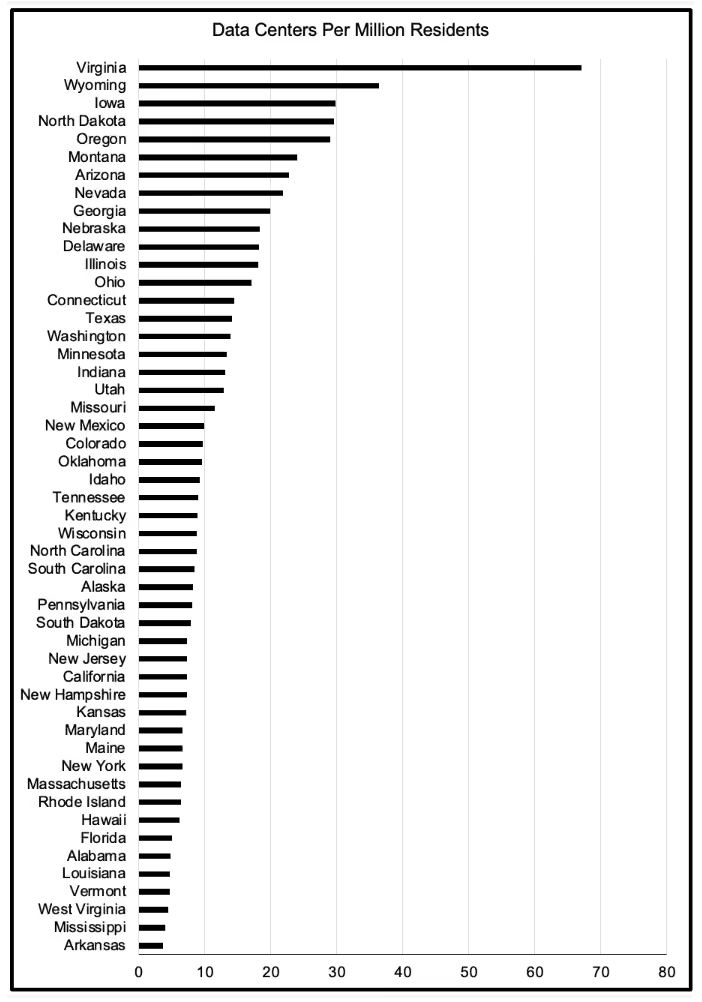
In 2024, the average proposed U.S. data center reportedly had a capacity of around 300 megawatts, roughly enough electricity to power about 240,000 homes. Facilities of that size can reshape local planning decisions and place new demands on the grid. As the figure below shows, some states have a disproportionate number of data centers:
Why are these facilities politically controversial?
For many, AI may feel new, but the underlying governance questions are familiar: how governments regulate private industry, how infrastructure gets built, and how public and private costs are divided.
One major concern is electricity demand. Lawmakers in several states have argued that rapidly expanding data center construction is increasing pressure on regional power grids and contributing to higher electricity costs for households. Some lawmakers and advocacy groups argue that consumers have already absorbed billions of dollars in added transmission and capacity costs linked in part to projected data center demand. Some estimates suggest that the average household in these regions could eventually face hundreds of dollars in added annual costs if current trends continue.
Water use is another concern. Some data centers use enormous quantities of water for cooling, and critics argue that this is especially troubling in places already facing water stress. Congresswoman Veronica Escobar (D-TX) has highlighted concerns that communities are not receiving enough information about rising electricity costs, water consumption, and environmental impacts from major projects, such as Meta’s data center expansion in El Paso, Texas. Representative Escobar and others have also pushed for greater public input and federal studies of data centers’ impact on water supplies.
The figure above suggests that different issues arise for different states. For states such as Wyoming, which have limited water supplies, water requirements might be the pressing issue. In contrast, in states such as Virginia, which have a high per capita number of data centers and a large population, power consumption might be the critical issue. And in states like Arkansas, where the number of data centers per capita is low, data centers might not create significant issues.
Other critics focus on broader questions about AI governance. Some Democratic lawmakers have tied opposition to rapid data center expansion to what they view as an absence of meaningful federal AI regulation. From this perspective, they argue that Congress should be cautious about allowing the physical infrastructure of AI to grow faster than the legal and ethical framework governing its use.
Republicans and business groups have tended to frame the issue differently. They often emphasize AI data centers as part of a broader competition with China and as a major opportunity for domestic growth, rural investment, and energy development. In this view, the United States needs more digital infrastructure, not less. Republican lawmakers have highlighted the economic potential of data centers in places like Texas, Pennsylvania, and South Dakota, as well as in rural communities seeking new investment. Business groups such as the U.S. Chamber of Commerce have supported legislation to expand the use of power sources, including advanced nuclear energy, to meet rising electricity demand driven by data centers.
Supporters of expansion also point to construction jobs, property tax revenue, support for small businesses, and strategic value for defense and research. Some projects are explicitly tied to national security, including proposed AI computing facilities connected to defense installations. Others are framed as part of a larger effort to ensure the United States leads in AI rather than falling behind global rivals.
From this perspective, the risk is not overbuilding, but underbuilding. If the United States cannot generate enough electricity, modernize the grid, and streamline approvals, it may lose economic and strategic ground to foreign competitors.
What role do states and local communities play?
Even when national leaders frame AI as a race the United States must win, the actual facilities still have to be built somewhere. That gives states and localities an important role. Communities often confront immediate questions about zoning, land use, traffic, water draw, noise, visual impact, and utility infrastructure. Some officials have defended the authority of residents and governments to shape or block projects in their own communities. That local dimension matters because the benefits and burdens of these facilities are often unevenly distributed. A project may bring tax revenue and some jobs, but nearby residents may worry more about water use, power demand, or the community's long-term character.
The Takeaway
Debates over AI data centers are about who pays, who benefits, how much local communities should control development, and what tradeoffs are acceptable in the push for innovation.
As AI becomes more embedded in American life, the politics around the infrastructure behind it will likely grow too, because decisions about energy, water, land use, and public accountability are never only technical decisions, but also community and government decisions.
Enjoying this content? Support our mission through financial support.
Further reading
Congressional Research Service (2026) Data Centers and Their Energy Consumption: Frequently Asked Questions, https://www.congress.gov/crs-product/R48646, accessed 4/15/26
Congressional Research Service (2025) Data Center Energy Infrastructure: Federal Permit Requirements, https://www.congress.gov/crs-product/R48762, accessed 4/16/26
Sources
Goldsmith, I, and Z. Bynum (2025) Powering the US Data Center Boom: Why Forecasting Can Be So Tricky. https://www.wri.org/insights/us-data-centers-electricity-demand, accessed 4/20/25
Congressional Research Service (2026) Data Centers and Their Energy Consumption: Frequently Asked Questions, https://www.congress.gov/crs-product/R48646, accessed 4/15/26
Daergan, J. (2026) U.S. Lawmakers Move to Pause Large-Scale AI Data Center Expansion Pending Regulation, https://tinyurl.com/2s3rd3wf, accessed 4/16/26
Thompson, D, Lenoir, T, & Perkins, L. (2025) Geopolitics of data centers: An AI showdown that will reshape the world. https://tinyurl.com/4fnw7vws, accessed 4/20/26
Data Center Map (2026) Data Center Map https://www.datacentermap.com/research/data/, accessed 5/30/26
Contributors
Lindsey Cormack (Content Lead) is an Associate Professor of Political Science at Stevens Institute of Technology and the Director of DCinbox, a comprehensive digital archive of Congress-to-constituent e-newsletters. She received her PhD from New York University. Her research explores congressional communication, civic education, and electoral systems. Lindsey is the author of How to Raise a Citizen (And Why It’s Up to You to Do It) and Congress and U.S. Veterans: From the GI Bill to the VA Crisis. Her work has been featured in The New York Times, The Washington Post, Bloomberg Businessweek, Big Think, and more. With a drive for connecting academic insights to real-world challenges, she collaborates with schools, communities, and parent groups to enhance civic participation and understanding.
William Bianco (Research Director) is Professor of Political Science at Indiana University and Founding Director of the Indiana Political Analytics Workshop. He received his PhD from the University of Rochester. His teaching focuses on first-year students and the Introduction to American Government class, emphasizing quantitative literacy. He is the co-author of American Politics Today, an introductory textbook published by W. W. Norton, now in its 8th edition, and authored a second textbook, American Politics: Strategy and Choice. His research program is on American politics, including Trust: Representatives and Constituents and numerous articles. He was also the PI or Co-PI for seven National Science Foundation grants and a current grant from the Russell Sage Foundation on the sources of inequalities in federal COVID assistance programs. His op-eds have been published in The Washington Post, Indianapolis Star, Newsday, and other venues.