

What you need to know
Since February 14, 2026, the U.S. Department of Homeland Security (DHS) has been without Congressionally approved funding, leading to long waits at some airport security checkpoints. What is causing the funding gap? How long are actual wait times? What will break the logjam?
What is the TSA?
After the 9/11 attacks, the federal government created the DHS to centralize agencies responsible for securing America’s borders. At the same time, the Transportation Security Administration (TSA) was created as a standalone agency within DHS, responsible for airline and passenger security.
What’s causing the shutdown and the travel delays?
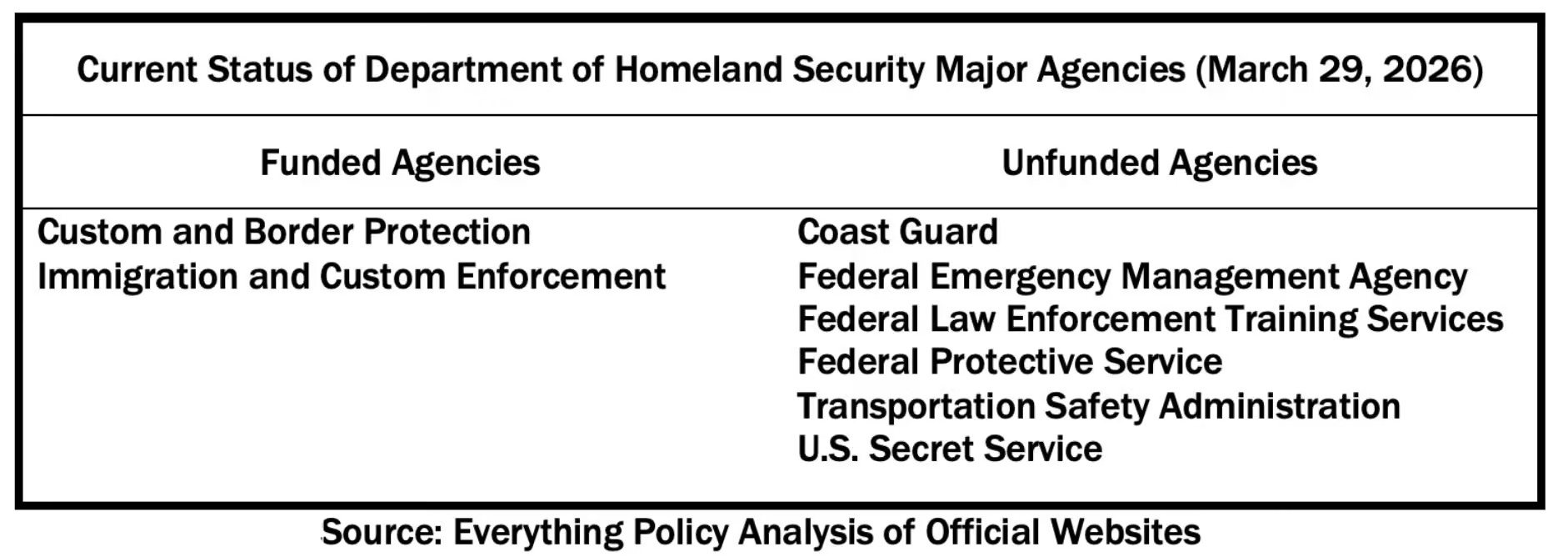
DHS and the rest of the federal government were funded under a continuing resolution, which expired on January 31, 2026. Congress has enacted budgets for the rest of the government, but funding for most DHS agencies remains unresolved. As shown in the table below, the exceptions are two DHS agencies whose funding was included in the One Big Beautiful Bill Act (OBBBA) enacted in July 2025.
Without funding, most agency operations are suspended. Some employees are designated “essential,” meaning they must continue to work during a funding lapse even though they are not being paid (they receive back pay after shutdowns are resolved). About 95% of TSA employees are considered essential.
During the shutdown, a significant number of TSA employees resigned. Absences due to illness and other reasons are also higher. The result is that at some airports, TSA does not have enough personnel to adequately staff its processing lines during peak travel times, leading to longer wait times for airline passengers.
On March 28th, President Trump issued an Executive Order directing the Secretary of Homeland Security to pay TSA employees. It is unclear whether the order is constitutional. Article I, Section 9, Clause 7 of the U.S. Constitution states, “No Money shall be drawn from the Treasury, but in Consequence of Appropriations made by Law.” Up to now, this clause has been interpreted to mean that federal employees cannot be paid during a shutdown unless Congress appropriates funds for their agency. An alternate theory is that funds from the OBBBA can be used. The question will likely be addressed in federal court.
Why haven’t Members of Congress funded DHS?
The current shutdown is not directly about the TSA or TSA funding, but rather about other aspects of Homeland Security. As the table above shows, DHS includes a myriad of other agencies, including Customs and Border Protection (CBP) and Immigration and Customs Enforcement (ICE).
At the core of the DHS shutdown are competing political visions of ICE and CBP enforcement policies. Democrats are seeking to change how ICE and CBP agents operate, including requiring agents to wear personal identification when in public, not to wear masks while conducting enforcement operations, and to obtain warrants before entering homes or businesses. While DHS leadership has offered to make these policy changes, Democrats want them included in the budget resolution, making it harder for DHS to reverse its decision in the future.
On March 27, 2026, the Senate passed a DHS budget that includes Democratic changes and does not fund ICE or CBP (they would continue to be funded from the OBBBA). However, House Republicans enacted a different funding bill that does not include these changes and also adds some additional provisions. The shutdown will end only when both chambers enact the same proposal.
What Has the Impact of the Partial DHS Shutdown Been on TSA Operations?
Most of DHS, including TSA, continues to operate, but employees are not being paid (except for TSA employees if the Trump order is sustained), and contractors are not being reimbursed. So far, the biggest impact has been TSA employees calling out sick or quitting, causing staffing shortages at many airports. While media stories have focused on the worst-case airports, such as Houston or Newark, the impacts on TSA screening wait times have varied widely across airports, as shown below.
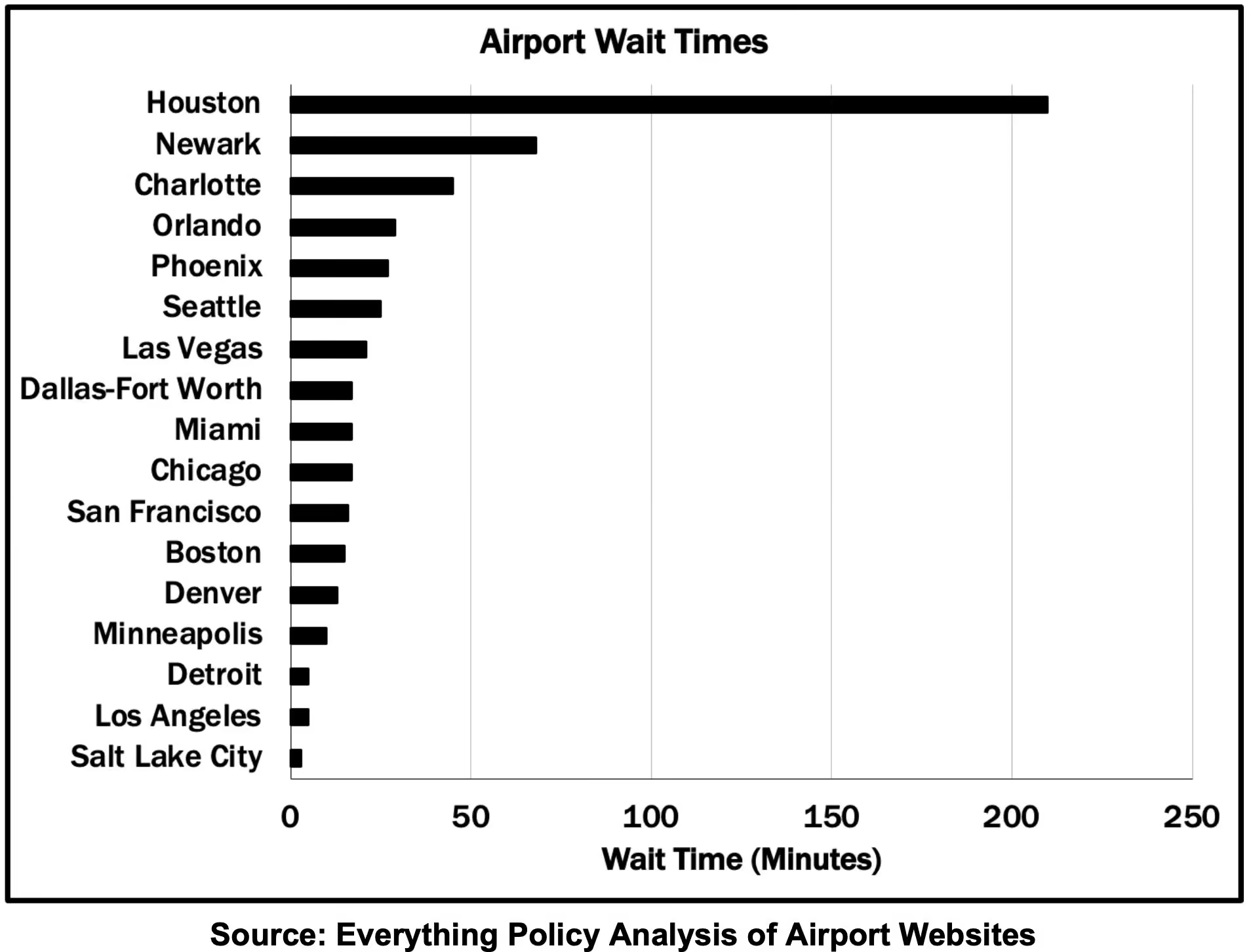
The chart shows a snapshot of wait times on a Thursday morning in late March 2026. Note that some of the largest airports, including La Guardia, JFK, and Atlanta, aren’t reporting wait times online and so aren't included, though media reports indicate several-hour wait times at each of these airports. However, it’s also easy to see that the difference in wait times between Houston and Los Angeles is several hours, indicating that TSA impacts are not uniform across the country. In addition, some airports (including San Francisco) have private security firms run airport security, so they are unaffected by the shutdown.
The Takeaway
Currently, employees of TSA are required to work without pay, leading to resignations and increased unscheduled absences.
Because of these staffing issues, wait times are significantly higher at some airports throughout the U.S. However, most major airports report near-normal wait times.
TSA operations will not return to normal until Congress enacts a budget for the TSA’s parent Cabinet Department, DHS.
Enjoying this content? Support our mission through financial support.
Further reading
Kiliç, K., & Sallan, J. M. (2023). Study of delay prediction in the US airport network. Aerospace, 10(4), 342.
Blinder, A., Sims, S. & Bonamo, M (2026). What It’s Like to Stand in an Airport Security Line for Hours, https://tinyurl.com/3r4kmw5y, accessed 3/28/26.
Sources
Twardowski, A. & O’Hanlon, M. (2019). During a government shutdown, we’re not paying our protectors, https://tinyurl.com/sw3exz9s, accessed 3/28/26.
Department of Homeland Security (2026a). DHS Law Enforcement Overview. https://www.dhs.gov/dhs-law-enforcement-overview, accessed 3/28/26.
Department of Homeland Security (2026b) Screening Partnership Program. https://www.tsa.gov/for-industry/screening-partnerships, accessed 3/28/26
McNeill, H. (2026). Oversight Hearing - DHS Shutdown Impacts. House Committee on Homeland Security. https://tinyurl.com/2uc33hd3, accessed 3/28/26.
Contributors
Robert Holahan (Content Lead) is Associate Professor of Political Science at Binghamton University (SUNY). He holds a PhD in Political Science from Indiana University where his advisor was Nobel Laureate Elinor Ostrom. His research focuses on natural resource policy, particularly in domestic oil and gas production, but also extends into international environmental policy. He was PI on a National Science Foundation grant that utilized a 3000-person mail-based survey, several internet-based surveys, and a series of laboratory economics experiments to better understand Americans’ perspectives on energy production issues like oil drilling and wind farm development.
William Bianco (Research Director) is Professor of Political Science at Indiana University and Founding Director of the Indiana Political Analytics Workshop. He received his PhD from the University of Rochester. His teaching focuses on first-year students and the Introduction to American Government class, emphasizing quantitative literacy. He is the co-author of American Politics Today, an introductory textbook published by W. W. Norton, now in its 8th edition, and authored a second textbook, American Politics: Strategy and Choice. His research program is on American politics, including Trust: Representatives and Constituents and numerous articles. He was also the PI or Co-PI for seven National Science Foundation grants and a current grant from the Russell Sage Foundation on the sources of inequalities in federal COVID assistance programs. His op-eds have been published in The Washington Post, Indianapolis Star, Newsday, and other venues.