

What you need to know
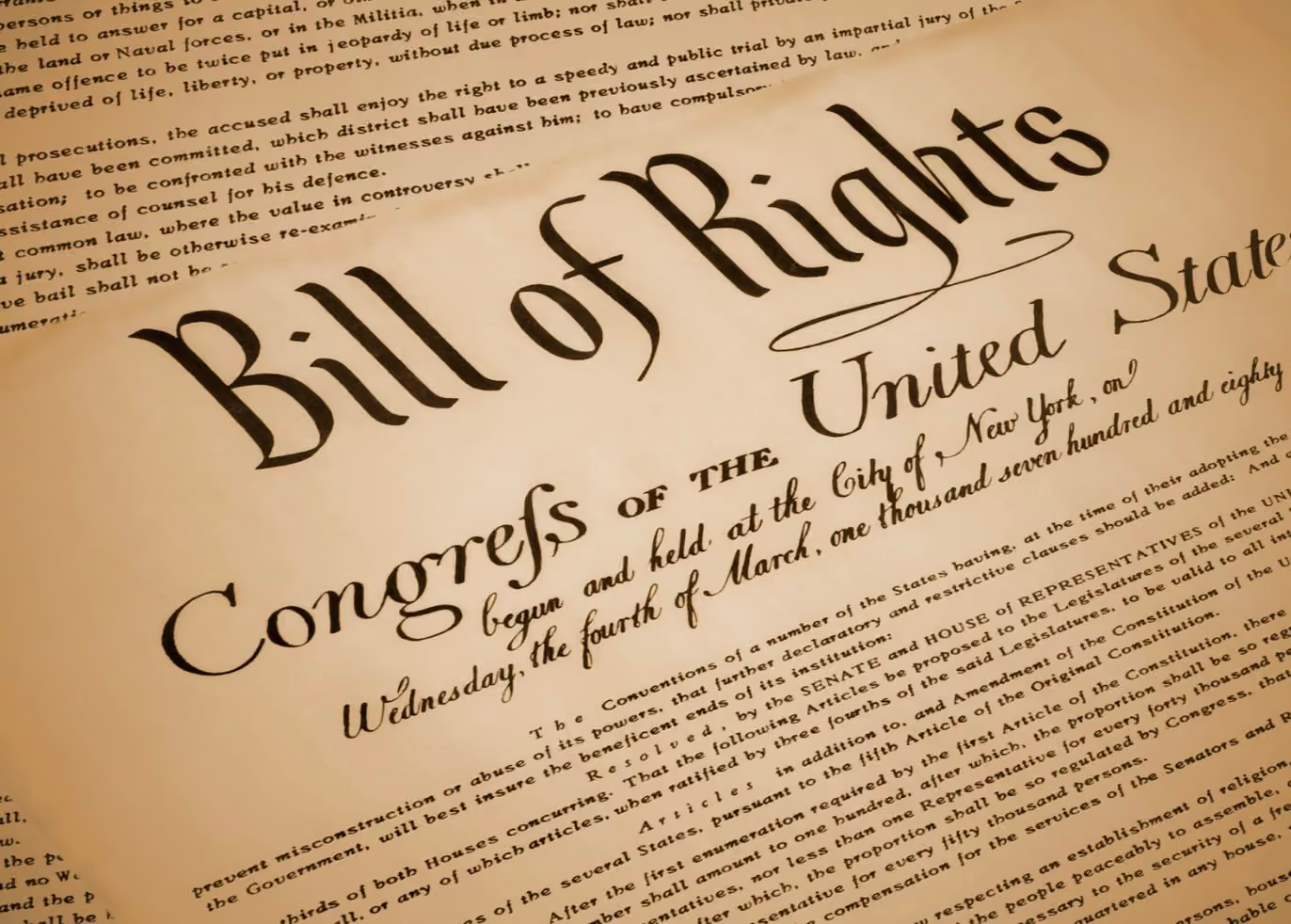
The Bill of Rights is a statement of the basic liberties guaranteed by the first ten Amendments to the Constitution. These rights were not included in the original Constitution but were promised as a condition for ratification (at least four states said they would not ratify without these protections). In this brief, we discuss how these rights have evolved to cover actions by state and local governments.
The Early Years: Federal vs. States
Before the Civil War, the Bill of Rights applied only to the laws and actions of the national government and not to those of the states. For example, the First Amendment says that “Congress shall make no law” infringing on freedom of religion, speech, and the press, among others. James Madison wanted to include the states in that language, but Antifederalists feared another power grab by the Federalists that would limit states’ rights, so his proposed amendment was voted down in Congress.
This decision proved consequential because the national government was relatively limited for the first half of our nation’s history. Because states exercised as much power over people’s lives as the national government did, if not more, it would have been more important for the Bill of Rights to limit the reach of the state governments than to limit that of the federal government. Thus, the Bill of Rights played a surprisingly small role for more than a century. The Supreme Court used it only once before 1866 to invalidate a federal action—in the infamous Dred Scott case that contributed to the Civil War.
The 14th Amendment
The significance of the Bill of Rights started to change with the ratification of the 14th Amendment after the Civil War. In addition to providing citizenship to everyone born in the United States (see the policy brief on Birthright Citizenship), Section 1 of the Fourteenth Amendment says: “No State shall make or enforce any law which shall abridge the privileges or immunities of citizens of the United States; nor shall any State deprive any person of life, liberty, or property, without due process of law; nor deny to any person within its jurisdiction the equal protection of the laws.”
Despite the amendment’s clear statement that “no State shall make or enforce any law” that denies due process and the equal protection of the laws, it took more than 50 years for the Supreme Court to expand the reach of the Fourteenth Amendment. In two early cases involving property rights and self-incrimination, the Supreme Court began to use the Fourteenth Amendment to prohibit state governments from violating individual rights—but stopped short of invoking the Bill of Rights itself to support its decisions. Then, in 1925, the Court said for the first time in Gitlow v. New York that the Fourteenth Amendment incorporated one of the amendments in the Bill of Rights (protections for freedom of speech and the press) and applied it to the states.
Selective Incorporation
This process of applying most of the civil liberties covered in the Bill of Rights to the states through the Fourteenth Amendment on a case-by-case basis is called selective incorporation. This process was not smooth and incremental. Rather, it progressed in surges with flurries of activity in the 1930s and 1950s-1960s, and has continued to the present day.
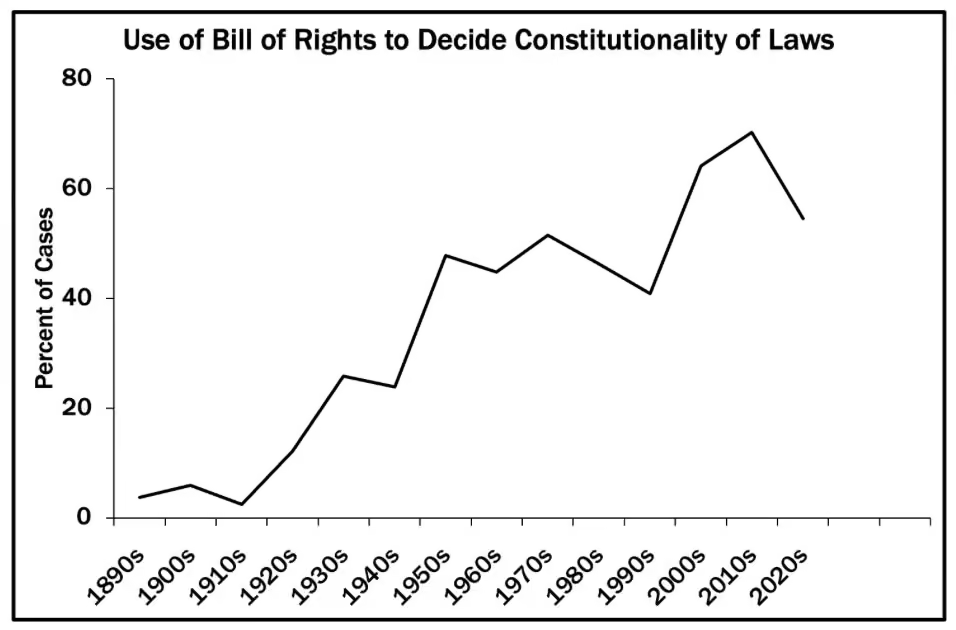
The chart below shows the percentage of cases in which the Supreme Court has held a law unconstitutional, where the rationale for the decision involved the Bill of Rights. The upward trend in the chart shows the important role that the Bill of Rights (and selective incorporation) plays in modern Supreme Court decision-making.
As a result of selective incorporation, the Bill of Rights has evolved from a narrow range of protections against national government actions in the early nineteenth century to a robust set of protections for freedom and liberty that limit actions by national, state, and local governments.
The Takeaway
Initially, the Bill of Rights applied to only the national government, not the states. Through the Fourteenth Amendment and the process of selective incorporation, the Supreme Court has gradually applied most of the Bill of Rights to the states.
Selective incorporation also illustrates how our constitutional rights have evolved and will likely continue to do so.
Enjoying this content? Support our mission through financial support.
Further reading
Amar, A. R. (1998). The Bill of Rights: Creation and Reconstruction. Yale University Press. https://tinyurl.com/mrsbruyw, accessed 08/14/26.
Chemerinsky, E., & Gillman, H. (2017). Free Speech on Campus. Yale University Press. https://tinyurl.com/yc2jpfdj, accessed 08/14/26.
Ketcham, R. (2003). The Anti-Federalist Papers and the Constitutional Convention Debates. Signet Classic. https://tinyurl.com/2nwpzbzp, accessed 08/16/26.
Pritchett, C. H. (1984). Constitutional Civil Liberties. Prentice Hall. https://tinyurl.com/mdj8343v, accessed 08/16/26.
Sources
Constitution Annotated. (2026). Table of Laws Held Unconstitutional in Whole or in Part by the Supreme Court. Congress.gov. https://tinyurl.com/y3b4rkhb, accessed 08/07/26.
Oyez. (1857). Dred Scott v. Sandford, 60 U.S. 393. https://tinyurl.com/4xu8h93a, accessed 08/07/2026.
Oyez. (1925). Gitlow v. New York, 268 U.S. 652. https://tinyurl.com/yfwfu9kz, accessed 08/07/2026.
Contributors
Dr. David Canon (Content Lead) received his PhD in Political Science from the University of Minnesota. He is Professor Emeritus at the University of Wisconsin, Madison. His research concerns Congress, elections, political careers, and race and representation.
Dr. William Bianco (Research Director) received his PhD in Political Science from the University of Rochester. He is Professor of Political Science and Director of the Indiana Political Analytics Workshop at Indiana University. His current research is on representation, political identities, and the politics of scientific research.