

What you need to know
In the U.S. House of Representatives, the majority party (currently Republicans) controls the legislative agenda, meaning they can determine which proposals come up for debate and a vote. There is one exception: a discharge petition. This brief describes the process and analyzes its recent use.
- Discharge petitions allow a majority of House members to override the majority party’s control over congressional proceedings.
- Successful discharge petitions are rare, but have succeeded twice this year.
- Their success in the current Congress reflects policy and political splits among House Republicans.
Who Runs the House of Representatives?
The rules of the contemporary U.S. House of Representatives give the majority party (currently the Republicans) and its leader, the Speaker of the House, the power to control which proposals are brought to the full chamber for debate and a vote.
The majority party exercises its power through the Rules Committee, which writes procedures that determine whether a proposal will be considered, how long debate will proceed, and which amendments will be allowed. While the minority party (currently the Democrats) is represented on the Rules Committee, the majority party generally always has a strong, loyal committee majority.
Under these circumstances, the minority party in the House can participate in debate and vote on proposals, but normally has little to no role in determining the legislature’s agenda.
What is a Discharge Petition?
Since 1924, House Rules have permitted members of the chamber to discharge a bill - force it to be brought to the floor for debate and a vote, in effect bypassing majority party control. Discharge requires signatures from a majority of the Chamber's members (218 if there are no vacant seats). Once 218 signatures are secured, a vote must occur within 30 days.
Efforts to use a discharge petition are common, with about 10 - 15 filed in every two-year congressional term, as shown in the chart below for the 112th (2011 - 2012) through the 119th (2025-2026) House.
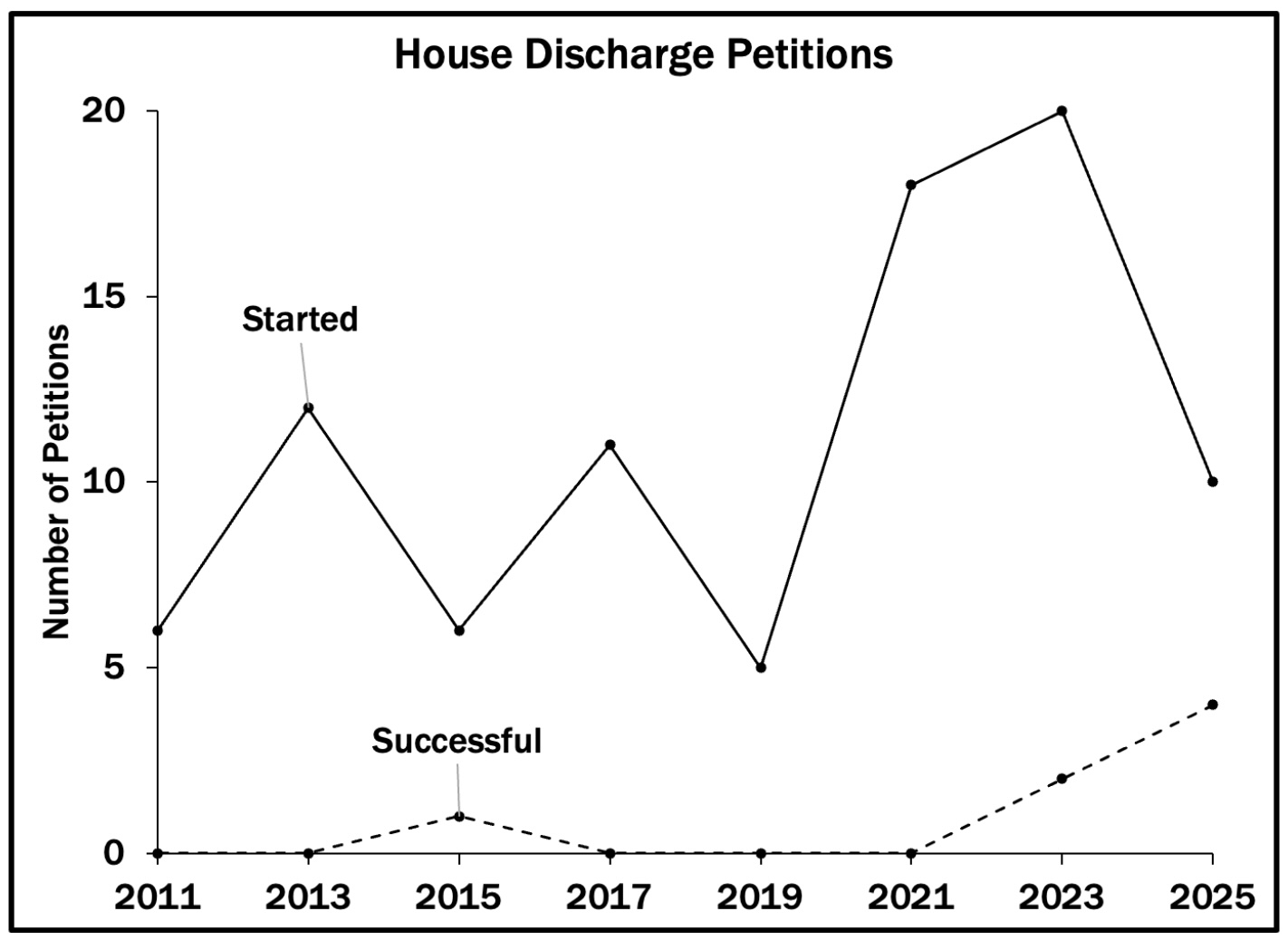
In general, however, successful discharge petitions are rare. From 2011 - 2022, only one petition succeeded: the 2015 effort to reauthorize the Export-Import Bank. Since 2023, there have been six successful petitions, including four in 2025:
- Allow proxy voting for pregnant and nursing House members.
- Restore collective bargaining rights to many federal employees.
- Release the so-called Epstein files held by the Justice Department. (Epstein was a financier convicted of sex crimes. The files may contain embarrassing information about some public figures.)
- Most recently (December 16, 2025), a discharge petition to extend ACA health care subsidies, with a vote likely in late December 2025 or early January 2026 (see our recent brief here).
In addition to these successful petitions, as of December 16, 2025, a petition supporting military aid to Ukraine has 214 signatures. While all current signatories are Democrats, only a small number of additional Republican signatures are needed to generate a majority. A discharge petition may also be filed to propose a ban on stock trading by members of Congress.
What’s happening here?
The increase in discharge petitions in the 119th House reflects splits among Republican House members. The majority of Republicans likely oppose all the proposals discussed above. However, a small number of Republicans from moderate districts, looking ahead to the 2026 midterms and knowing that proposals such as the release of the Epstein files are popular among Democratic and independent voters, want these proposals to be voted on. While these members have little power within the Republican Conference, they can join Democrats to create enough votes to invoke a discharge petition.
In discussing these possibilities, our intent isn't to highlight fracturing within the Republican party, or to place blame on one party over the other for policy outcomes, but rather to emphasize that a Discharge Petition is most widely used and likely passed when differences in policy approaches are seen within the political party that maintains majority control of the House.
The Take Away
- Discharge petitions allow members of the House to circumvent the majority party's agenda control.
- Historically a rare practice, the past year has seen four discharge petitions achieve the minimum 218 House votes to pass with more possible before the end of 2025.
- The rise in the use of discharge petitions is a signal of divisions among the majority party in the House, currently Republicans.
Enjoying this content? Support our mission through financial support.
Further reading
Miller, S. M., & Overby, L. M. (2014). Discharge petitions and the conditional nature of agenda control in the US House of Representatives. Party Politics, 20(3), 444-455.
Oleszek, Mark J. 2023. Discharge Procedures in the House. Congressional Research Service. Available at https://tinyurl.com/8mrvurts, accessed 12/1/2025.
Sources
Clerk of the U.S. House of Representatives. 2025. Discharge Petitions. Available at https://clerk.house.gov/DischargePetition, accessed 12/1/2025.
History Blog. 2023. Who Controls the House?: The Discharge Petition and Legislative Power in the New Deal Congress. U.S. Congressional Research Service. Available at https://tinyurl.com/2s3h2atw, accessed 12/1/2025.
Oleszek, Mark J. 2023. Discharge Procedures in the House. Congressional Research Service. Available at https://tinyurl.com/8mrvurts, accessed 12/1/2025.
Contributors
Robert Holahan (Content Lead) is Associate Professor of Political Science at Binghamton University (SUNY). He holds a PhD in Political Science from Indiana University where his advisor was Nobel Laureate Elinor Ostrom. His research focuses on natural resource policy, particularly in domestic oil and gas production, but also extends into international environmental policy. He was PI on a National Science Foundation grant that utilized a 3000-person mail-based survey, several internet-based surveys, and a series of laboratory economics experiments to better understand Americans’ perspectives on energy production issues like oil drilling and wind farm development.
William Bianco (Research Director) is Professor of Political Science at Indiana University and Founding Director of the Indiana Political Analytics Workshop. He received his PhD from the University of Rochester. His teaching focuses on first-year students and the Introduction to American Government class, emphasizing quantitative literacy. He is the co-author of American Politics Today, an introductory textbook published by W. W. Norton now in its 8th edition, and authored a second textbook, American Politics: Strategy and Choice. His research program is on American politics, including Trust: Representatives and Constituents and numerous articles. He was also the PI or Co-PI for seven National Science Foundation grants and a current grant from the Russell Sage Foundation on the sources of inequalities in federal COVID assistance programs. His op-eds have been published in the Washington Post, the Indianapolis Star, Newsday, and other venues.


