


What you need to know
Health care is one of the rare policy areas where nearly everyone agrees something is wrong, but almost no one agrees on a specific solution. One alternative, used in many other countries, is a single-payer system, where the government pays providers for healthcare services. Medicare-for-all, which we described in a previous brief, is one version of single-payer, but as we show here, there are many other ways to implement this system.
What would single-payer do?
A single-payer system means that one public or quasi-public program pays most or all covered healthcare bills. However, plans differ on other factors, such as whether the government owns medical facilities, whether medical providers are government employees, whether the plan covers all services or excludes some, and much more. The following table describes some key differences across four countries that proponents of single-payer point to as models: Taiwan, the United Kingdom, Canada, and Australia.
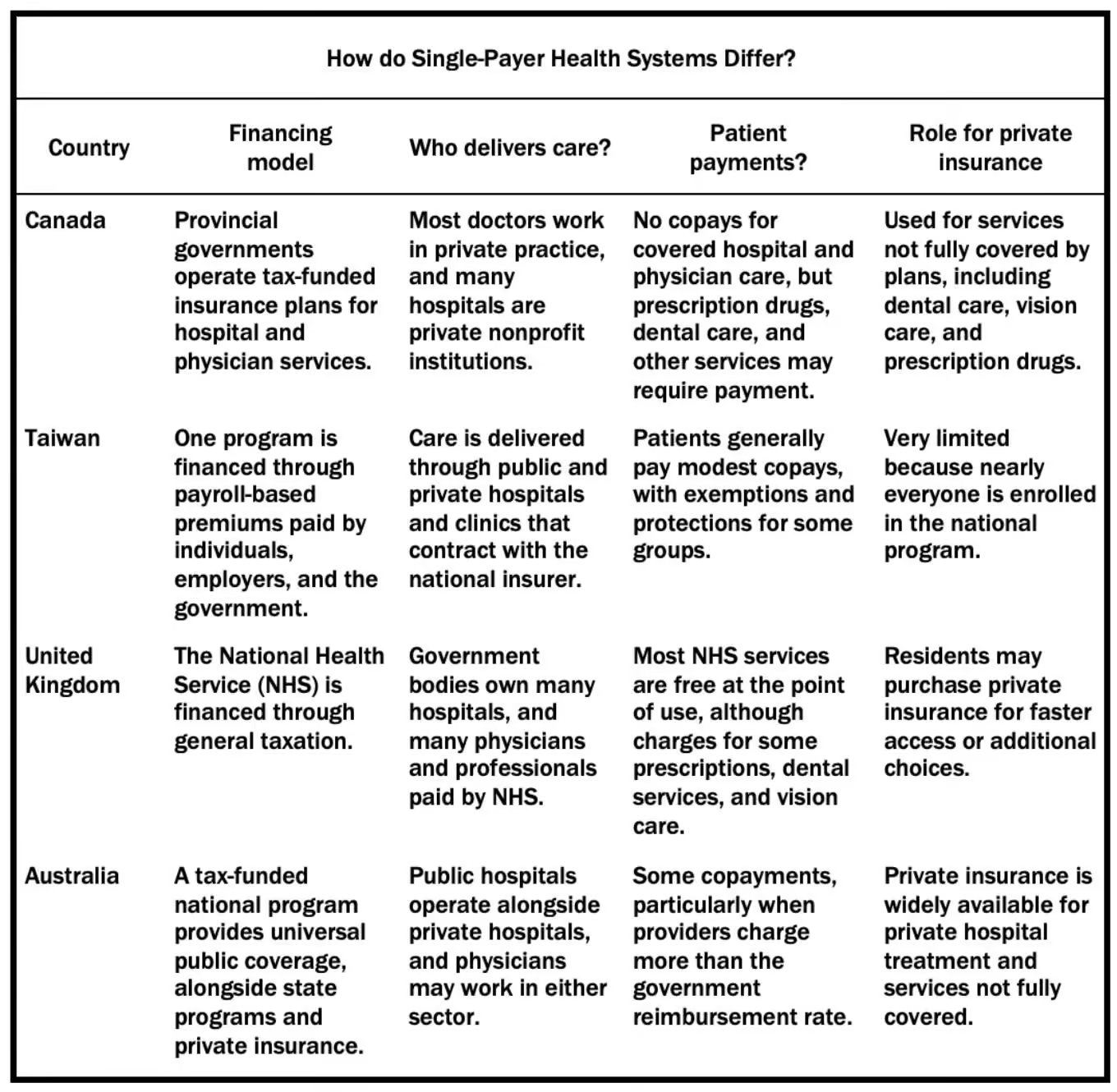
The Medicare-for-all proposal described in our previous brief most closely resembles the Canadian or Taiwanese programs. However, the examples show that there are many other ways to implement single-payer, with the United Kingdom’s NHS system being an exception in its reliance on government employees and facilities to provide healthcare.
How would single-payer be financed?
Currently, most working Americans buy insurance coverage from private companies, with rates reduced by an employer subsidy. In the case of Medicare (for seniors), Medicaid (for the poor and disabled), Tricare (for active military), and the Veterans Administration Healthcare programs (for retired military), the insurer is the government, with individuals paying insurance premiums directly to the government. There are many different ways to implement a single-payer system, as shown below.
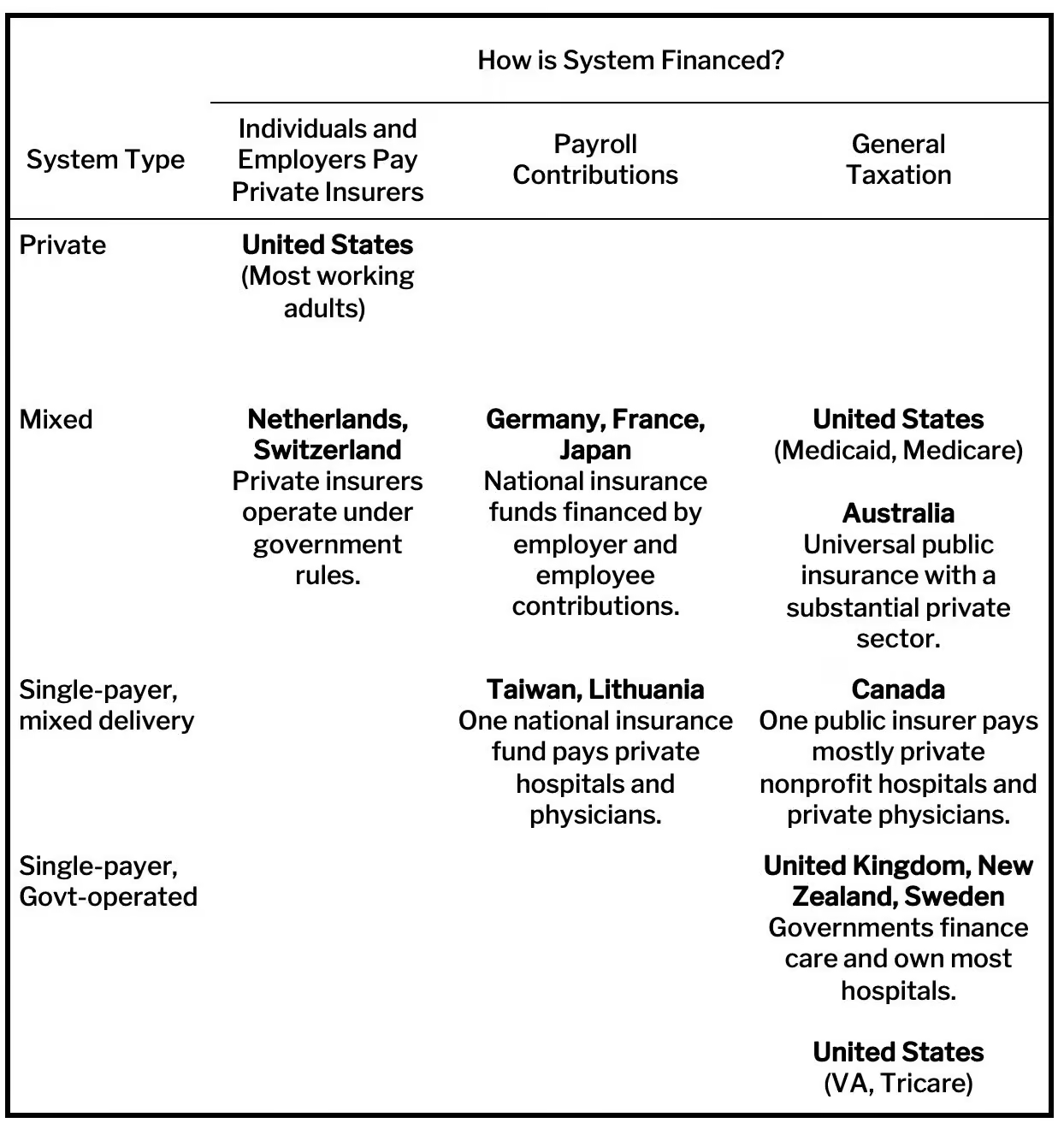
As the table shows, the international experience does not offer a single-payer payment blueprint. For instance, Canada separates public insurance from mostly private delivery. Taiwan operates one national insurance program funded in part by premiums and in part through payroll contributions. The United Kingdom combines public financing with substantial public ownership and employment. Australia maintains universal public insurance while allowing a larger parallel private-insurance market. These choices affect how much households pay directly, how providers are reimbursed, and how much control the government exercises over health care spending.
It is also important to note that the U.S. already has operational single-payer systems, including Medicare, Medicaid, Tricare, and the VA system. Here again, the lesson is that Medicare-for-all (which would resemble the existing Medicare program) is not the only way to implement single-payer in the U.S.
The Takeaway
While the proposed Medicare-for-all system is one way to implement single-payer healthcare, it is not the only option. Other countries vary in how they finance and deliver healthcare, suggesting that other options might work in the U.S. as well.
While most working Americans receive healthcare through their employment, there already exists large single-payer systems in America, used to provide healthcare to seniors, the poor and disabled, and active and retired military. These programs offer an alternate model for single-payer healthcare in the U.S. vs. the Medicare-for-all proposal.
Enjoying this content? Support our mission through financial support.
Further reading
Swagel, P. (2020). How CBO Analyzes Proposals for a Single-Payer Health Care System. CBO. https://tinyurl.com/ydvsrpu9, accessed 07/25/26.
Blumenthal, D., Gumas, E. D., Shah, A., Gunja, M. Z., & Williams, R. D., II. (2024). Mirror, Mirror 2024: A Portrait of the Failing U.S. Health System. https://tinyurl.com/2cabm5dv, accessed 07/25/26.
Sources
Wager, E., & Cox, C. (2025). International Comparison of Health Systems. KFF. https://tinyurl.com/4kct24mu, accessed 07/25/26.
KFF Health News. (2026). Diagnosis: Debt. https://tinyurl.com/vv7w7x7b, accessed 07/25/26.
World Health Organization. (2026). Global Health Expenditure Database. https://tinyurl.com/487b8eud, accessed 07/25/26.
Canadian Medical Association. (2025). How is health care funded in Canada? https://tinyurl.com/47bbxmm9, accessed 07/25/26.
The Commonwealth Fund. (2026). Taiwan. https://tinyurl.com/3ermdww9, accessed 07/25/26.
The Commonwealth Fund. (2026). International Health Care System Profiles. https://tinyurl.com/249ch5s3, accessed 07/25/26.
CMS.gov. (2025). National Health Expenditure Data. https://tinyurl.com/4xewypsd, accessed 07/25/26.
Cai, C., Runte, J., Ostrer, I., Berry, K., Ponce, N., Rodriguez, M., Bertozzi, S., White, J. S., & Khan, J. G. (2020). Projected costs of single-payer healthcare financing in the United States: A systematic review of economic analyses. https://tinyurl.com/2uzsce7e, accessed 07/25/26.
Swagel, P. (2020). How CBO Analyzes Proposals for a Single-Payer Health Care System. CBO. https://tinyurl.com/ydvsrpu9, accessed 07/25/26.
Bunch, L. N., & Ketema, H. (2025). Health Insurance Coverage in the United States: 2024. https://tinyurl.com/3u6zhzd7, accessed 07/25/26.
Contributors
Lindsey Cormack (Content Lead) is an Associate Professor of Political Science at Stevens Institute of Technology and the Director of DCinbox, a comprehensive digital archive of Congress-to-constituent e-newsletters. She received her PhD from New York University. Her research explores congressional communication, civic education, and electoral systems. Lindsey is the author of How to Raise a Citizen (And Why It’s Up to You to Do It) and Congress and U.S. Veterans: From the GI Bill to the VA Crisis. Her work has been featured in The New York Times, The Washington Post, Bloomberg Businessweek, Big Think, and more. With a drive for connecting academic insights to real-world challenges, she collaborates with schools, communities, and parent groups to enhance civic participation and understanding.
William Bianco (Research Director) is Professor of Political Science at Indiana University and Founding Director of the Indiana Political Analytics Workshop. He received his PhD from the University of Rochester. His teaching focuses on first-year students and the Introduction to American Government class, emphasizing quantitative literacy. He is the co-author of American Politics Today, an introductory textbook published by W. W. Norton, now in its 8th edition, and authored a second textbook, American Politics: Strategy and Choice. His research program is on American politics, including Trust: Representatives and Constituents and numerous articles. He was also the PI or Co-PI for seven National Science Foundation grants and a current grant from the Russell Sage Foundation on the sources of inequalities in federal COVID assistance programs. His op-eds have been published in The Washington Post, Indianapolis Star, Newsday, and other venues.