


What you need to know
The 2026 U.S. Midterm Elections occurred on November 3, 2026. In this brief, we give a preliminary summary of the results, present campaign spending data, and discuss the implications for policy change in the upcoming 120th Congress.
What Happened in the 2026 Midterm Elections?
While some races are still being decided, Democrats gained majority control of both the House and the Senate. Based on available data as of Wednesday, November 4, analysis by Everything Policy indicates that Democrats will have at least 245 House seats and at least 51 Senate seats. These results give Democrats a clear majority in both chambers. While 51 seats is a bare Senate majority, three Senators (Hamilton of Kansas, King of Maine, and Sanders of Vermont) identify as Independents but are expected to vote with Democrats to form the Senate majority.
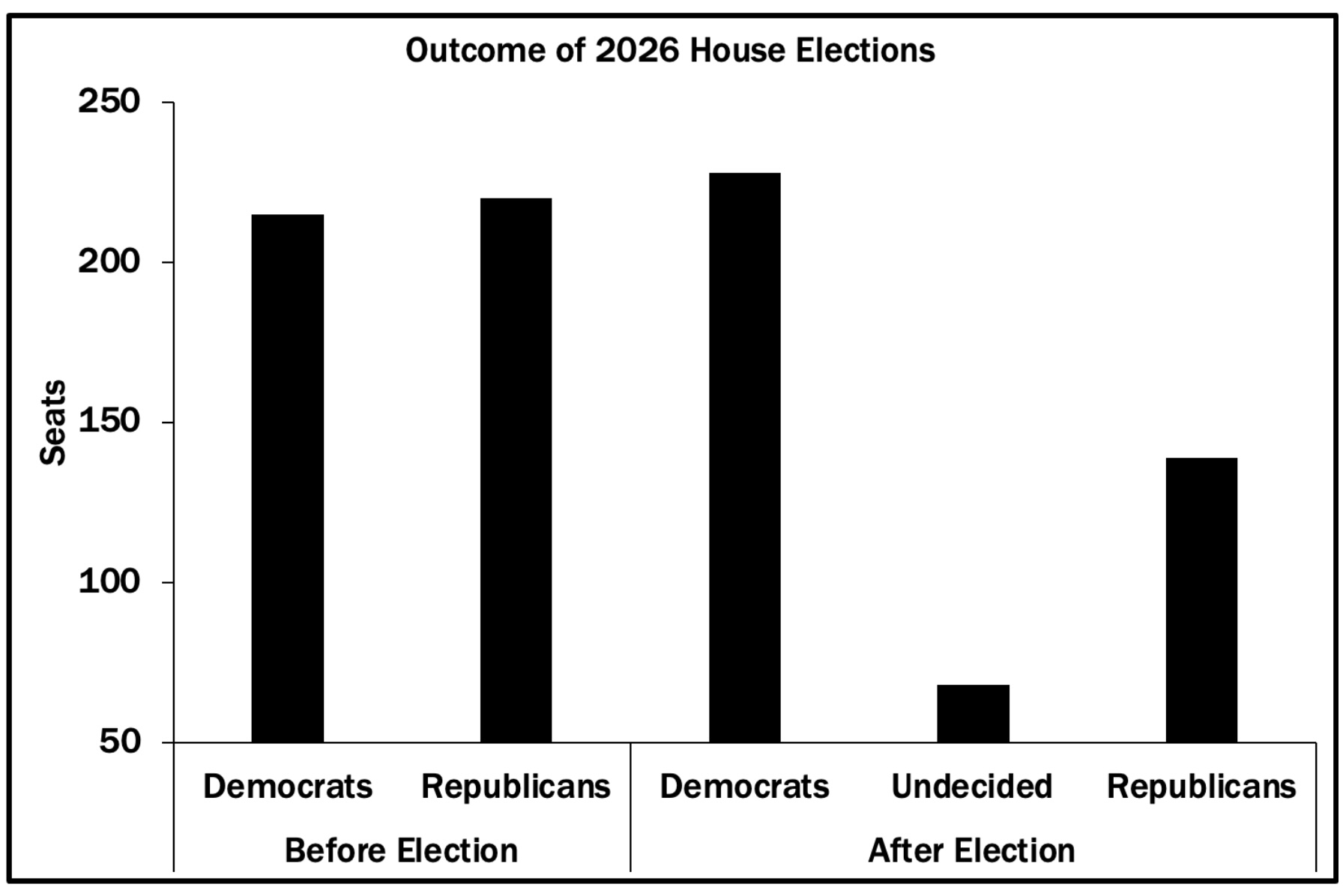
As we discussed in a previous brief, Republicans held a narrow advantage in the pre-election House, and the President’s party almost always loses seats in midterm elections. However, in the Senate, Republicans entered the midterms with a 53–47 majority, with only one contest (Senator Collins in Maine) in a state where Democrats won a majority of presidential votes in 2020.
Political scientists will need to study these results to understand the forces driving House and Senate contests. However, Everything Policy’s preliminary analysis of both Fox News and CNN exit poll data suggests Democratic victories were driven by voters’ concerns about the economy and disapproval of President Trump’s performance in office.
Campaign Finance: Individuals and Super PACs in 2026
OpenSecrets, a nonpartisan research organization, estimates that total spending in the 2026 midterms will reach a record-setting $14 billion.
Early data suggests individual donors and Super PACs continued to dominate campaign financing in the 2026 midterms. Individual contributions are those made by citizens to candidates or political parties. PACs (Political Action Committees) also contribute directly to candidates or parties. In 2026, individuals could contribute up to $3,500 per election to a candidate or party, while PACs were limited to $5,000. Super PACs are different. They are allowed to spend unlimited funds on campaign ads if their efforts are independent (not directly coordinated with) a party’s or a candidate’s campaign.
The figure below shows total individual and PAC direct contributions, as well as Super PAC independent expenditures. The totals are through June 2026, and exclude contributions and spending in the last four months of the election cycle, when significant sums are often spent.
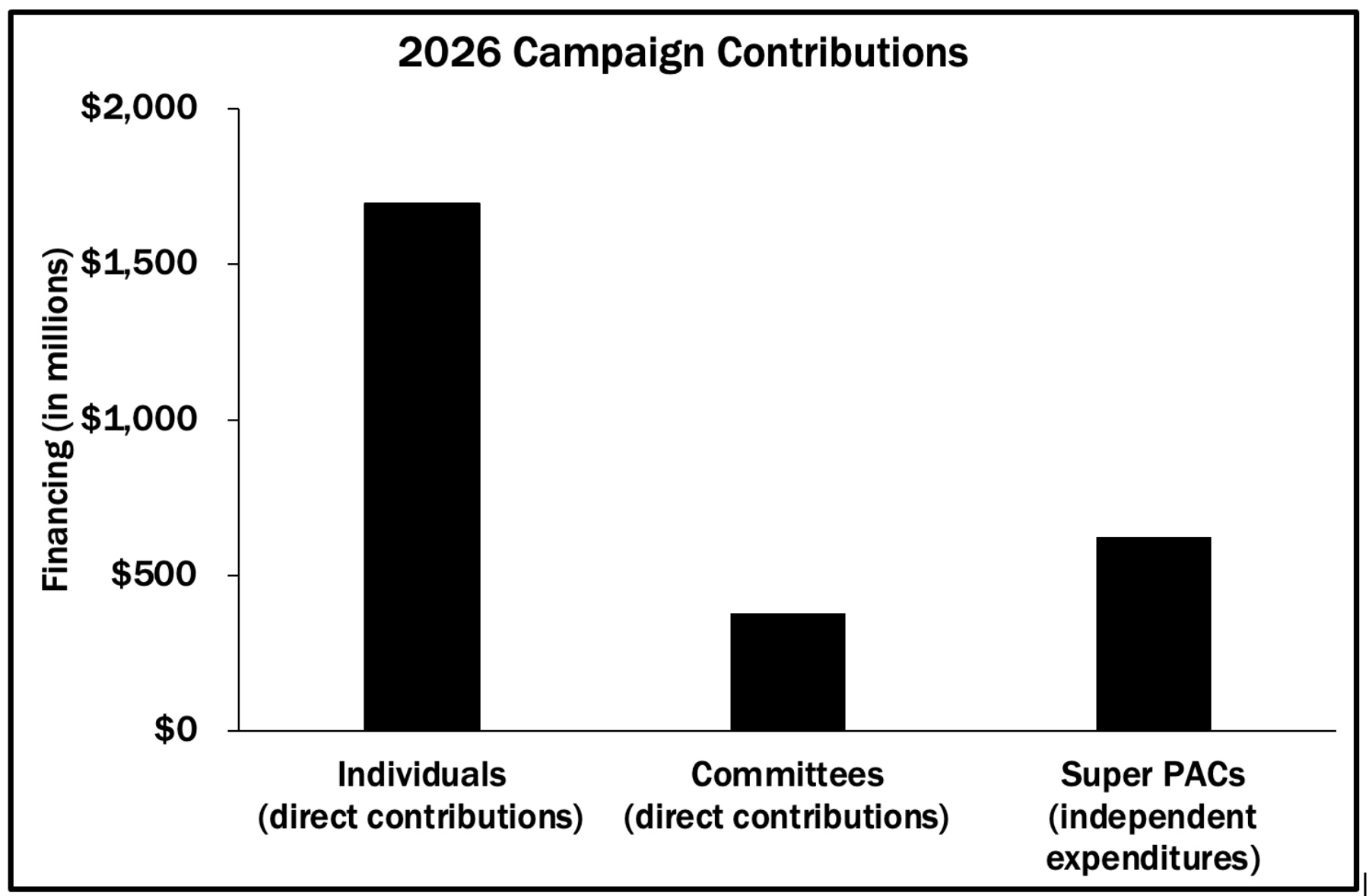
The charts show a consistent pattern: individual contributions and independent expenditures dominate modern campaign financing. Apart from the money spent in the last four months, individual contributions total nearly $1.7 billion – just $300 million less than the final totals in 2018 and 2022. Independent expenditures, on the other hand, totaled$624 million – much lower than recent midterms. It is likely that this number will increase significantly – probably exceeding 2018 and 2022 totals – once full data is available (see below).
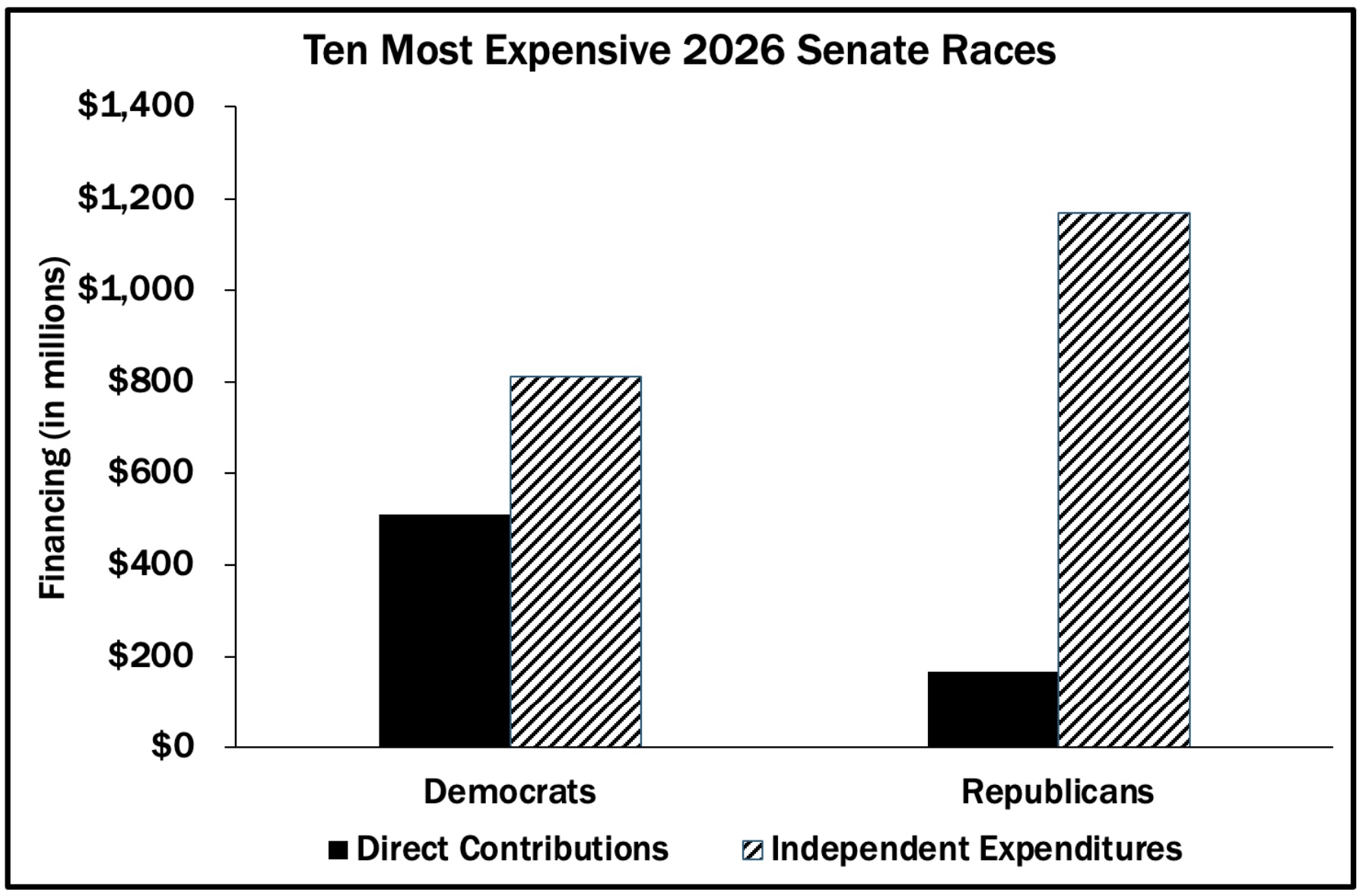
One potential reason for such strong individual contribution numbers is the fact that the 2026 midterms have been framed as an incredibly high-stakes election. Individual donors are motivated to contribute when campaigns stoke their emotions – outrage, fear, hope, and more. In the most competitive races, Democratic candidates have raised significantly more in direct contributions than Republicans. In contrast, Republicans have benefitted more from independent spending.
This can be seen in the figure below, which shows total direct contributions (using FEC records) and outside spending (using OpenSecrets data) by party through October 2026 in the ten most expensive US Senate races. Independent expenditures benefitting Democrats include spending in support of the Democratic candidate or opposing the Republican candidate, and vice versa for pro-Republican spending.
What Happens Next?
The upcoming 120th Congress will feature divided government, meaning one major party controls the presidency and the other controls at least one house of Congress. Under these conditions, enacting legislation requires a bipartisan coalition of Democrats and Republicans. In recent years, the only major legislation enacted under a divided government was the COVID assistance package (the CARES Act) enacted in Spring 2020.
This record suggests that in the upcoming Congress, major initiatives like Medicare for All, substantial increases in defense spending, or the deficit-reduction packages discussed in our recent brief are unlikely to pass. These measures may be debated and voted on, allowing the parties to signal their priorities to voters, but enactment will likely require a unified government. The only exception would be a national emergency such as COVID that requires immediate action and overrides partisan differences.
For the same reasons, Senate Democrats are unlikely to remove the filibuster from Senate rules, a procedure that allows opposing senators to delay or block legislation by preventing a final vote. Removal of the filibuster would allow them to enact legislation with 51 votes instead of 60. However, because President Trump can block legislation with his veto power, and a veto override requires 67 votes in the Senate, removing the filibuster would likely not help Democrats enact their policy priorities. The topic of removing the filibuster has been widely debated and carries a broad range of potential impacts. Arguments for eliminating the filibuster include potentially reducing legislative gridlock, improving accountability, and possibly lessening the increasingly partisan Senate. Arguments against eliminating it include potentially further protecting the minority party’s interests, preventing rapid policy reversals, and limiting concentrated political power.
The Takeaway
Democrats gained majority control of the House and Senate in the 2026 midterms.
Since Republicans still control the Presidency, the upcoming Congress is unlikely to enact major policy changes.
Most modern campaigns are financed by direct contributions from individuals and independent expenditures by Super PACs. Early data suggests the 2026 midterms followed this trend.
Enjoying this content? Support our mission through financial support.
Further reading
Albert, Z., & La Raja, R. J. (2026). Small Donors in US Politics: Myth and Reality. University of Chicago Press. https://tinyurl.com/bdcm2a56, accessed 10/30/26.
OpenSecrets. (2026). Outside Spending by Race. https://tinyurl.com/4st9vhrj, accessed 11/2/26.
Sources
Federal Election Commission (2026a). Candidates for Senate. https://tinyurl.com/2uxv5yn3, accessed 11/2/26.
Federal Election Commission (2026b). Congressional Candidate Table 1: House and Senate Financial Activity From January 1, 2025 through June 30, 2026. https://tinyurl.com/3pxtez8r, accessed 10/30/26.
Federal Election Commission (2026c). Independent Expenditure Table 3: Independent Expenditures Made For or Against Congressional Candidates, January 1, 2025 through June 30, 2026. https://tinyurl.com/3u9x8kvv, accessed 10/30/26.
Glavin, B., Mayersohn, A., Weber, D., & Mitchell, J. (2026). OpenSecrets predicts record $12 billion in midterm election spending. https://tinyurl.com/3v76rrp8, accessed 11/2/26.
OpenSecrets. (2026). Outside Spending by Race. https://tinyurl.com/4st9vhrj, accessed 11/2/26.
Schleifer, T., & Zdun, M. (2026). Campaigns Spend Over $1 Billion Over Two Weeks in Final Search for Votes. New York Times. https://tinyurl.com/2mvp922s, accessed 10/30/26.
Victor, J. N. (2026). Democrats fund their candidates. Republicans fund their cause. Mischiefs of Faction. https://tinyurl.com/r2nu5t2e, accessed 10/30/26.
CNN (2026) An electorate unhappy with Trump and the economy hands Congress to Democrats, CNN Voter Poll shows. https://tinyurl.com/ydphsktt, accessed 11/4/26
Fox News (2026) Fox News Voter Poll, https://tinyurl.com/2ytj3esc, accessed 11/4/26.
Contributors
Zachary Albert (Content Lead) is Assistant Professor of Politics at Brandeis University. He received his PhD from the University of Massachusetts Amherst. His research focuses on elections, political parties, and public policymaking in American politics. He is the author of Partisan Policy Networks (2025), Small Donors in US Politics (2026), and numerous peer-reviewed journal articles. He has also published op-eds and reports for the Brookings Institution, the Bipartisan Policy Center, The Conversation, and other venues. In the classroom, Albert teaches classes on American elections, political parties, public policy, and quantitative methods, in addition to running the Politics Department internship program.
David T. Canon (Content Lead) is a professor emeritus in the political science department at the University of Wisconsin, Madison. He received his Ph.D. from the University of Minnesota and previously taught at Duke University. He also served as the Distinguished Fulbright Chair in Tübingen, Germany in 2011-2012 and Debrecen, Hungary in 2003-2004. His teaching and research interests are in American political institutions, especially Congress. His more specific research interests include election administration, racial representation, redistricting, political careers, and the historical study of Congress. He is author of Race, Redistricting, and Representation (University of Chicago Press, 1999, winner of the Richard F. Fenno Award for the best book on legislative politics), The Dysfunctional Congress? The Individual Roots of an Institutional Dilemma (with Ken Mayer; Westview Press, 1999), Actors, Athletes, and Astronauts: Political Amateurs in the U.S. Congress (University of Chicago Press, 1990), American Politics Today (with William Bianco, WW Norton, 2025, 8th edition), several edited books, and various journal articles and book chapters.
William Bianco (Research Director) is Professor of Political Science at Indiana University and Founding Director of the Indiana Political Analytics Workshop. He received his PhD from the University of Rochester. His teaching focuses on first-year students and the Introduction to American Government class. He is the co-author of American Politics Today, an introductory textbook published by W. W. Norton, now in its 9th edition, and authored a second textbook, American Politics: Strategy and Choice. His research program is on American politics, including Trust: Representatives and Constituents, and numerous articles. His op-eds have been published in the Washington Post, the Indianapolis Star, Newsday, and other venues.