


What you need to know
In analyzing public policy, one of the most important distinctions is between opinions and facts. This brief defines these terms, using health care for the undocumented as an illustration of how they differ and why the differences matter.
Facts and Opinions
Everything Policy’s approach to contemporary policy issues is illustrated by a quote from the late Senator Daniel Patrick Moynihan: “Everyone is entitled to their own opinions, but not to their own facts.” We research, analyze, and publish facts – verifiable information about a policy topic. We leave it to our audience to make up their own minds – to form their opinions.
Our firm belief is that knowledge of the facts is key to a well-functioning democracy. Facts provide a basis for civil discourse. They provide a common understanding that is necessary for working out differences. Knowing the facts also helps people effectively express their demands about policy change or evaluate what elected officials do in their name.
Knowing the facts will not always generate agreement. Even in a world where everyone is well-informed, people could use the same facts to arrive at different conclusions about the merits of a policy. However, information mitigates disagreements arising from misunderstandings or misperceptions. It highlights the consequences of different policy choices. And it helps to identify possible compromises that everyone can live with, even if their opinions differ.
An Example: Health Care for the Undocumented
In a recent brief, we analyzed claims that undocumented individuals are receiving government-funded healthcare in hospital emergency rooms. Under federal law (EMTALA, the Emergency Medical Treatment & Labor Act), hospitals are required to provide emergency treatment (including labor and delivery) to everyone, regardless of their ability to pay or citizenship status, with costs covered by the federal government through the Medicaid program.
Hospital obligations under EMTALA are limited to stabilizing patients. They are not obligated to treat underlying conditions or provide routine care. In fact, under EMTALA, if an initial examination reveals no emergency, the government will not reimburse the hospital for any care that is provided.
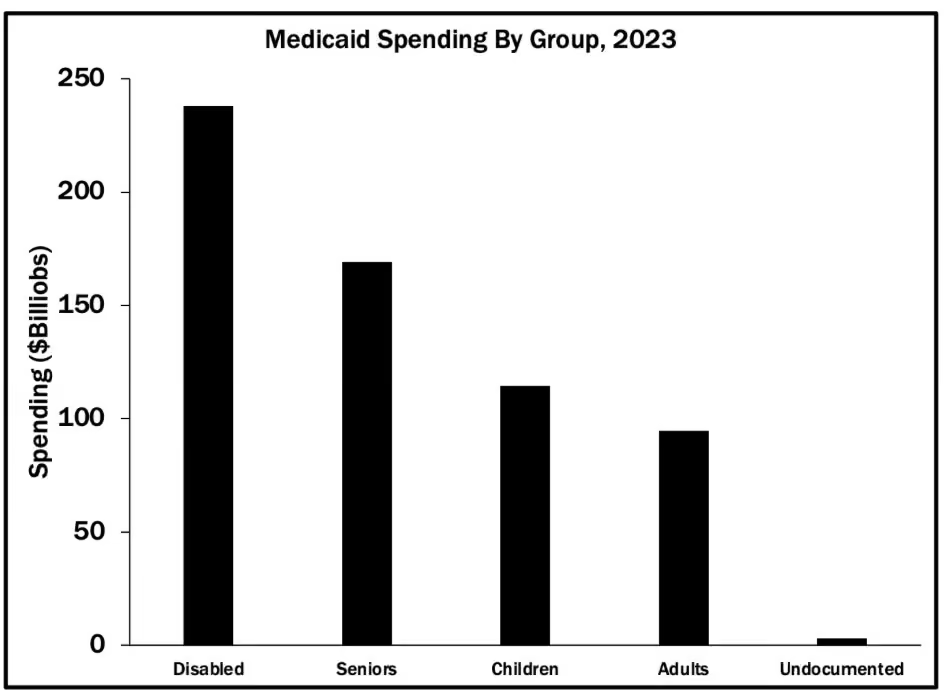
The chart below shows Medicaid spending in 2023 for different groups. The largest spending categories are for the disabled and seniors. Health care for the undocumented accounts for a very small share of the Medicaid program. (The chart omits Medicaid spending on Affordable Care Act subsidies, as these expired at the end of 2025; see our brief for details).
In addition to EMTALA, some states (California, Colorado, Connecticut, Illinois, Maine, Massachusetts, Minnesota, New Jersey, New York, Oregon, Rhode Island, Utah, Vermont, Washington, and D.C) pay for health care for undocumented children, and a smaller number (California, Colorado, Illinois, Minnesota, New York, Oregon, Washington, and D.C.) cover some undocumented adults. Some private and public medical facilities also use their own funds to pay for undocumented health care.
What Do the Facts Tell Us?
None of these facts about EMTALA answers the question of whether undocumented individuals should receive medical care and who should pay for it. Someone can reasonably conclude that it is wrong for the government to spend anything on the undocumented. A second person might look at the same facts and conclude that the government should provide health care to everyone, regardless of their citizenship. Both opinions, as well as many in between, are equally consistent with the facts.
However, the facts help us understand the implications of different opinions. First, at least at the federal level, spending on undocumented health care is not a major burden. It amounts to .4% of expenditures on Medicaid, the federal health program for the poor. An individual can certainly believe that not even one federal dollar should be spent on undocumented health care. But it is not accurate to say that the EMTALA is bankrupting the federal government.
Second, the facts show that under certain circumstances, it is entirely legal for the undocumented to receive free health care. Whether some undocumented individuals manage to evade EMTALA restrictions to receive federally funded nonemergency care is an open question. But the fact that they are receiving care is not evidence of illegality.
Third, the facts highlight the harsh policy tradeoffs that underlie policies like EMTALA. It is certainly possible to require Americans to document their citizenship status when accessing medical care, and to mandate that people who cannot prove their citizenship status be turned away, even in emergency situations. Such a policy would end federal healthcare spending for the undocumented, but it would also affect many citizens who arrived at an emergency room without sufficient identification.
The Takeaway
Facts give us a basis for our opinions – for deciding what we think the government should do.
Facts don’t tell us what opinions we should hold, but they help us understand the implications of different policy choices.
Understanding the facts in a policy area is a first step towards civil discourse with people who hold different opinions.
Enjoying this content? Support our mission through financial support.
Further reading
Centers for Medicare and Medicaid Services. (2026) Emergency Medical Treatment & Labor Act (EMTALA), https://tinyurl.com/4839ycex, accessed 4/15/26
Wampler, D., & Wang, H. E. (2021). Emergency care for undocumented immigrants. Journal of the American College of Emergency Physicians Open, 2(3), e12481.
Sources
Mejia, R. (2007). Emergency care for the undocumented: who bears the burden and where to draw the line?. Annals of emergency medicine, 50(4), 445-447.
Centers for Medicare and Medicaid Services. (2026) Emergency Medical Treatment & Labor Act (EMTALA), https://tinyurl.com/4839ycex, accessed 4/15/26
Wampler, D., & Wang, H. E. (2021). Emergency care for undocumented immigrants. Journal of the American College of Emergency Physicians Open, 2(3), e12481
Samra, S., Taira, B. R., Pinheiro, E., Trotzky-Sirr, R., & Schneberk, T. (2019). Undocumented patients in the emergency department: challenges and opportunities. Western Journal of Emergency Medicine, 20(5), 791.
Kaiser Family Foundation. (2025) Key Facts on Health Coverage of Immigrants, https://www.kff.org/racial-equity-and-health-policy/key-facts-on-health-coverage-of-immigrants, accessed 4/15/26
Kaiser Family Foundation (2026) Medicaid Spoending by Enrollment Group https://www.kff.org/medicaid/state-indicator/medicaid-spending-by-enrollment-group/, accessed 4/15/26
Moynihan, Daniel Patrick. (1983) "More Than Social Security Was at Stake," The Washington Post, January 16, 1983, available at https://tinyurl.com/3trarh8b, accessed 4/16/26.
Contributors
William Bianco (Research Director) is Professor of Political Science at Indiana University and Founding Director of the Indiana Political Analytics Workshop. He received his PhD from the University of Rochester. His teaching focuses on first-year students and the Introduction to American Government class, emphasizing quantitative literacy. He is the co-author of American Politics Today, an introductory textbook published by W. W. Norton now in its 9th edition, and authored a second textbook, American Politics: Strategy and Choice. His research program is on American politics, including Trust: Representatives and Constituents and numerous articles. His op-eds have been published in the Washington Post, Indianapolis Star, Newsday, and other venues.