In November 2026, the U.S. will hold midterm congressional elections. Potential outcomes range from a continued Republican unified government (control of the Presidency, House, and Senate) to a divided government in which President Trump faces Democratic majorities in the House and/or Senate. This brief considers how predictions have changed since our last update in April 2026.
Thank you! Your submission has been received!
Oops! Something went wrong while submitting the form.
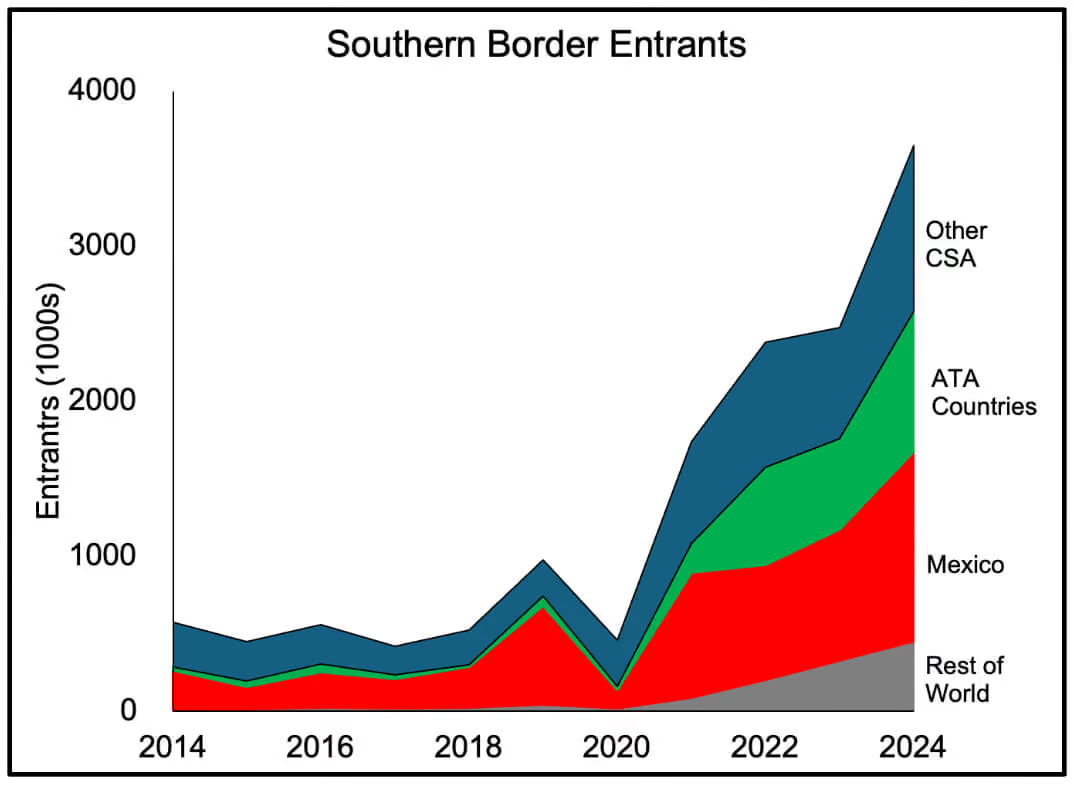
The figure below shows the top 10 countries of origin for southern border entries from 2014 to 2024 (the 2024 data is annualized based on January - May entries). It is based on official Department of Homeland Security (DHS) reports of entries at official border crossings and arrests of people crossing the border elsewhere.
The Advance Travel Authorization (ATA) countries are Cuba, Haiti, Nicaragua, and Venezuela, whose citizens are eligible for ATA, which allows them to enter the U.S. automatically and work while their asylum claims are decided. “Other CSA” refers to other countries in Central and South America.
Source: Department of Homeland Security (2024)
The figure shows the dramatic increase in migration to the U.S. over the last decade. Pre-pandemic, the majority of entrants were from Mexico. Now, migrants are coming from a much wider range of countries, both the ATA countries and other places such as Columbia (330 entrants in 2014 vs. 219,120 in 2024).
Why are migrants coming to the US?
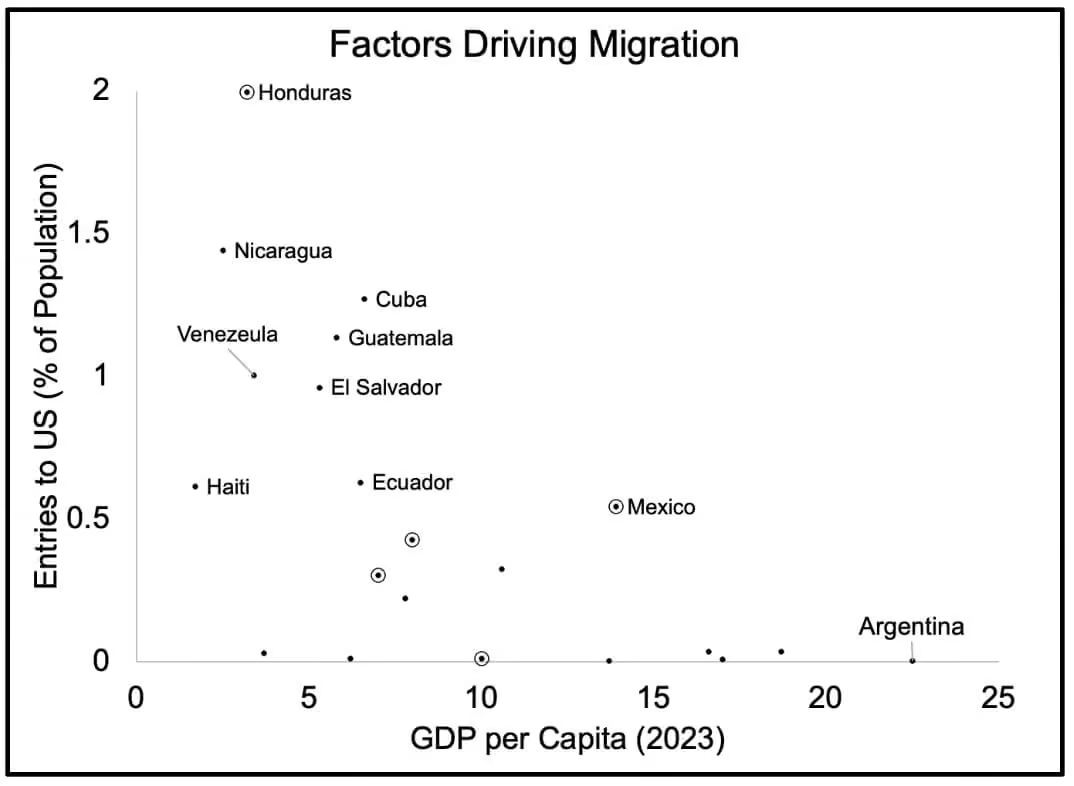
Research shows that migration is often the result of quality-of-life issues, most notably poor economic conditions. The figure below illustrates this point using DHS migration data from Central and South American countries. The data point for each country shows its GDP per capita (2023 data) on the x-axis – this variable measures the strength of a country’s economy and the quality of life that its citizens can expect. The y-axis shows the percentage of the country’s population that entered the U.S. through America’s southern border in 2023.
Source: Analysis by Everything Policy based on data from DHS (2024), International Monetary Fund (2024), World Bank (2024), and Freedom House (2024)
The chart highlights the countries with a high percentage of migrants, including Honduras, Nicaragua, Cuba, Guatemala, Venezuela, and El Salvador. The chart shows why migrants are more likely to come from these countries than others. These eight countries are all relatively poor, with a GDP per capita of less than $10 thousand. (In contrast, the U.S. GDP per capita is over $80 thousand.) On the other hand, countries with stronger economies, such as Argentina, with a GDP of more than $20 thousand per capita, have virtually no migration to the U.S.
Other reasons for migration include fears of crime and living under an authoritarian political regime. For example, Honduras, which of the nations examined here had the highest rate of migration to the U.S. in 2023, also had one of the highest murder rates in the world – 38.3 per 1000 compared to 6.8 per 1000 in the U.S. The same is true for Mexico. High migration rates from Cuba, Haiti, Nicaragua, and Venezuela, in part, are driven by repressive governments that imprison citizens (all are rated as “Not Free” by Freedom House, a respected NGO that evaluates political freedoms in countries throughout the world).
The Take-Away
The U.S. faces an ongoing problem: many Central and South American people want to immigrate to America. Our recent analysis shows that new policies are reducing the number of migrants, at least for now.
This brief expands on the earlier analysis to show how quality-of-life issues drive migration decisions. Migrants are not just coming from Haiti, Cuba, and Venezuela. Rather, migration is happening throughout Central and South America from countries with weak economies, high crime rates, and repressive political regimes.
It is an open question whether the U.S. should assist countries in Central and South America with improving the quality of life of their citizens. Our findings raise the issue that if improvements do not happen, would-be migrants may find new ways to evade restrictions on the southern border, leading to increased entries and a continued border crisis.
When the federal budget is higher than tax revenue received in a given year, the federal government has a budget deficit and the Treasury Department issues bonds to make up the difference. Investors—people, other governments, and financial companies—buy these bonds because they offer a fixed and guaranteed interest rate (typically in the 2-5% range). These bonds cover the difference in spending vs. tax revenue, but lead to an increase in the national debt, which is the sum of every year’s deficit plus the interest owed on the money borrowed.
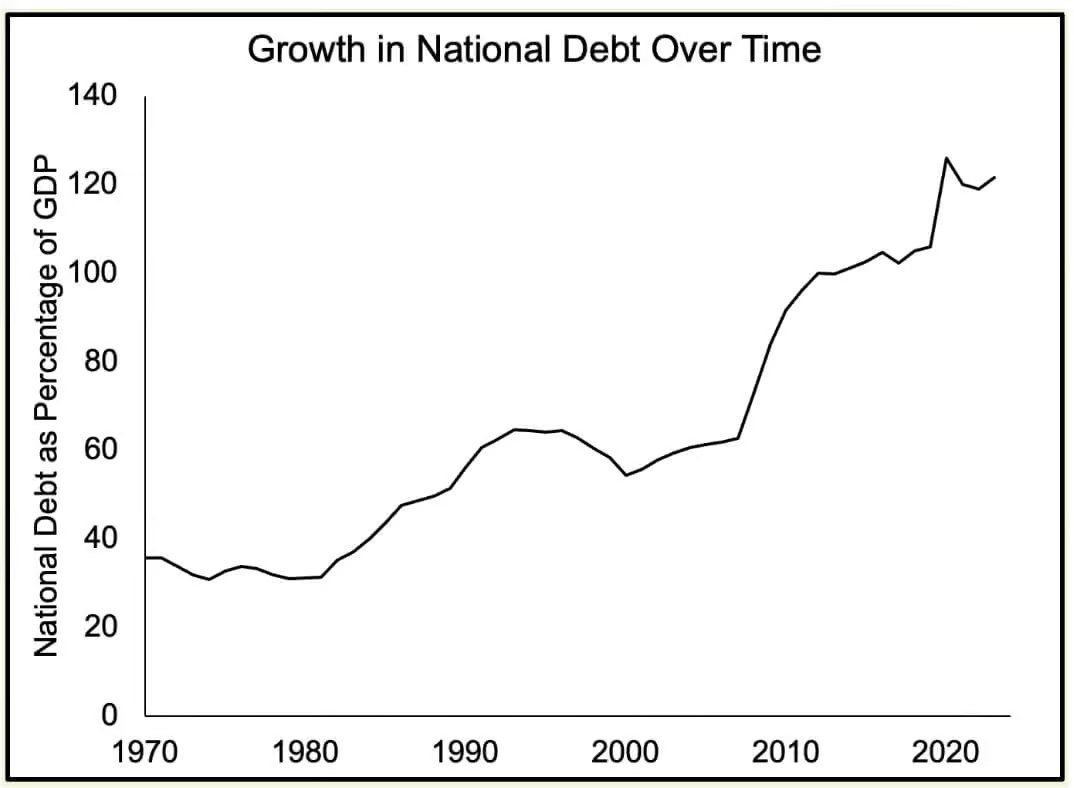
The standard way to measure the size of the national debt is as a percentage of Gross Domestic Product (GDP), the amount of goods and services produced by the U.S. economy. After an increase during World War II, the national debt was about 40% of GDP until about 1980. Since then, however, the debt has steadily increased, exceeding 100% of GDP in recent years, as shown in the figure below.
Source: Federal Reserve Bank of St. Louis (2024)
The 100% debt to GDP level is seen by some economists as the point where the national debt should begin to have significant negative effects. However, despite the national debt being over this level since 2010 or so, these effects have not been observed. Except for a brief spike in inflation and interest rates caused by supply chain disruptions during the COVID pandemic (see our Inflation brief for details), Americans have generally enjoyed low unemployment, moderate economic growth, and a rising stock market.
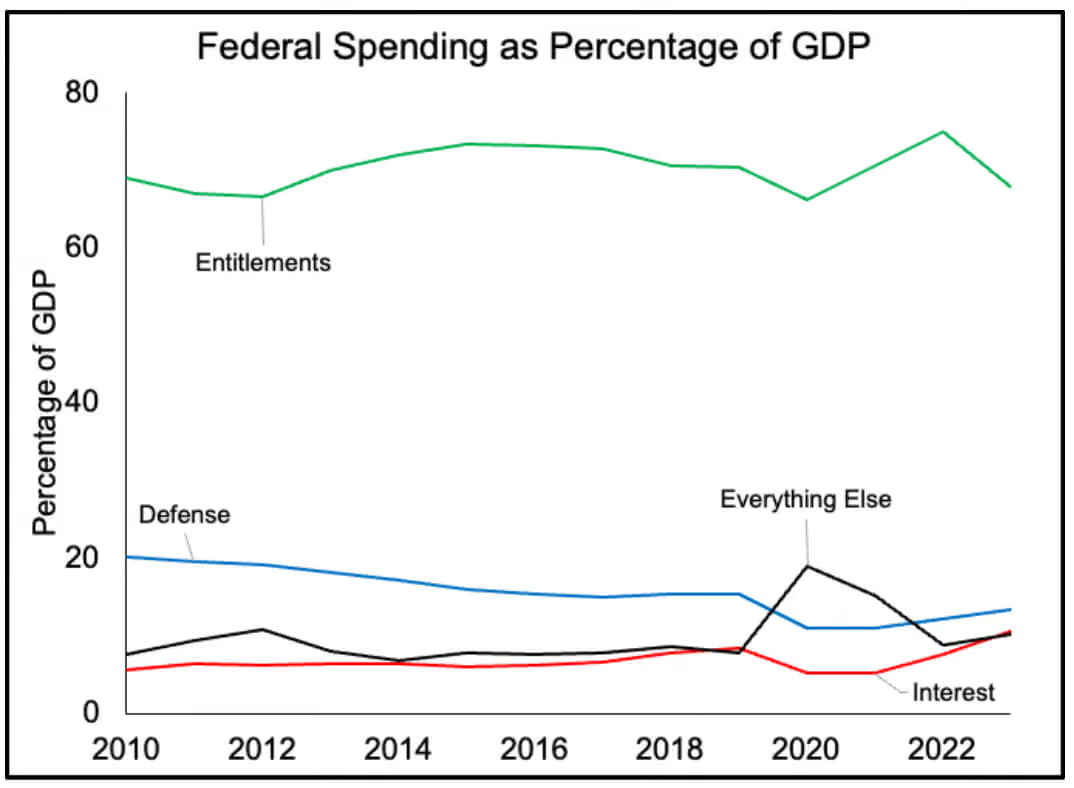
Moreover, as the figure below shows, the increasing debt has not affected the distribution of federal spending. The figure aggregates spending into four categories: entitlements (Social Security, Medicare, Medicaid, etc.), defense, interest payments on the debt, and everything else. For details on each type of spending, see our policy briefs on federal spending.
The figure shows that the percentages of GDP spent on each category are roughly the same over time. There are two exceptions: (1) a spike in spending on non-defense, non-entitlement programs in 2020-21 due to COVID assistance programs and (2) a slight increase in interest payments beginning in 2021, due to the higher interest rates on government bonds used to finance the deficit.
Source: White House (2024)
Why The Debt Matters
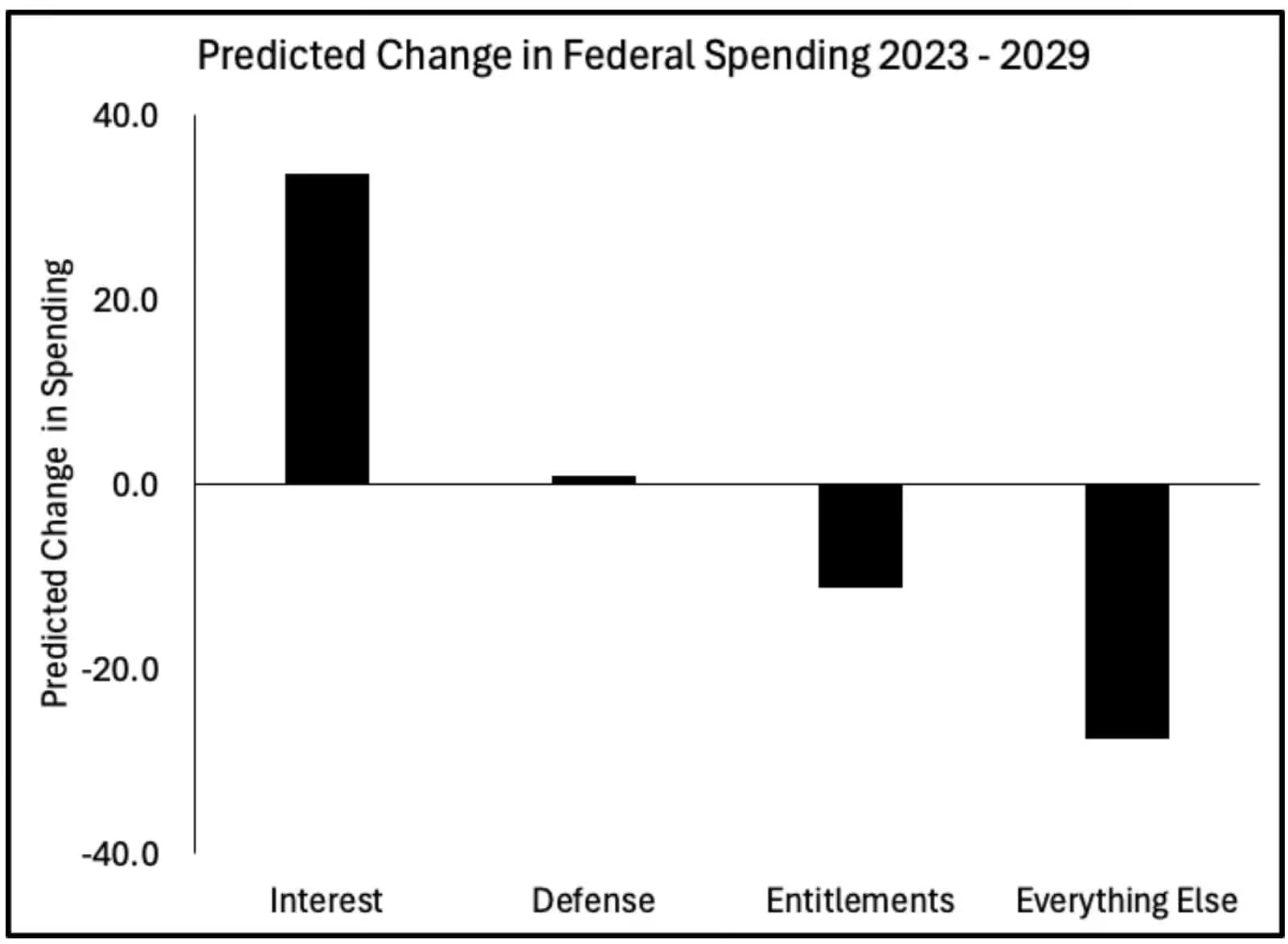
The stability in federal spending levels is about to change. The chart below shows the predicted change in actual spending in 2023 versus projected spending for 2029 – five years from now.
Source: White House (2024)
Over the next five years, interest payments will increase almost 30 percent due to the increased size of the national debt and the higher expected interest rates that will be paid on government bonds. The chart shows how this increase will affect spending on other non-interest payment categories if no significant changes are made to policies regarding taxing and spending. The likely outcome - Defense spending will increase by only 1 percent. Entitlement spending will decline by almost 10 percent. And spending on all other government programs will decrease by over 30 percent.
The Take-Away
While the increasing national debt has not yet damaged the American economy, it is about to have a serious impact on federal spending. As debt payments increase, spending on all other programs will be crowded out. With the exception of defense spending, every other federal program will see spending cuts, in most cases at a severe level.
Cutting the national debt will require painful choices to raise taxes and / or cut spending, requiring a debate over what the government should and should not do. Our brief shows that if these choices are not made, increasing debt payments will constrain virtually every non-defense federal program, without regard to the priorities held by the American public.
The measures implemented in recent months include the following:
Increased border patrols to reduce unauthorized entries
Increased border agents at ports of entry to reduce processing times
People who try to enter the U.S. illegally cannot make a subsequent asylum claim
Individuals who were found to be threats to public safety or national security are subject to expedited deportation
Changes to the asylum process to reduce processing time
Informal agreements with the Mexican government to reduce the flow of people entering the U.S.
These changes are designed to reduce legal and illegal border entries by (a) reducing the flow of people traveling from Mexico to the U.S. border, (b) increasing the chances that people trying to cross the border illegally will be apprehended, and (c) reducing the number of people living in the U.S. while their asylum claims are being decided.
How can we assess the effectiveness of the new border policies?
None of these changes are guaranteed to be successful. Border-crossers may be able to evade increased patrols. The Mexican government may promise change but do little or nothing. Adding personnel to evaluate asylum claims may not have the desired outcome in reducing processing times if other changes aren’t made to increase efficiency in reviewing claims.
In addition, many changes may take time to be effective. At present, there are over two million pending asylum claims, with only about ten thousand being decided per month. Even if the monthly processing rate is doubled or tripled, there will still be millions of pending claims a year from now. Moreover, since the Department of Homeland Security (DHS) only releases asylum data annually, it will take until 2026 before we can fully assess the effectiveness of the 2024-era policy changes.
One variable that allows a near-term assessment is monthly data on border encounters. An encounter occurs when a Border Patrol agent spots an individual trying to cross the border between ports of entry (whether or not the individual is eventually apprehended). Encounter data captures in-person efforts, but also identifications made by fixed video cameras, drones, and other surveillance technologies.
In principle, increased patrols, penalties for illegal entry, faster processing of asylum claims, and Mexico’s efforts to reduce migrants crossing into the U.S. are designed to reduce the number of unauthorized border crossings – both by reducing the supply of would-be entrants and by increasing the costs (risk) of trying to enter the U.S. illegally. If these policies work, we should see a reduction in monthly encounters.
What is the trend in encounters on the southern border?
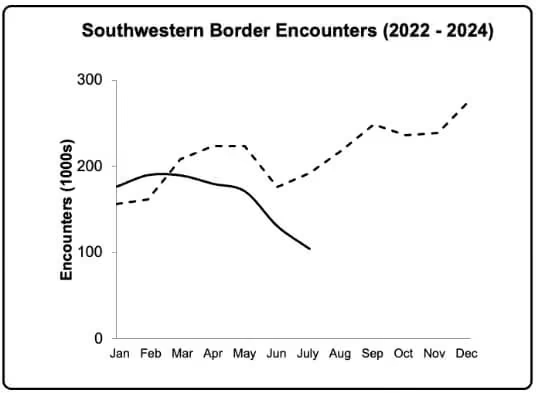
The figure below compares monthly 2024 encounters released by DHS with data from 2022 and 2023. 2024 data is the black solid line, while the average monthly encounters for 2022 and 2023 is a dashed line.
Source: Department of Homeland Security (2024)
Comparing the 2024 data with the earlier years reveals two things. First, border encounters in July 2024 are down by almost 50 percent compared to January 2024. Moreover, July 2024 encounters are also down almost 50 percent compared to the same months in 2022 and 2023.
The Take-Away
The data provides two insights into the effectiveness of the federal government’s recent border policy changes. Border encounters for July 2024 are at their lowest levels since 2022, and are significantly lower compared to 2022 and 2023.
The critical questions are whether the decline in border encounters continues in the coming months and whether data on asylum claims will reflect an increased number of claims being adjudicated. The data does reflect a decline in Southwestern border encounters, but given the cyclical nature of border crossings, it will take further analysis throughout the remainder of 2024 to determine if the new policies are reducing asylum claims and illegal entries on a sustained basis.
How much charging infrastructure exists at present?
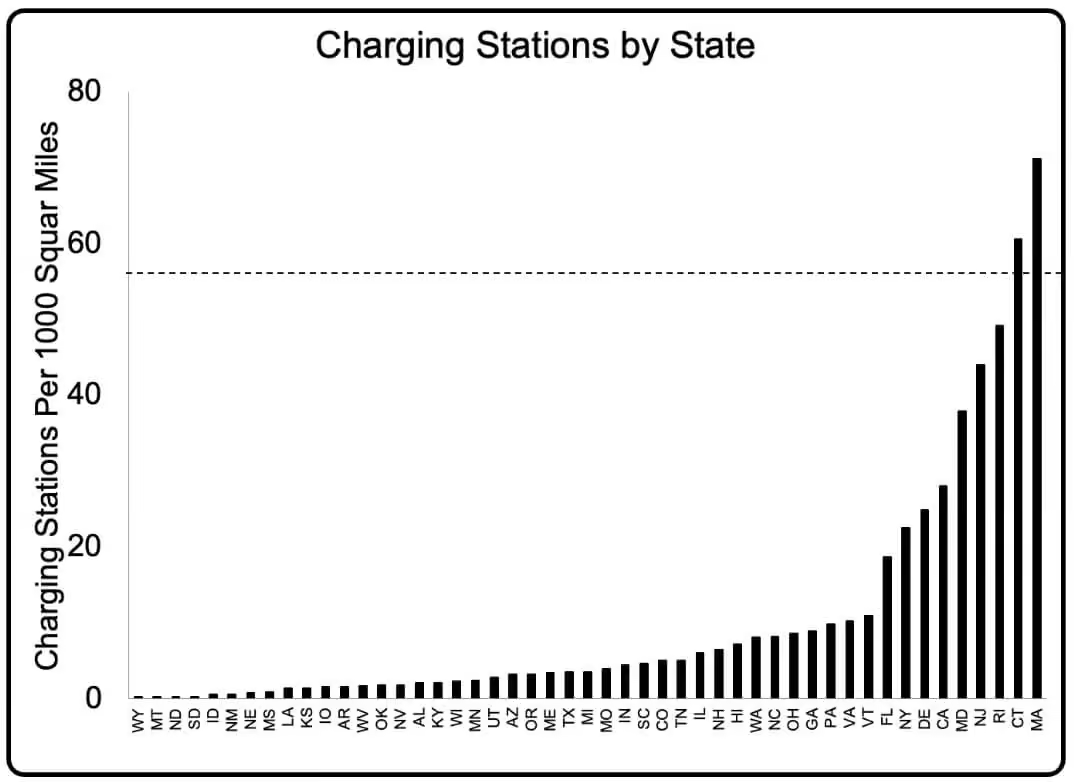
The U.S. Department of Energy’s most recent report on EV infrastructure determined that for an EV driver to be no more than three miles from a fast-charging station in any city or town, there would need to be a charger density of 56 stations per 1,000 square miles. This number is significantly lower than the density of gas stations, which have an average density of about 960 stations per 1,000 square miles. The chart below shows the density of charging stations by state, with the EPA recommendation as a dashed line.
Source: U.S. Department of Energy (2024)
The data shows that only two states, Massachusetts and Connecticut, have charging station densities above the EPA recommendation. Many large, low-population Western states, such as Wyoming or Montana, have relatively few charging stations. Moreover, even some high-population states, such as Texas and Illinois, are well below the EPA requirement.
While this data does not assess population density, geographic conditions (e.g. seasonal temperatures where batteries perform better or worse), the exact specifics of these charging stations themselves (accessibility, parking allotment, etc.), or whether charging stations are located in the right places to satisfy the EPA’s 3-mile requirement, they provide a first look at the number of new stations needed to satisfy the U.S. Department of Energy’s guidelines.
How many new charging stations are needed?
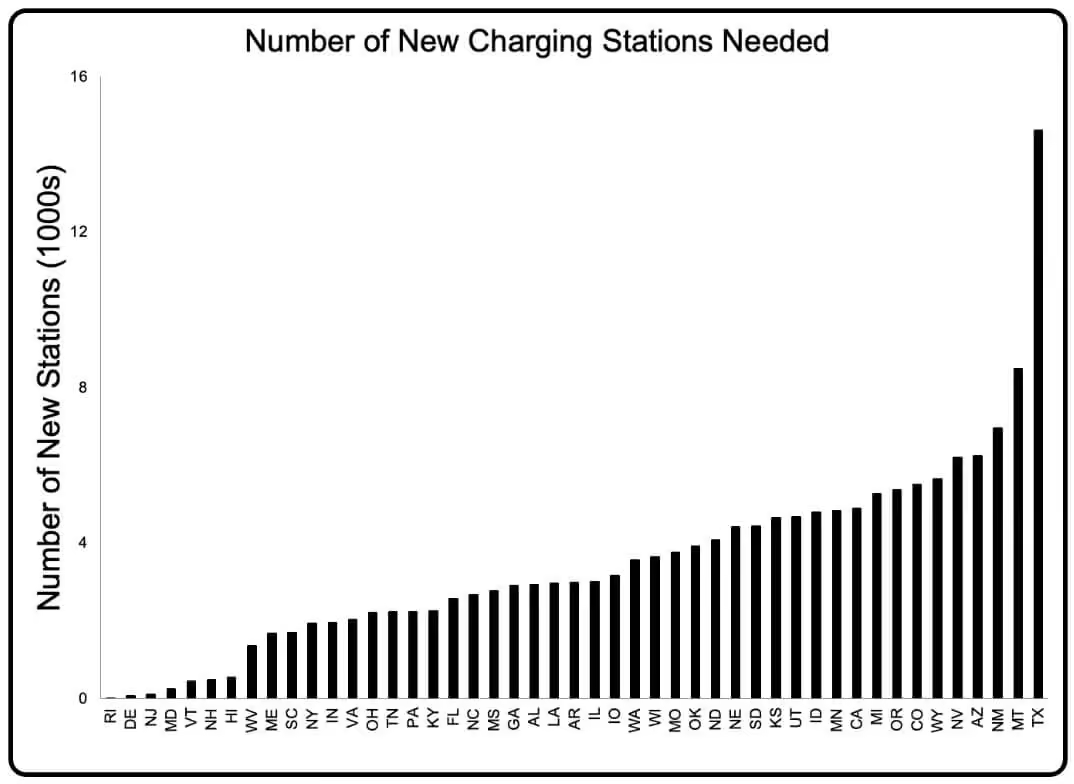
Based on analysis by Everything Policy’s research team, the chart below shows the number of new charging stations needed in each state to satisfy the EPA’s 3-mile guidelines. Overall, this goal requires the addition of over 160,000 charging stations.
Source: Calculated by Everything Policy
Similar to the previous chart, the number of new stations is especially high in large, low-populated western states such as Montana. However, even California, which has one of the highest station densities, needs over 5000 new stations. And Texas, which is both large in terms of square miles and has a high population, needs over 10,000 new stations to meet EPA requirements. At the other end, many Northeastern states, such as Rhode Island or New Jersey, need relatively few new stations to join Massachusetts and Connecticut in having a dense network of EV charging stations.
The Take-Away
Few analyses of EVs as the primary mode of personal transportation have considered the infrastructure needed to make this transition work. Our analysis shows that over 160,000 new charging stations are needed to meet the EPA’s 3-mile guideline. Based on Department of Energy estimates, a new 10-port charging station may cost nearly $400,000, including hardware, land costs, and construction. If so, the cost of a national network is nearly 80 billion dollars – much more than the 5 billion dollars currently allocated by the federal government for new charging stations. Moreover, building this network may require the use of eminent domain (see our Brief on Eminent Domain in Further Reading) to construct the number of EV charging stations required in the optimal locations.
Police misconduct is difficult to document. Departments are not generally required to disclose the number of complaints filed against officers, so the data must be obtained from cooperative departments or through public records requests.
For this brief, Policy vs Politics analysts used the following sources:
Data collected by the Invisible Institute’s Civilian Police Data Project for misconduct cases in the Chicago Police Force during 1988 – 2018
Data collected by the New York City Civil Liberties Union for misconduct cases in the New York City Police Department during 2000 – 2021
Data collected by the Invisible Institute and local USA Today reporters for 700 police departments (out of 1800 total) in 44 states covering misconduct cases during 2010- 2019
These sources include information on misconduct complaints, the percentage of complaints substantiated, and the punishments given to offending officers. Policy vs Politics analysts used data in the reports to calculate the total number of officers serving in these departments during the periods.
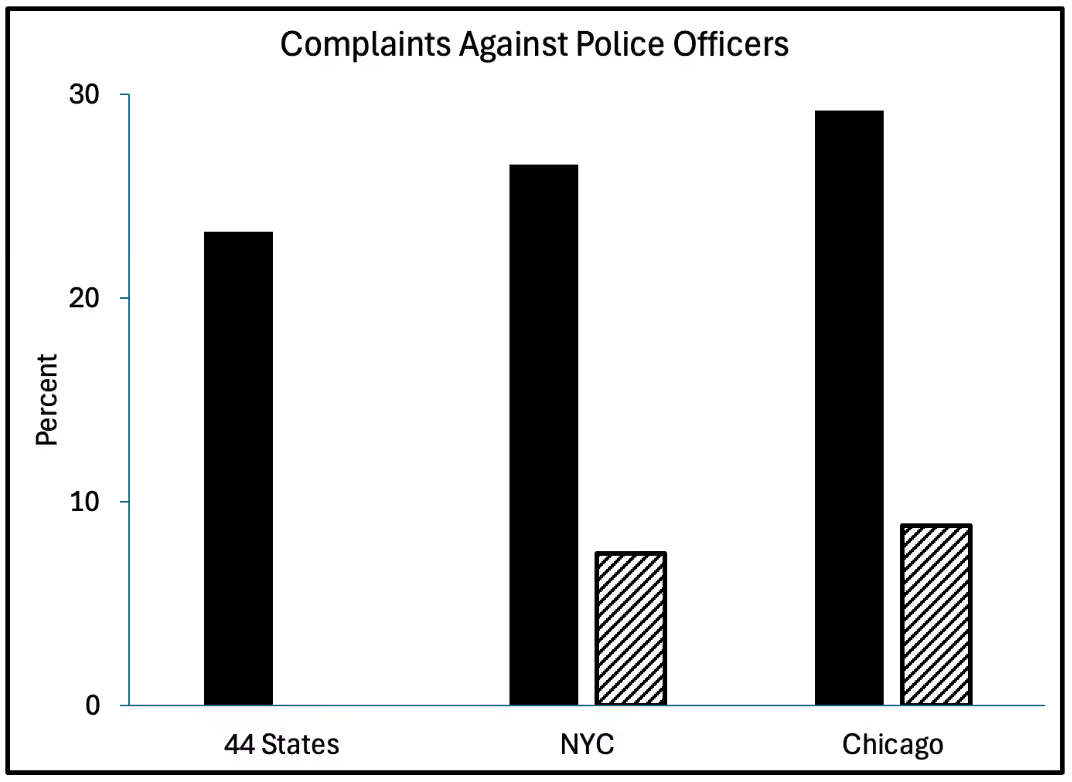
The chart below shows the percentage of officers with one or more complaints filed against them (solid bar) and the percentage with at least one substantiated complaint (striped bar). (The latter percentage could not be calculated from the 44-state study.)
Sources: Invisible Institute (2024), Kelly and Nichols (2020), NYCLU (2021)
Interestingly, the three sources agree that over a decade, about a quarter of police officers will be accused of misconduct. However, based on data from the urban departments, only a fraction (about eight percent, or a third of those accused) of these officers will be found to have committed misconduct.
The other way to inept this chart is that during the time frame analyzed here, nearly ninety-two percent of America’s police officers were accused of misconduct or were exonerated after an investigation. This conclusion is consistent with another finding raised by all three organizations: a relatively small percentage of officers (about 5%) account for most complaints.
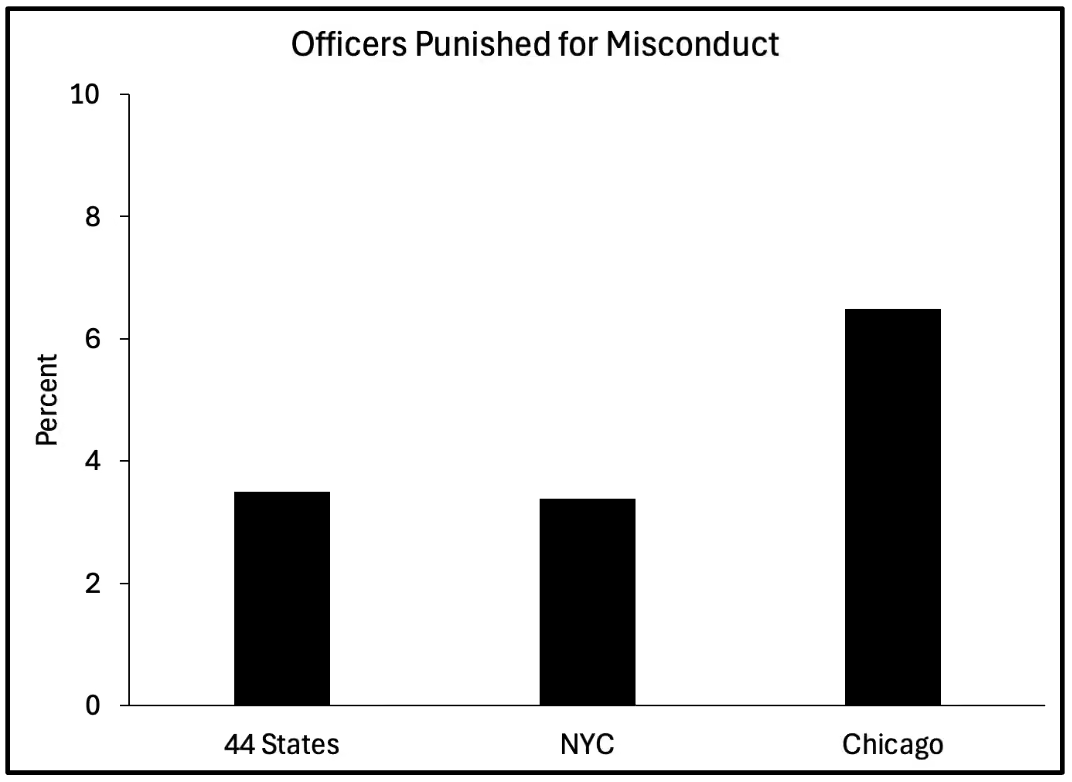
The next figure details the percentage of officers whose misconduct is serious enough to warrant significant punishment. For the 44-state study, it is the percentage of officers fired from the force. For New York City, it is the percentage fired or given serious sanctions such as suspensions of greater than a week or loss of more than a week’s vacation days. For Chicago, it is the percentage of officers fired plus the percentage of officers who resigned rather than accept their sanction, presumably a multi-day suspension or firing.
Sources: Invisible Institute (2024), Kelly and Nichols (2020), NYCLU (2021)
These data refine our understanding of police misconduct. While about eight percent of officers are found to have committed misconduct, the percentage whose behavior was serious enough to warrant a major punishment is around three to five percent. In other words, if Americans are concerned about reducing police misconduct, it is important to see that the problem is limited to a small percentage of officers. The challenge is identifying these officers before they commit serious offenses and determining what type and level of training, professional development, and other assessments can be done to mitigate any potential negative impact to the community.
What kinds of police misconduct occur?
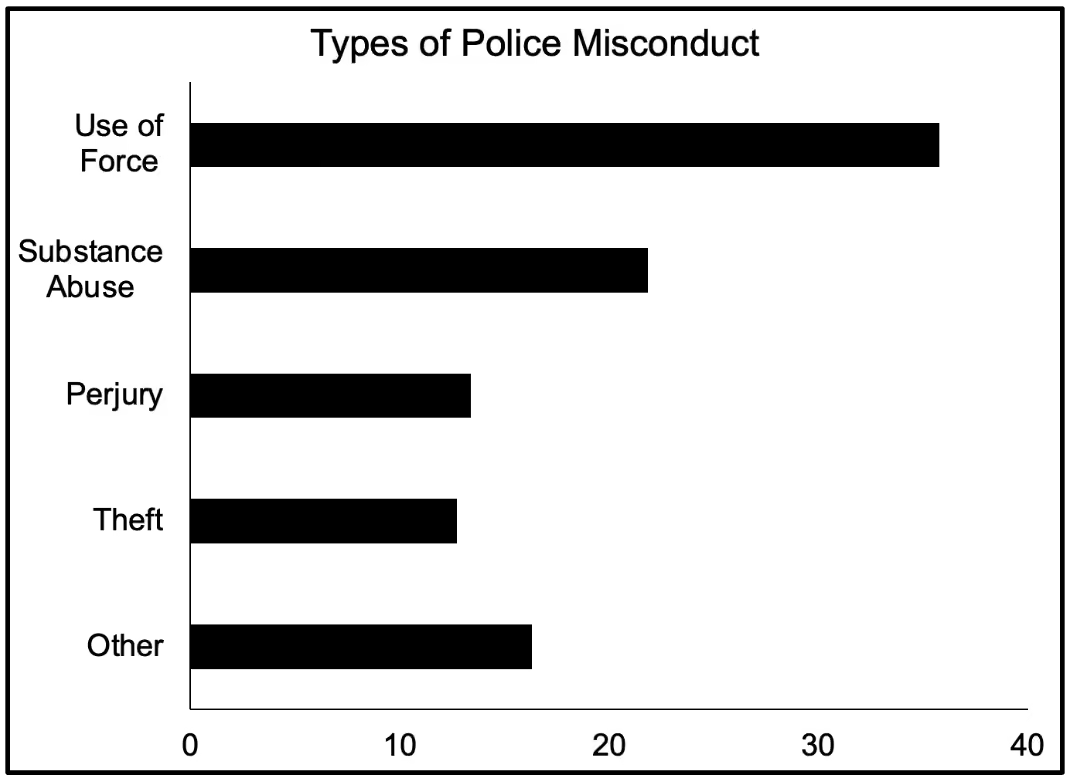
The 44-state study contains detailed information on the nature of offenses committed by police officers, as shown in the figure below.
Source: Kelly and Nichols (2020)
Use of force involves threats or violence against suspects, detainees, and civilians. Substance abuse is the use of illegal drugs or excessive alcohol consumption. Perjury involves lying to superiors or in court. Theft is taking official property or evidence. The final category covers all other offenses.
Use of force complaints against the police only accounts for about a third of misconduct cases. Out of the rest, the most common offense is substance abuse. Perjury accounts for just over ten percent of police misconduct cases, as does theft.
The Take-Away
In recent years, there have been many well-publicized cases of clear police misconduct involving the injury or death of detainees or the unwarranted use of force against individuals suspected of committing relatively minor crimes. One interpretation of these incidents is that many officers can commit misconduct under certain conditions and that major reforms to police training and policies are needed.
However, available data does not support this conclusion. Even over a decade, relatively few officers are found to have committed any kind of misconduct. The percentage found to have committed major misconduct is even smaller. And many misconduct cases do not involve the use of force at all.
The problem police departments face is not to completely rethink law enforcement. It is to identify the individuals whose records suggest they are capable of major acts of misconduct. This task is difficult, particularly because few departments are willing to analyze their misconduct data or allow outside organizations to do so. Relaxing these restrictions and developing new ways to identify and isolate problem officers may help reduce the likelihood of major police misconduct.
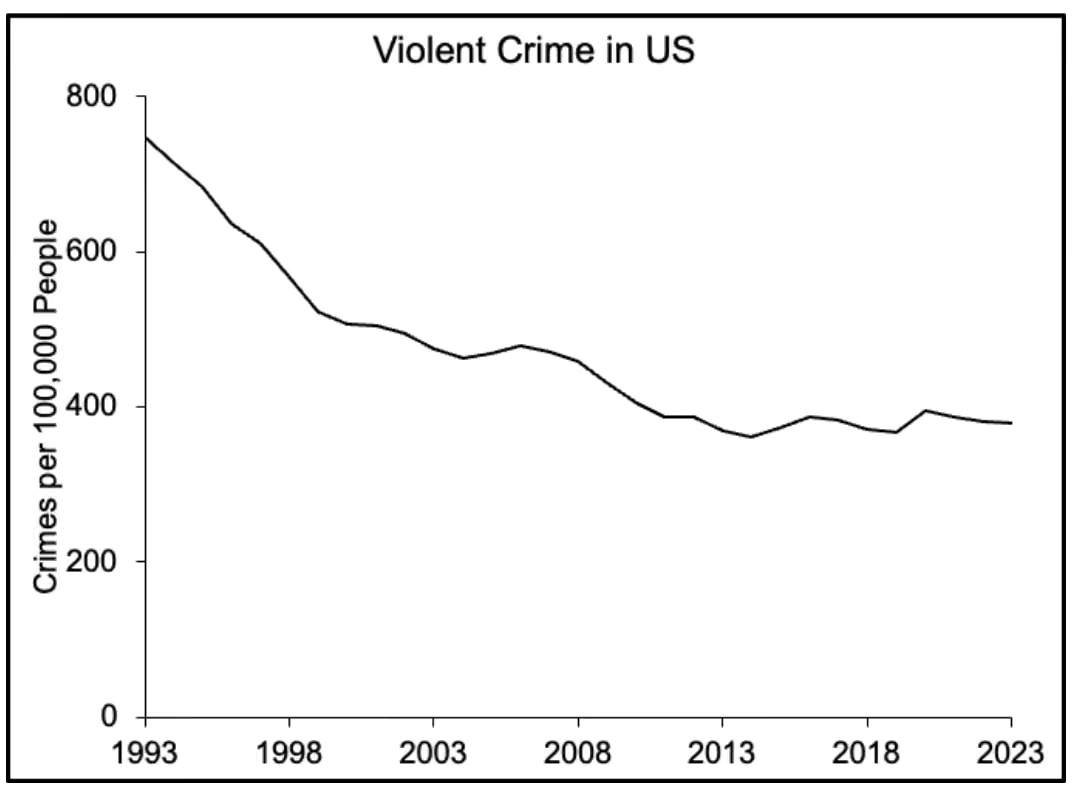
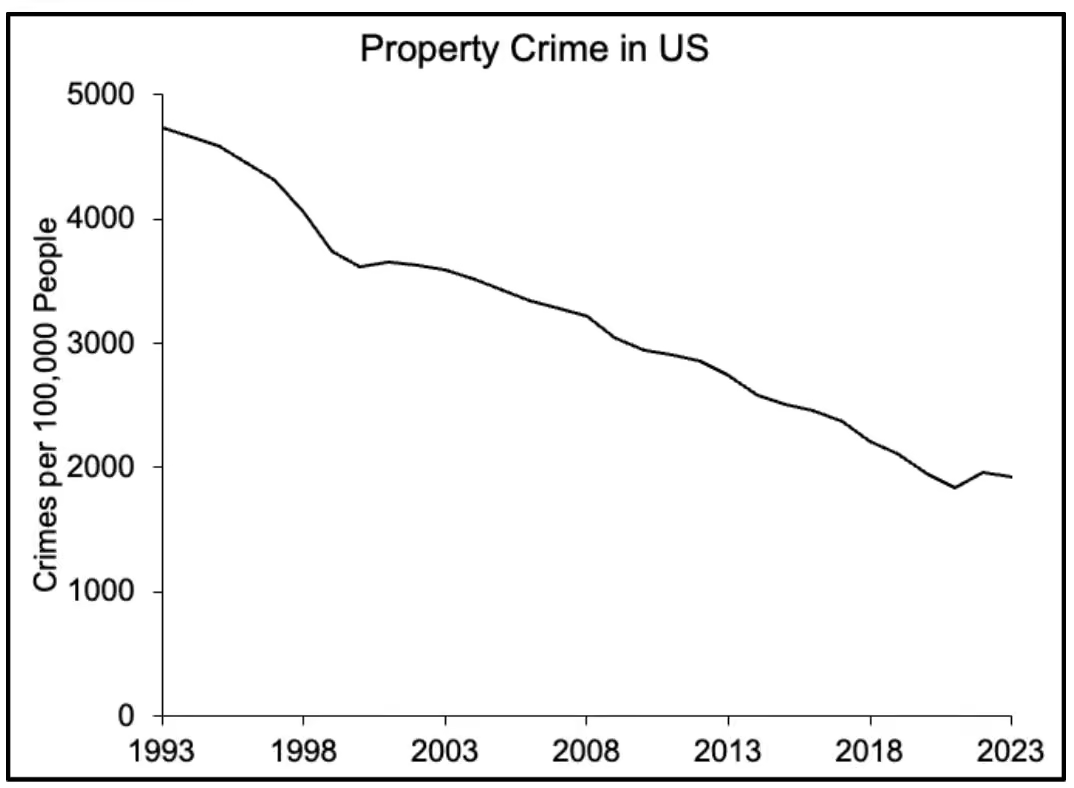
The best data about crime in America comes from the Federal Bureau of Investigation Uniform Crime Reporting (UCR) System, which collects data from local police and sheriff’s departments. The two charts below show the trend in reported rates of violent crime (murder, assault, etc) and property crime (burglary, larceny, etc.) in America over the last 30 years. Each chart shows the number of crimes per 100,000 people.
Source: Uniform Crime Reporter (2024)
Source: Uniform Crime Reporter (2024)
The charts show that crime rates have declined by over 50% over the last three decades, with a very small rebound in property crimes during the COVID-19 pandemic. The same pattern shows up in data from the U.S. Bureau of Justice Statistics, which annually surveys Americans to determine if they have had crimes committed against them. At the national level, crime rates have declined, regardless of how we measure it.
Public opinion about crime
Americans believe crime is increasing. A 2024 survey by the Pew Research Center showed that 58% of Americans (68% of Republicans and 47% of Democrats) believe reducing crime should be a top priority for the President and Congress. Moreover, 77% of those surveyed believe that crime has increased in the U.S. over the last year, and 55% believe it has increased in their community.
The Pew report also notes that despite decreasing crime rates over the last 30 years, in 23 out of 27 annual Gallup surveys conducted during this time, at least 60% of respondents believed that crime rates were increasing.
Why do Americans believe crime is up when the national-level data says otherwise? One argument is that responses to questions about crime reflect partisan ties, with Republican voters saying crime is a problem because a Democrat is in the White House. However, the Pew data shows that many Democrats are also concerned about crime.
A second argument is that Americans are responding to sensationalized crime coverage on local news media and social media. There is no doubt that Americans today see more stories about crimes than they did a generation ago. However, the Gallup data suggests that something else is going on. The mismatch between declining crime rates and increased public concern about crime existed long before the Internet.
Further analysis suggests a possible different explanation for the mismatch. The outcome may be a consequence of measuring crime at the national level. When we look at local data, a very different picture emerges, one where the public’s concerns about rising crime are more aligned with what the data reflects.
Crime at the local level: New York City
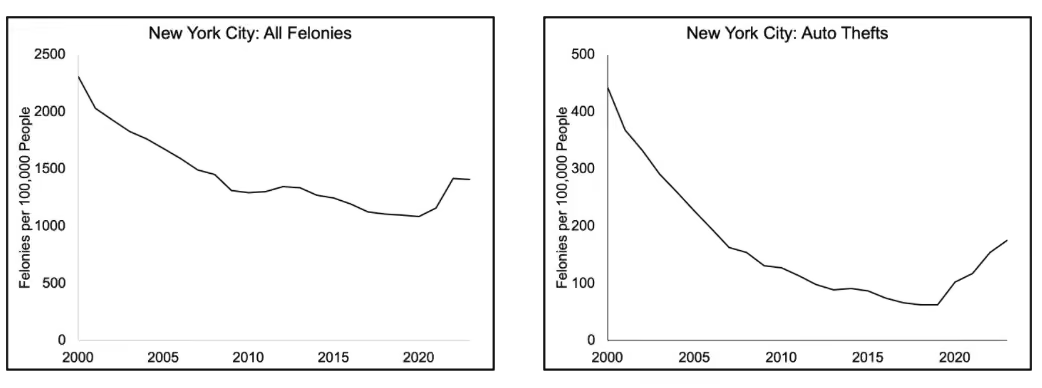
For our analysis, we use crime data from 2000 - 2023 reported by the New York Police Department. The chart on the left below shows annual crime rates in New York for seven major felonies (murder and manslaughter, rape, robbery, assault, burglary, grand larceny, and auto theft). As in the national data, the overall trend is downward, meaning less crime over time. However, there is a significant spike (over 20%) in felonies from 2019 to 2023.
Source: New York City Police Department (2024)
The Take-Away
Many observers of American public opinion question surveys that reveal the public’s high levels of concern about crime. Why are people worried when crime nationwide has been declining for three decades? In communities experiencing similar outcomes like New York City, the answer is clear: local crime data reveals a different picture, with felonies up almost 20% in recent years and auto thefts skyrocketing nearly 200%.
This data suggests a new explanation for the public’s concern about rising crime: national trends may miss what some Americans see in their local communities. Crime may be declining nationwide, but at the same time, it is increasing in many communities, leading people who live in these communities to conclude that crime rates are a pressing problem based on what they are experiencing firsthand.
The minimum wage is the lowest hourly wage that an employer can legally pay an employee. It is set by federal or state law. Currently, the federal minimum wage is $7.25 per hour. The federal minimum wage is set by the Fair Labor Standards Act (FLSA). The FLSA applies to most employees, although there are exceptions such as tipped employees, people under age 14, and those working in certain agricultural or service industries, for whom the minimum wage is lower.
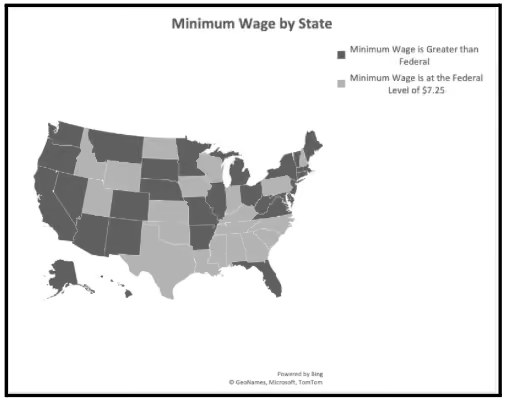
State laws can set higher minimum wages than the federal minimum. In fact, as shown below, 29 states and the District of Columbia have minimum wages that are higher than the federal minimum. Additionally, there are 18 states that require annual adjustments to minimum wage based on factors such as the inflation rate.
US Department of Labor (2024)
How has the level and applicability of the minimum wage varied over time?
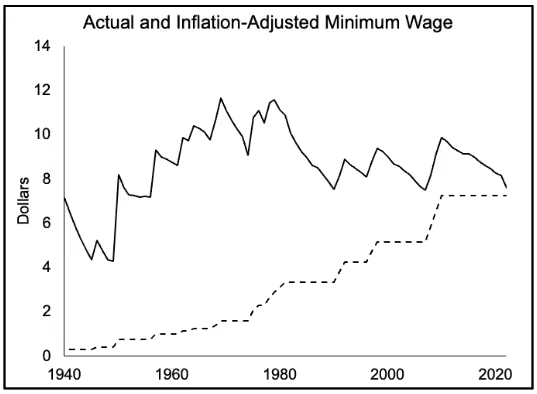
The federal minimum wage has been raised 22 times since it was first established in 1938. The most recent increase was in 2009, when the minimum wage was raised from $6.55 to $7.25 per hour. The dotted line in the chart below shows the trend in the nominal (actual amount) of the minimum wage over time, while the solid line reflects adjusted values that take into consideration inflation using 2022-era dollars. The adjusted values are typically a better measure of how much the minimum wage is worth in ‘current-time period dollars’ considering cost of living.
The plot of the wage’s adjusted values taking inflation into consideration shows that the purchasing power of the minimum wage has declined since the late 1960s. For example, in 1968, the nominal value of the minimum wage was less than $2.00 per hour, but the inflation adjusted value was over $11.00 per hour.
Cooper et al (2022)
What are the arguments for and against the minimum wage?
The central argument in favor of a minimum wage is that it puts more money in the paychecks of low-income workers. This argument is based on two primary claims: that no one’s wages should be below a certain standard for quality of life given the overall cost of living conditions and that without a minimum wage, employers will seek to drop wages as low as possible. The difficulty with these arguments is that people disagree about what level of pay is fair for workers and the actual effects of unemployment levels and hiring trends due to minimum wage mandates. Also complicating matters are topics like whether young workers should have the same minimum wage as someone who possesses greater skills or experience and may need to support others in their household.
One central argument against the minimum wage is that it may reduce overall employment – that if employers are forced to pay a higher minimum wage, they will hire fewer workers, either because they cannot afford a larger workforce or because some workers do not add enough value to justify paying a higher wage. Another concern voiced by some, including small businesses or those employers operating in low-margin industries, is that the cost of absorbing such minimum wage will be passed on to consumers in the form of higher prices for goods and services.
A related argument is that a minimum wage works against a free market where workers and employers are free to negotiate over wages and other compensation. By this logic, workers should be allowed to accept lower wages because they want to guarantee that a company hires them or because they are compensated in other ways, such as waitstaff who receive tips as part of their income. On the other hand, abolishing the minimum wage can give power to companies to lower wages, particularly during economic hard times when jobs are scarce.
What evidence is there about the impact of the minimum wage?
This is not an easy question to answer. The difficulty is that employment levels and wages move up or down for reasons other than the minimum wage, such as economic shocks. For example, unemployment rose after the last federal minimum wage increase in 2009 – but this change was due to the Great Recession, caused largely by speculation in housing markets that had nothing to do with a minimum wage. Unemployment levels have been very low in recent years, but this decline probably has more to do with increased retirements during the COVID pandemic than with a stable minimum wage. Unemployment has been stable even as large states like California, New York, and Illinois increased their minimum wages.
Looking across many studies of the effects of minimum wages, the central conclusion is that current minimum wage levels do not have any systematic impact on economic growth or unemployment; however, they can have a negative impact on certain businesses and the affordability of certain consumer goods and services. With this said, leveraging a minimum wage to support an increase in salaries of low-income, unskilled workers will continue to be debated, but it does help establish minimum quality of life standards based on current cost of living standards.
A labor union is an association of workers authorized to negotiate with business owners for better wages, more favorable work schedules, safer working conditions, and other employment conditions.
There are multiple types of labor unions. Craft unions are composed of skilled trade workers, like plumbers, electricians, and construction workers. Professional unions represent workers with college degrees, such as teachers or government employees. There are also industrial unions, which represent a wide range of workers in a specific industry. An industrial union may represent assembly line, skilled, and unskilled workers in a single industry, such as automobile manufacturers.
Under current law, unions are created by a vote of the workers at a particular business. These organizational efforts often involve support from a national union. Business owners cannot prevent a union from forming or punish workers for organizing a vote or joining a union. Once a union is formed, it can collect dues from workers and start bargaining with the business’s owners.
Why do businesses bargain with labor unions? One main reason is that unions can order a strike against a business, where workers refuse to do their jobs. Strikes can also be called for a set time, such as a day or even an hour. A union can also ask workers to stay at work but follow the exact language of policies or work rules, which is often as disruptive as a formal strike. During a strike, businesses can attempt to operate with management taking on worker tasks or even try to hire other workers. Even so, strikes are usually very disruptive and costly for businesses and the customers they serve. Strikes are also costly for workers, who are not paid as long as they are on strike, although some unions provide members with payments that make up for some of their lost salaries.
How Many Americans Belong To A Union? Where Do They Work?
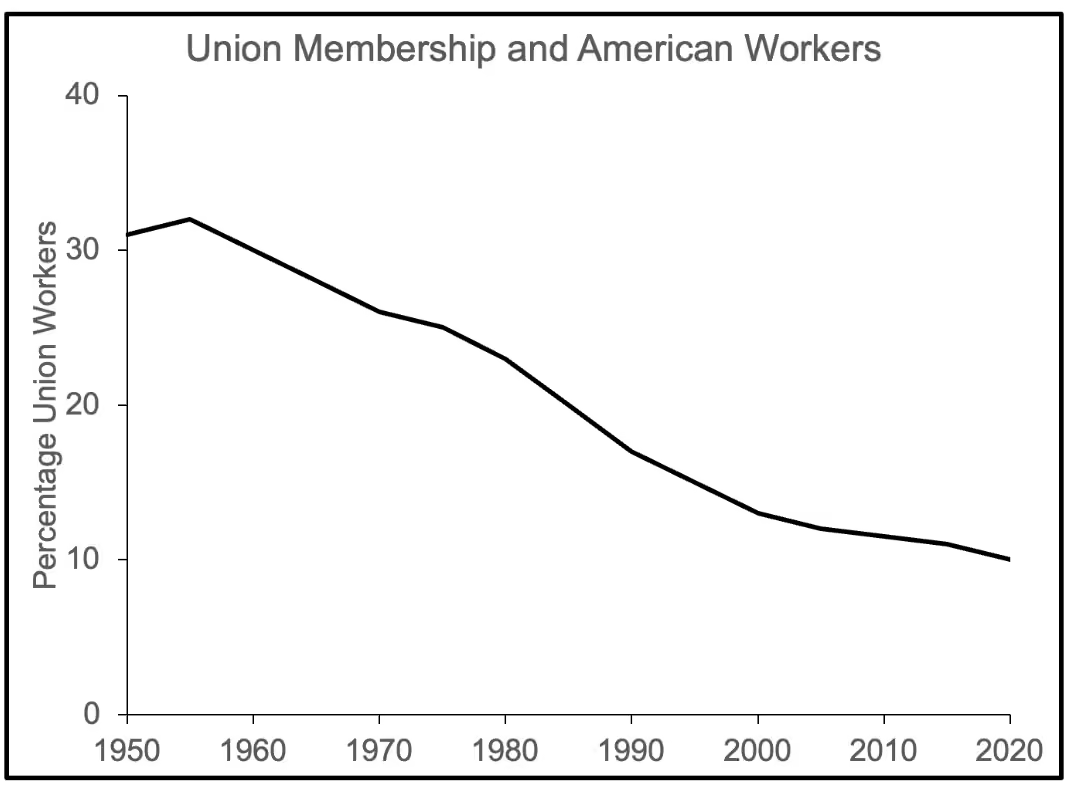
In 2022, 10.1% of American workers belonged to a union. This figure shows that union membership has been on the decline for more than 50 years.
Source: Congressional Research Service (2023)
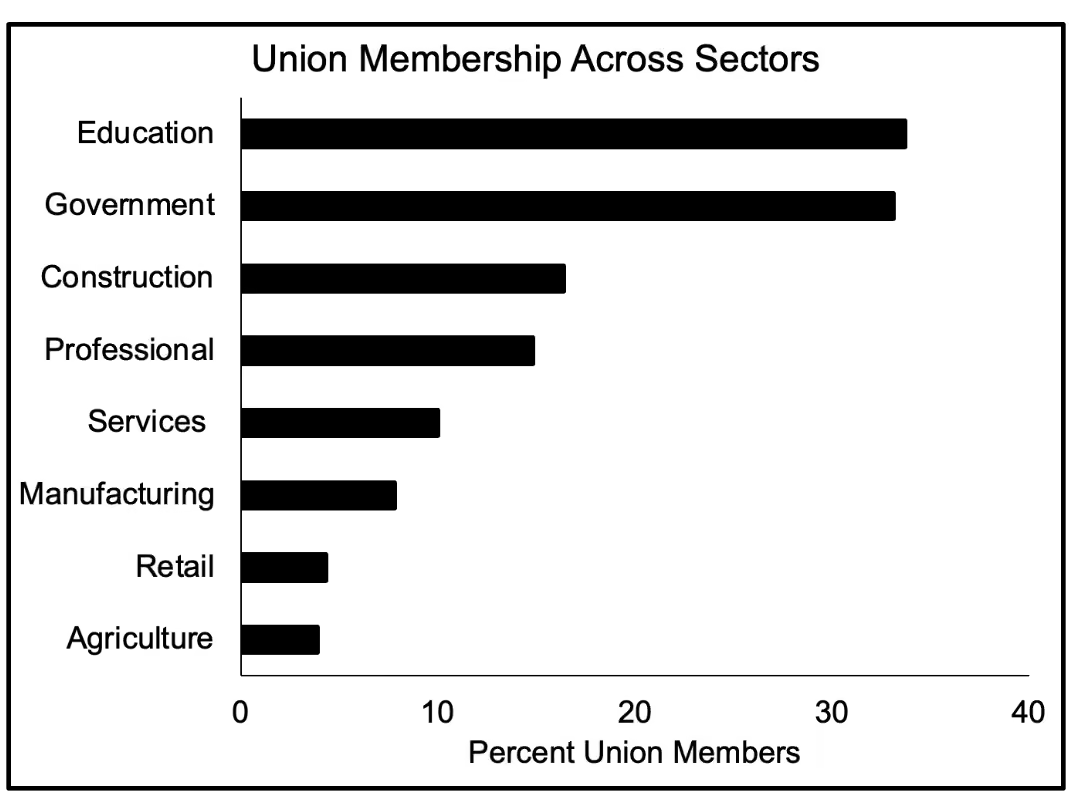
The next figure shows the economic sectors with a high percentage of union workers. Union membership is particularly high among government employees (civilians) and the education sector. It is low in the retail and agriculture sectors.
Bureau of Labor Statistics (2023)
Why Has Union Membership Declined?
Union membership peaked in the early 1950s when almost one-third of private sector employees were union members. The decline in union membership is primarily due to two factors. The first is the decline of industries with a high percentage of union members. The auto industry, for example, which is highly unionized, employs far fewer people than it did in the 1950s. Many emerging industries, particularly high-tech companies, have very low union membership rates.
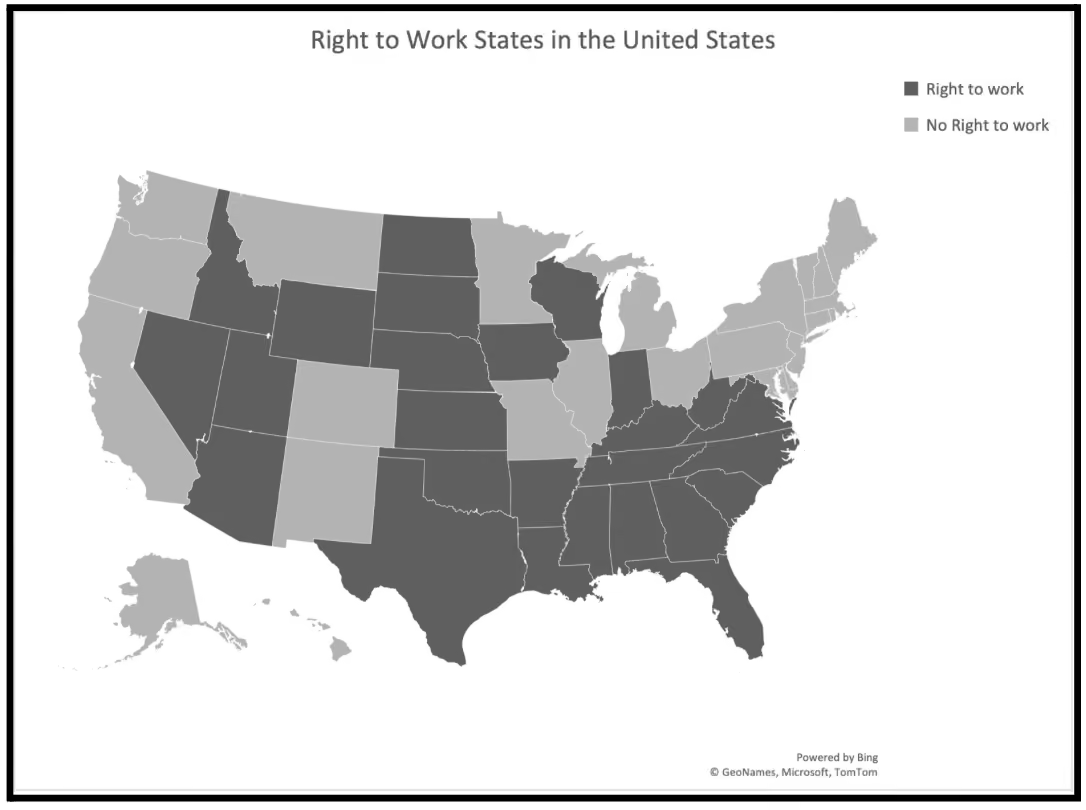
The second factor behind the decline of union membership is the increase in states with so-called Right to Work laws. These laws allow employees to work at a company with an established union without paying union dues. (The opposite is called a Union Shop, where workers must pay union dues to work at a business with an established union.) The figure below shows the variation in these laws across states as of 2023.
Source: National Council of State Legislators (2024)
Generally, union membership rates are much lower in Right-to-Work states. About 6 percent of workers in Right-to-Work states are union members, compared to over 13 percent in Union Shop states, and there are fewer companies where unions represent workers.
What Difference Do Unions Make?
Unions can make a big difference. Union representation likely correlates to an increase in wages: 2023 data from the Bureau of Labor Statistics shows that the average median weekly earnings of a full-time salaried union worker is $1216, whereas the median nonunion worker earns $1029. While this comparison looks at wage differences between jobs, more sophisticated analyses that account for these factors found that union bargaining increases wages and fringe benefits.
Labor unions are not always beneficial for workers. Some unions have refused to negotiate on wages and working conditions, even for corporations that must restructure in the face of economic hard times. Others have bargained for agreements that preserve high salaries for existing workers by accepting lower wages for new hires. Some union leaders have spent member dues on high salaries and benefits for themselves. And many companies offer generous wage and benefit packages even though workers are not unionized.
The Take-Away
Many advocates for Right to Work laws cite cases of union corruption and inefficiency to argue that no one should be forced to join a union. At the same time, there is clear evidence that union representation can benefit workers. The question is, which of these outcomes do you consider more important? How the reader thinks about this question will determine whether they favor or oppose labor unions and how they view the decline in union membership.
The formal definition of unemployment starts with estimating the labor force, people working or looking for work. This definition excludes people who are too young to work or have retired, people who are unable to work, and people who are not actively looking for a job, like those who choose to stay home to care for children. The number of unemployed includes only those who currently do not have a job, have actively looked for a job in the last four weeks, and can work.
To determine the unemployment rate, the number of unemployed individuals is divided by the number of people in the labor force. As of April 2024, the unemployment rate was 3.9%, or 6.5 million persons. The Bureau of Labor Statistics reported that teenagers currently have the highest unemployment rates among demographic groups, at 11.7% in April 2024.
What about under-employed people?
A low unemployment rate indicates good economic conditions, but it does not necessarily mean everyone is happy with their current job. An unemployment rate can be low, but only because of underemployment: people who are employed but are overqualified for their jobs or people who are employed in a part-time job but wish to be employed full-time. Including underemployed and part-time workers in the calculation increased the rate from 3.9% to 6.9% as of April 2024.
How has the unemployment rate varied over time?
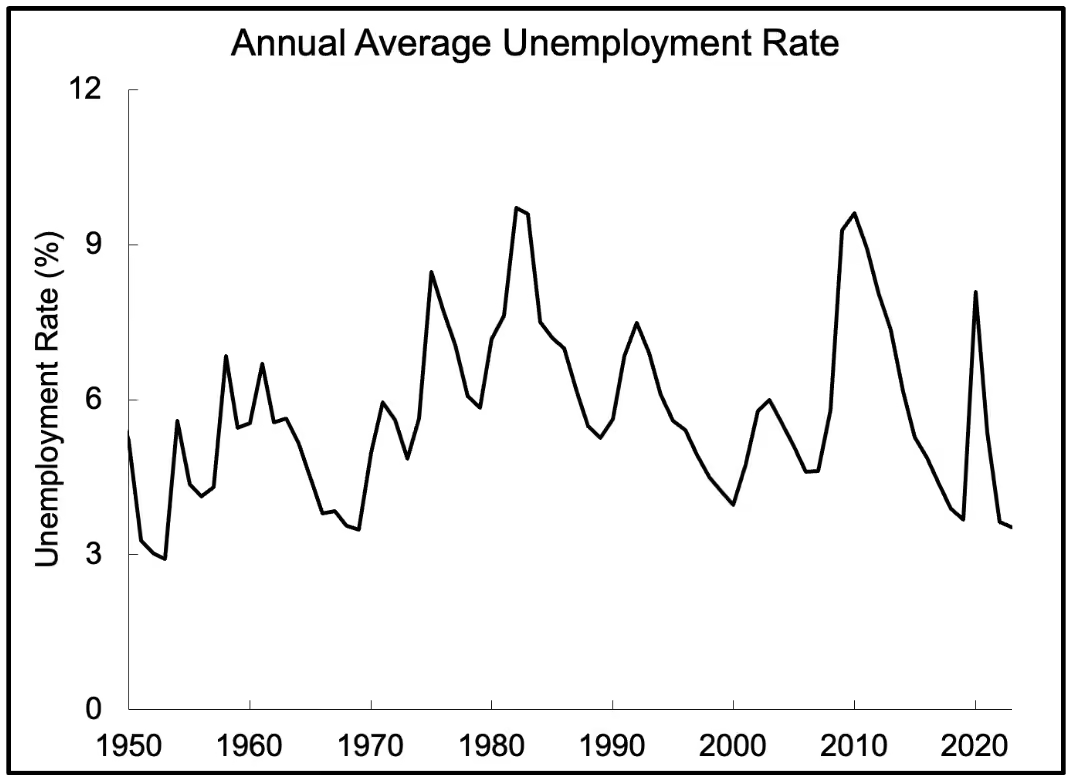
The unemployment rate tends to follow the economy’s ups and downs. The economy has its cycles of expansion and contraction, and employment tends to follow this cycle. Unemployment rises with negative economic conditions as firms hire fewer workers or lay off current employees. Similarly, firms hire and recall workers when the economy grows and unemployment drops.
The figure below shows the yearly average unemployment rate since 1948. The plot shows that the U.S. has seen major spikes in unemployment during economic recessions, such as in the early 1980s and the Financial Crisis of 2008-2010. (See our Policy Brief on Inflation, linked in Further Reading, for more details.) The U.S. also saw a dramatic spike in unemployment during the early months of the COVID pandemic. However, the unemployment rate rapidly declined as the economy reopened and workers were called back to their jobs. Current unemployment rates are near all-time lows.
Source: BLS (2023)
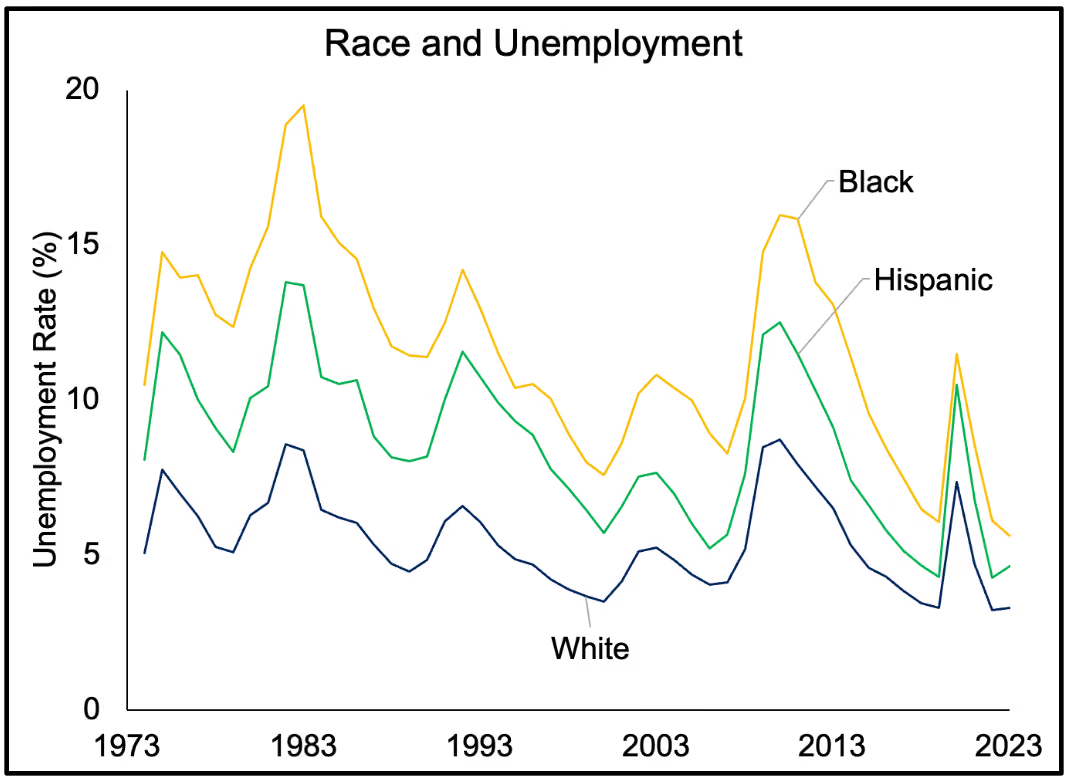
As shown in the figure below, the unemployment rate for Blacks and Latinos is generally higher than that of White Americans (the figure shows the same annual average as the earlier plot, but for a shorter time frame). The causes of these racial differences are debated. Part of the answer lies in different levels of education, differences in where people live, and differences in the sectors they work in. For example, unemployment levels for Blacks in the Upper Midwest are about 3-5 times higher than for Whites. However, unemployment levels are very similar in states like West Virginia and Kentucky.
Source: BLS (2024a, 2024b, 2024c)
Do some states have higher unemployment rates than others?
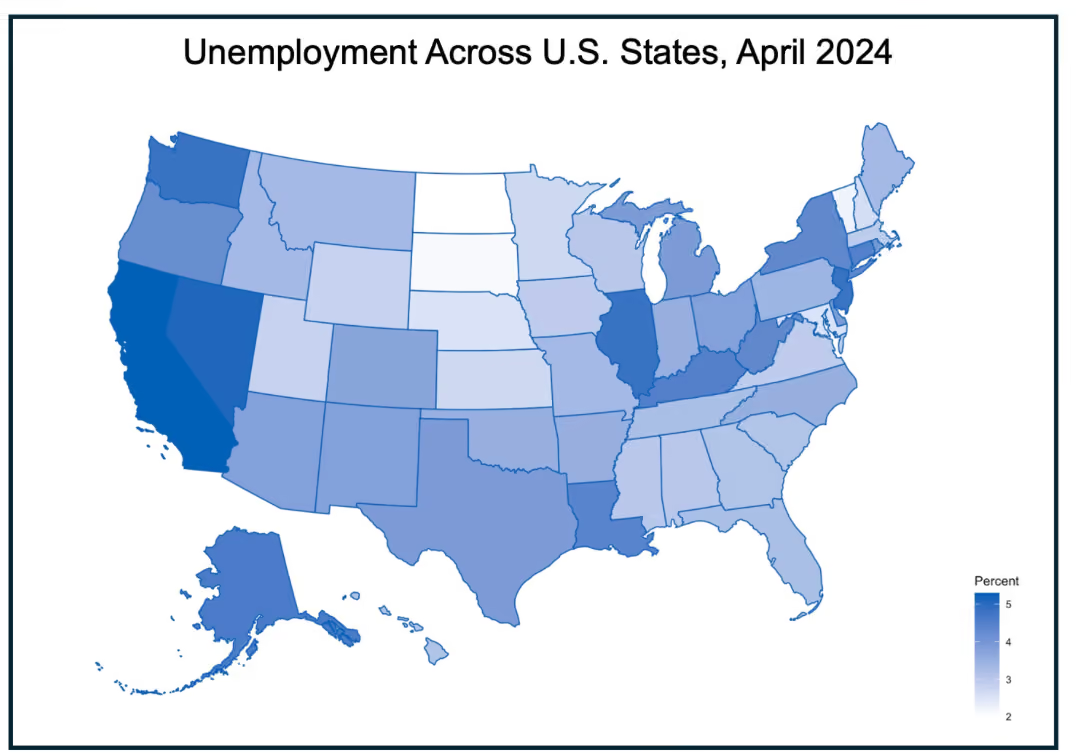
The economies of American states vary significantly – they have different kinds of industries and businesses. As a result, unemployment levels can vary across states. One state may have industries growing strongly, while another may be dominated by industries with low growth or even declining. For example, during COVID, hospitality industries were particularly hard hit, so states like Nevada, whose economies depended on tourism, had much higher unemployment than others.
In the post-pandemic era, unemployment levels have been similar across states, as shown in the figure below for June 2023. Overall, there is only a 3.3 percentage point difference between the state with the highest unemployment rate (California, 5.3%) and the state with the lowest (North Dakota, 2.0%).
Source: BLS (2024d)
The Federal Reserve, tasked by Congress with maintaining a healthy economy, defines ‘Maximum Employment’ as an unemployment rate low enough that almost anyone wanting a job can find one and in which the inflation rate is relatively low and stabilized. While they do not make their precise targets public, most analysts believe that the Fed aims for 2% inflation and an unemployment rate of 4%.
It is important to remember that a low unemployment rate is not necessarily good economic news. Particularly after an economic downturn, many individuals may be underemployed. For example, while the overall unemployment rate in the 1990s was near historic lows as the economy surged, many of those in the industrial sector permanently lost their jobs as manufacturing was relocated abroad to take advantage of fewer regulations and lower wages. These individuals remained in the labor force but moved to lower-paying jobs. For more details see our Policy Brief on Offshoring.
A cap and trade system creates a marketplace for trading the right to emit greenhouse gasses. Under this system, there would be a national cap on emissions. Firms that produce greenhouse gasses would be given emission credits, which is the right to release a set amount of greenhouse gasses, such as 1000 tons of CO2. Firms could use these allowances to operate normally or install equipment that reduces their emissions and sell some of their credits to other firms. Credits could also be purchased by pro-environment groups and retired out of the marketplace. Doing so would reduce the total amount of greenhouse gas emissions.
What Problem is Cap and Trade Designed to Solve?
Cap and trade has emerged as a popular policy alternative to the more strict “command and control” policy – for example, where the government requires all firms to reduce their emissions by a set amount or mandates that firms install new technology to reduce emissions.
While regulations of this kind can effectively reduce emissions, they can be inefficient and reduce innovation. For example, when the government sets emissions standards, firms are not motivated to install technologies that might further reduce emissions. Similarly, government technology mandates reduce the incentive to develop alternate technologies that might be cheaper or work better.
Under a cap and trade system, the government’s role is limited to setting a cap on emissions. Firms then make their own decisions about how to implement this limit. Advocates of cap and trade argue that leaving it up to firms to make these decisions increases the chances that the best possible solutions will be adopted and strengthens incentives to develop new technologies that reduce emissions even more.
Does Cap and Trade Happen Today?
There are a few cap and trade programs at various levels of government worldwide. California implemented a cap and trade program in 2013 and found that greenhouse gas emissions were reduced annually by about 9% from 2012 to 2017. However, as we noted in our brief on decarbonization, emissions declined across the United States during this time, though by a smaller amount.
The Regional Greenhouse Gas Initiative (RGGI) focuses on electrical power generation among Northeastern states. However, the emissions cap is nonbinding and has produced only limited reductions in CO2 emissions. In recent years, states such as Virginia have withdrawn from the initiative.
The European Union’s Emissions Trading System (established in 2003) is the only multi-country emissions trading system. The system’s emissions cap has evolved from being set by member states—who had incentives to make the cap high—to a more restrictive centrally determined cap. As the cap became more restrictive, emissions dropped, saving 1 billion tons of CO2 (about 4% of total EU emissions).
Why don’t more governments use Cap and Trade?
For cap and trade to effectively limit carbon emissions, it requires a cap on overall emissions that is progressively ratcheted down and a high enough price on carbon to encourage innovation and adoption of low-carbon technology. The RGGI cap and trade system had a nonbinding cap, meaning there was no penalty for the over-production of carbon. Similarly, the price of carbon in the European Union’s Emissions Trading System is quite low. Thus, despite its theoretical potential, cap and trade systems have had only limited effects because of how they were implemented.
Simply put, even if politicians are willing to enter into a cap and trade system, the system is not effective unless they commit to restrictive caps – even caps that are so low that businesses do not receive enough credits to cover their current emissions, and are therefore forced to develop or buy new technology to cut emissions or purchase credits on the open market. In this way, cap and trade systems give enormous power to governments, as they can set emissions caps at whatever level they wish.
The fact that cap and trade systems increase rather than reduce the government’s regulatory power is one reason why many businesses oppose cap and trade. From their perspective, a cap and trade system can increase energy costs, forcing them to raise prices or even lose business to firms in other countries that do not operate under a cap and trade system. Even if caps are initially set high, a company might worry that future governments would reduce them to reduce greenhouse gas emissions.
How Many Electric Vehicles (EVs) Are On The Road Today?
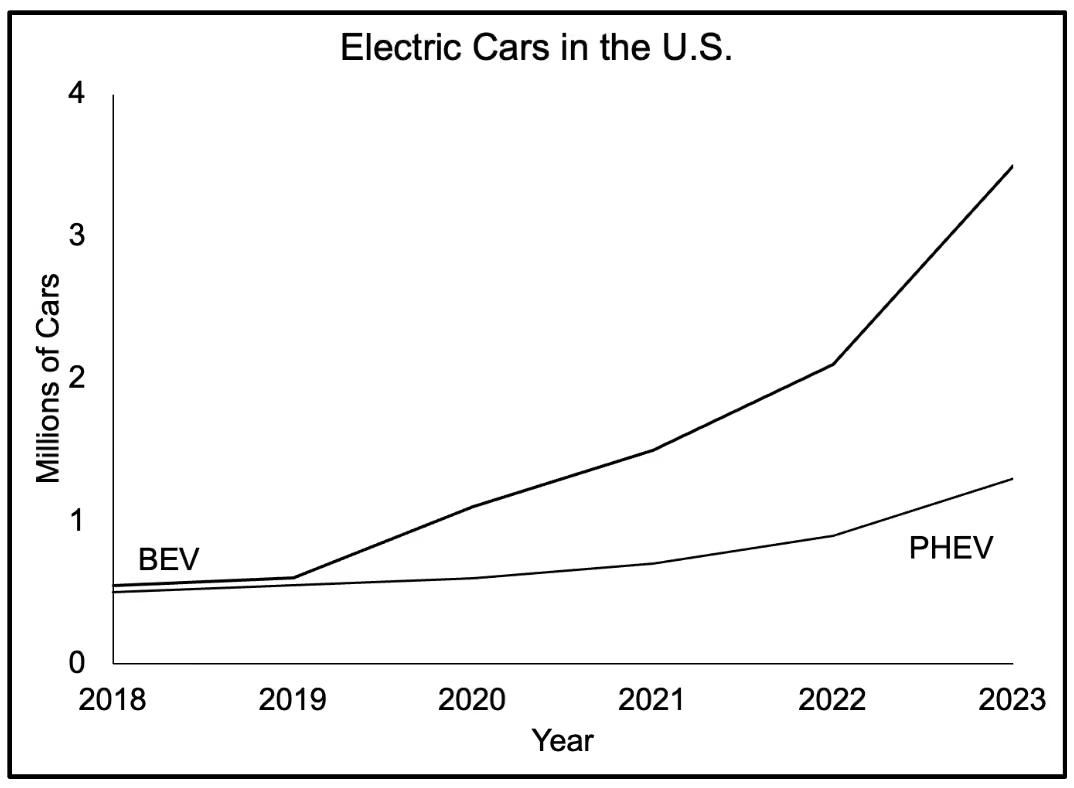
As shown in the figure below, based on data from the International Energy Agency, the number of EVs on U.S. roads has increased substantially in recent years. The number of BEVs, or pure battery electric vehicles, increased sevenfold from 2018 to 2023, while the number of PHEVs (plug-in hybrids that combine electric and gas-powered engines) tripled. These numbers are small compared to the nearly 280 million cars and trucks Americans owned in 2023.
Source: IEA (2024)
How Is EV usage projected to increase?
The growth in EV sales is highly uncertain. Part of the uncertainty is whether the U.S. or state governments will mandate purchases of EVs (either pure battery or plug-in hybrids). Some states, such as New Jersey and California, have laws on the books that will ban the purchase of conventionally powered cars after 2030—either simple bans or pollution limits that will make it virtually impossible to sell conventionally powered cars. As this date approaches, the bans may be relaxed, particularly if public opinion rises.
There are several additional uncertainties. The first is whether EV technology will improve, particularly in areas of range (current EVs can be driven about 250-400 miles before requiring a charge), battery lifetime, and resistance to cold weather, which lowers battery capacity. A second uncertainty is whether current tax credits for the purchase of EVs will remain in place. A third uncertainty is whether EVs will become price-competitive with conventionally-powered vehicles, with or without tax credits – right now, they are significantly more expensive, even with tax credits. Finally, the widespread introduction of EVs would require constructing a nationwide charging station network, and create a much higher demand on production of electricity.
With all of these uncertainties, predicting what will happen to EV sales over the next decade and beyond is difficult. The International Energy Agency gives a wide range of projections, from EVs moving to be about half of U.S. car sales in 2032 to a scenario where they are almost 100% of the market.
Are federal, state, and local governments encouraging sales of EVs?
In total, 45 states and the District of Columbia provide financial incentives to encourage the sale and purchase of EVs, including tax credits, tax rebates, and exemptions from emissions testing. The federal government has also passed legislation to encourage the development and purchase of EVs. The Infrastructure Investment and Jobs Act of 2021 allocated $7.5 billion in federal funding to build a national charging network. The Inflation Reduction Act of 2022 (IRA) extended a tax credit of up to $7,500 to purchase new EVs until at least 2032. Beginning in 2023, the IRA permits qualifying used EV purchases to receive a credit of up to $4,000.
What infrastructure changes are needed to support the widespread use of EVs?
One of the largest roadblocks to EV adoption is the need for a nationwide charging network. For most EV users, a fully charged battery is sufficient for daily use – enough to go to work, run errands, and then return home, where the car can be plugged in for recharge. The problem for current EVs (especially BEV or battery-only vehicles) is long trips away from home. In many communities, few (often none) locations can charge an EV battery in 20 minutes or less. Thus, widespread adoption of EVs would require a massive increase in charging stations, particularly in small towns throughout the U.S. Having an insufficient number of fast-charging stations could create a variety of logistical issues, spanning beyond just long lines and traffic congestion to safety concerns where ample space and parking hasn’t been taken into account.
Is the United States making the investments needed to support the EV mandates mentioned earlier? The current answer is no. A 2021 executive order established a goal that half of all new vehicles will be zero-emissions by 2030, including battery electric, plug-in hybrid electric, and fuel cell electric vehicles. That same year, the federal government’s Electric Vehicle Charging Action Plan created a target of 500,000 new public EV stations by 2030.
Is 500,000 enough? A Standard and Poors Global study concluded that the U.S. would need over 2 million new charging stations by 2030 to support an all-electric mandate – and many more stations afterward as EVs become the dominant vehicle on the road. Given the limited government investment, most of these new stations will be built by private-sector companies. As of now, there are no signs of an effort large enough to close the gap.
A second limit on EV adoption is shortages in the materials needed to produce EV batteries. Currently, 70% of global EV battery production occurs in China. Moreover, production in the United States is highly dependent on importing five minerals critical to producing lithium-ion batteries (lithium, cobalt, manganese, nickel, and graphite).
Efforts are underway to shore up the domestic supply of minerals used in EV battery production. Some solutions are easy: graphite can be mined from Alaska and Alabama facilities or easily recycled. However, some minerals are simply not available. For example, the United States has no viable domestic manganese ore sources. While researchers are investigating methods to recycle (extract and reuse) minerals in used EV batteries, a large increase in EV production would require new sources of all these materials.
The Take-Away
The number of electric vehicles on the road in America is increasing rapidly due to declining prices, increased capabilities, and government tax credits. However, the current number is small as a percentage of total automobile ownership. Constructing a nationwide charging network over the next six years to support vastly higher numbers of battery-only EVs will not be easy or cheap.
An alternative strategy is to encourage the purchase of plug-in hybrid vehicles that can use batteries for daily trips around town, but have a gas engine for long trips. At present, there are plug-in hybrid versions of most types of cars and light trucks. Purchases are eligible for tax credits under current law, which makes them cost-competitive with comparable gas-powered vehicles. Hybrids are not carbon neutral – they still produce CO2 when they use their gas engine. However, because they can operate in battery-only mode for short trips, hybrids can make a significant contribution to the decarbonization of transportation.
Fracking is a technique for accessing oil and natural gas from underground shale formations and existing wells where production has declined. A combination of water, sand, and chemicals are injected below ground to create fractures in the rock, allowing the oil and gas to move into a well for extraction. Fracking is incredibly effective at extracting oil and gas from areas that had previously been considered unreachable. It has contributed to dramatically expanding oil and gas production in the United States.
How Much Energy Is Produced By Fracking?
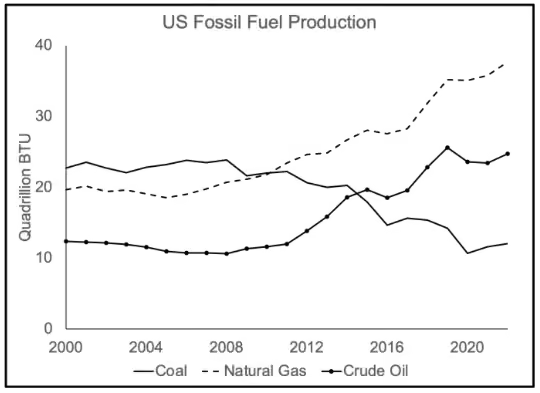
Oil and gas production in the United States had been declining from the 1970s to the early 2000s as all the more easily accessible reserves were increasingly depleted. The advent of fracking reversed this trend: the United States became the world’s largest natural gas producer in 2009 and oil in 2014.
Source: EIA (2024a)
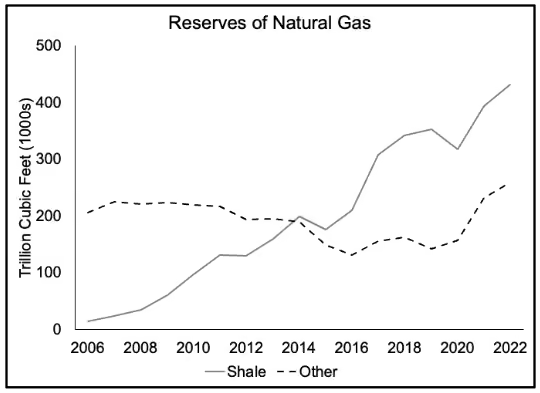
Overall, data from the US Energy Information Agency shows that increased fracking drove this change: production from shale formations – those for which fracking was developed – comprises 75% of U.S. natural gas production and 48% of oil production. And, as the second chart shows, fracking has led to a substantial increase in proven natural gas reserves in the U.S..
Source: EIA (2024b)
What are the disadvantages of fracking?
While fracking has generated a massive boom in domestic oil and gas production, it has environmental costs. One issue is that fracking uses a substantial amount of water and can exacerbate shortages in areas where demand exceeds what can be supplied by local aquifers.
Fracking also generates waste from drilling muds, flowback, and the produced “brines” that must be properly treated and disposed of. Whether due to equipment malfunction, human error, or improper storage practices, it is estimated that about 2% of wells dump these byproducts into streams and roads, damaging the ecosystem and contaminating drinking water with toxic and carcinogenic compounds.
Fracking has also been linked to increased earthquakes in the Central and Eastern United States. Before fracking, there were about 25 earthquakes per year in this region. Once fracking began in 2009, there have been at least 58 earthquakes per year. It’s important to emphasize that to date many of these earthquakes have a magnitude between 3 and 4, strong enough to be felt but not enough to cause damage.
Lastly, while greenhouse gas emissions from natural gas production are far lower than coal, natural gas wells may leak methane through loose joints and valves or from open wastewater evaporation ponds.
What would happen to energy production if we stopped fracking?
A ban on fracking would move the United States from being a net exporter of natural gas to an importer, as natural gas consumption far exceeds the production from conventional techniques. Similarly, ending fracking would reduce U.S. production of oil by almost 40%. These changes would cause a spike in both oil and natural gas prices, affecting families and businesses.
Beyond these challenges, an end to fracking would also present new geopolitical complications. By way of example, Russia is the world’s largest exporter of natural gas. If the U.S. were to depend on Russian exports, it would make it far more difficult for policymakers to check Russian aggression in Ukraine.
Lastly, while fracking can negatively impact the environment, the increased natural gas production has reduced coal consumption by power plants and other energy producers. If natural gas became prohibitively expensive, a portion of energy production would likely return to coal, which has been found to be far worse for the environment.
How does fracking fit into the debate over climate change?
At one level, increased production of fossil fuels by fracking is a source of climate change, as energy production using natural gas and oil releases greenhouse gas CO2 into the atmosphere, likely contributing to increased global temperatures. However, increased production of natural gas and oil has led to reductions in the amount of coal burned to generate electricity. In this way, energy production through fracking is a low-cost way to reduce overall CO2 emissions in the short run and buy time to develop renewable energy technologies.
One sequestration technique, Carbon Capture and Storage (CCS), collects CO2 as it is produced by a power plant or factory. This method has the advantage of capturing CO2 before it is released into the atmosphere. The CO2 is pressurized into liquid form and then injected into rock formations within geological basins, deep enough that it will not leak back into the atmosphere. CO2 can also be injected into depleted oil and natural gas wells to increase production.
A second technique, Direct Air Capture (DAC), involves extracting CO2 from the atmosphere and injecting it underground. At present, this technique is only used in small-scale experimental facilities.
A third technique, Biological Carbon Sequestration (BCS), involves efforts to increase the biomass (plants and trees) in the environment, which removes carbon dioxide from the atmosphere through the natural process of photosynthesis. Conservation ensures that the carbon remains in solid form, or, the biomass can be harvested and burned to produce energy, with the resulting CO2 emissions captured and stored.
Can Sequestration make a difference?
At present, sequestration is a minor contributor to controlling atmospheric CO2 levels. The Rhodium Group, a leading, independent researcher on climate and energy policy, estimates that the United States emitted 5,100 MM tons in 2023 (MM = million metric tons, one metric ton equals about 2,200 pounds), a 1.9% drop in emissions from the prior year. Sequestration was a very minor component of this decline. The United States houses 15 CCS facilities as of September 2023. These facilities can capture about 22 MM tons of carbon emissions each year (or approximately 0.4% of the total emissions in the United States).
Cost estimates for a larger sequestration effort that would capture enough CO2 to offset continued emissions are unavailable. CCS systems have only been implemented for a narrow set of CO2-generating facilities such as power plants. It is unclear how to capture CO2 from other major producers such as automobiles and aircraft. DCS systems exist today only in experimental form.
As for biological methods, an estimate developed by a team of scientists led by Dr. Thomas Crowther and published in a leading journal (Science 365) found that meeting the goal of capturing enough CO2 to limit global temperature increases to 1.5 degrees Celsius would require doubling the size of the world’s forests – a dramatic change in land-use patterns and one that might require government expropriation of privately-held lands. For more details on the laws governing expropriation, see our brief on Eminent Domain in the further reading section. It is impossible to estimate the cost of this effort, but it is surely massive.
It is also possible that increased CO2 levels could cause increased plant growth, leading to some additional carbon capture without human intervention. However, studies of this mechanism also suggest that higher CO2 levels could lead to increased releases of CO2 from decayed plant matter in the soil. Thus, it is unclear whether the net effect of higher CO2 levels on sequestration is positive or negative.
The introduction of large-scale sequestration technologies would raise additional questions. The capture and transportation of compressed CO2 requires specially designed pipes and storage facilities that are expensive to build. Moreover, the Environmental Protection Agency’s underground injection control program mandates a 50-year post-injection period in which the site must be maintained and monitored. It is unclear whether existing techniques ensure that CO2 will not leak out during this time, or what could be done to stop a leak once it started.
Current federal programs offer grants to demonstration and pilot projects for development of new sequestration programs. However, the success of these efforts is far from guaranteed.
The Take-Away
If large-scale, cheap sequestration was possible, it could be an ideal choice for reducing global CO2 levels. At present, however, sequestration is expensive and can only deal with a small percentage of global CO2 emissions. Without significant technological breakthroughs, sequestration is currently not a viable option for addressing climate change.
The federal government often incentivizes behavior by using carrots or sticks. Tax credits, like a carrot, are a reward for engaging in behavior the government wants to encourage, like installing solar panels on your home. The alternative strategy is to use sticks, taxing people who do things the government wants to discourage, like operating a coal-fired power plant. Such taxes are discussed in our policy brief on carbon taxes. Another form of sticks are cap-and-trade systems that limit the amount of greenhouse gases emitted by utilities and other businesses. The policy brief on cap-and-trade has details.
What energy tax credits are available?
There are many energy tax credits at the federal and state levels. Here, we summarize some of the major programs. Federal programs for individuals give credits for weatherizing homes, installing solar and other renewable energy systems, and buying hybrid and electric vehicles. For example, the Energy Efficient Home Improvement Credit incentivizes homeowners (landlords and renters are not eligible) for weatherizing their homes and making energy-efficiency improvements. This credit is capped at $3,200. The Residential Clean Energy Credit refunds citizens up to 30% of the costs of renewable energy technologies such as solar panels, geothermal heat pumps, small wind turbines, and other renewable systems.
Federal clean vehicle credits reimburse up to $7,500 of the cost of a qualifying electric vehicle. Both individuals and businesses are eligible for these credits, which can cover purchases of new and used vehicles. The qualifications include that the vehicle can be charged by an external source, has undergone final assembly in the United States, and is manufactured by a company that has not manufactured more than 200,000 electric vehicles since 2010. (As of mid-2024, the last provision only disqualifies vehicles produced by Tesla.)
Businesses constructing or retrofitting buildings to be energy efficient can claim the Energy-Efficient Commercial Building Credit. Construction companies that build energy-efficient homes can claim credits up to $5,000 per home. Additionally, the Renewable Electricity Production Tax Credit gives power-generation companies two options: a tax credit for money invested in new renewable energy systems or a credit on the electricity produced by these systems. Credits are also available for construction of energy storage facilities. There are other credits for producing clean fuels (those that produce minimal CO2 when used), building and operating nuclear power plants, facilities that reduce CO2 emissions from factories, and building electric vehicles.
What are the costs of energy tax credits?
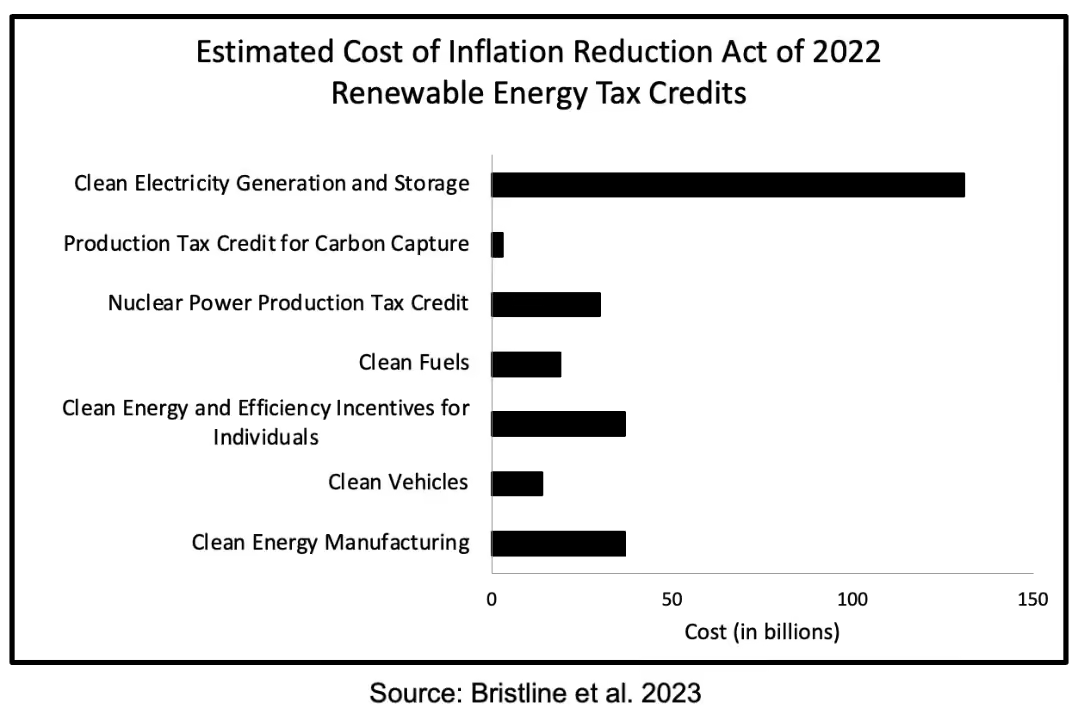
The Inflation Reduction Act of 2022 extended many existing energy tax credits into the future, many until 2032. A Brookings Institution study estimates that the cost of these tax credits, in lost tax revenue and direct expenditures, will be $392 billion between 2022 and 2032.
What are the pros and cons of energy tax credits?
Energy tax credits offer both direct and indirect benefits. The direct benefits include reducing total energy consumption and increasing the energy produced by renewable sources. In addition, tax credits can create a second benefit: if they lead to increased purchases of new systems such as solar cells, producers may respond by investing in production efficiencies and research that lowers the cost to future purchasers. As discussed in our brief on renewable systems, the price of solar electricity systems has sharply declined over the last two decades. Demand stimulated by individual and business tax credits is one possible explanation.
The largest disadvantage of using tax credits to shift towards renewable systems is that governments must make difficult decisions about which technologies to encourage, and is associated with financial implications and restrictions on individual, social and industrial preferences. For example, as the table above shows, over the next ten years, the federal government will spend over $50 billion on tax credits for manufacturing and purchasing electric vehicles. The goal is to reduce CO2 emissions from automobiles and trucks. Is a shift towards electric vehicles the best way to achieve this goal? The same funds might achieve larger reductions if used to improve existing vehicle technologies. As we discussed in our brief on electric vehicles, broad adoption of EVs will require significant investments in charging infrastructure. By implementing an EV tax credit, the federal government is making complex decisions that have long-lasting consequences, in many cases, without having a complete picture of all relevant factors that may impact the outcome of such policies.
A second problem with tax credits is that they can reward people for decisions they would make regardless of the tax benefits. For example, a generation ago, solar energy systems were uneconomic, meaning that the cost per kilowatt-hour of energy produced was far greater than buying energy from a local utility. Tax credits were needed to reduce costs and motivate individuals and businesses to install solar systems. Now, after sharp declines in the price of solar systems, people may buy these systems at comparable prices to alternative sources regardless of the tax benefits. If so, then the credits are depleting taxpayer funds while not having a meaningful impact on changing consumer behavior.
Due to lobby efforts and political influence, much of these tax credits and other incentives typically benefit only a select group of people with influence and power within the energy and related sectors. The credits can also influence land use and associated values for both target and adjoining properties (e.g. how would the majority of Americans feel if a neighboring property’s zoning allowed for a large solar or wind farm next to their home?)
Tax credits can also become feel-good public relations measures with little real benefit. For example, the figure above shows very little use of the credits for carbon capture. One of two things might be true: the credits are too small to change anyone’s behavior, or appropriate technology is not yet available. Either way, the tax credit is unlikely to have its intended effect.
What are the principal renewable energy sources used in the United States?
Renewable energy is defined as energy that is produced from natural sources like wind, solar power, geothermal, biomass (plants), and hydropower. For the most part, renewable systems produce electricity; the exception is geothermal systems, which produce heat. Renewables are different from fossil fuels in two ways. One is that renewable energy is predominantly available from naturally replenished sources, compared to fossil fuels, which are limited to what is available under the Earth’s surface. The other advantage of renewable energy options is that they are typically cleaner, meaning subject to the mining of select minerals and the discarding of key components with limited life expectancy (i.e., batteries, solar panels, composite blades for turbines, etc.), their operation does not generate greenhouse gasses.
Not all clean energy sources are renewable. Nuclear fission systems, for example, are clean but not considered renewable because they rely on uranium mined from the ground.
How much renewable energy is currently produced in the United States?
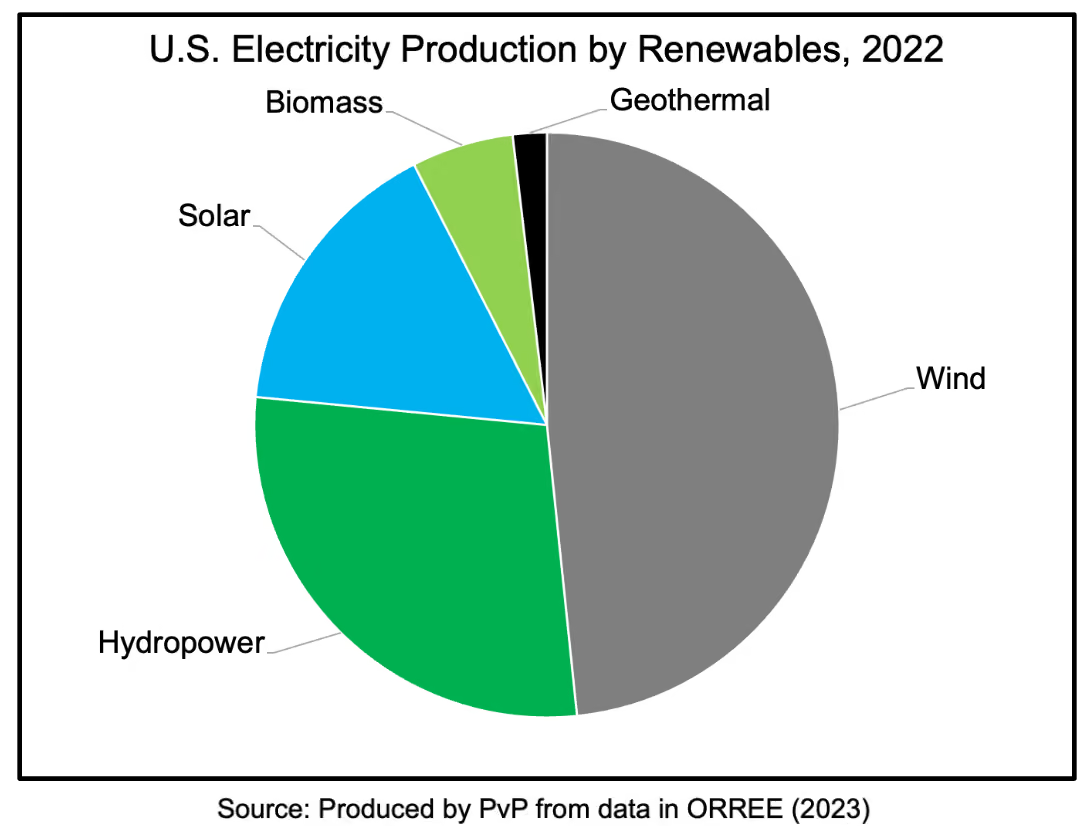
As of 2022, roughly 20% of the total electricity produced in the United States is produced by renewable sources. About 20 percent is produced by nuclear fission sources, with the remaining 60% produced by fossil fuels. (For information on non-renewable sources, see our brief on decarbonization, which is linked in the Further Reading section.) The shares from different renewable sources are shown below.
Is the generation of renewable energy expected to increase?
The U.S. Energy Information Administration projects that renewable energy will account for a quarter of electricity production in 2024. The percentage is expected to further increase over time.
The increase in renewable use has two primary drivers, both related to the U.S. government subsidizing adoption. First, the cost of renewable energy systems has been steadily dropping as a result of available funding for research to improve renewable technologies. One study found that the cost of electricity generated by solar systems declined by 80 percent between 2011 and 2021. Second, the U.S. government has established substantial tax credits to offset the cost for individuals and businesses to install renewable systems.
Is renewable energy cost-competitive with fossil fuels?
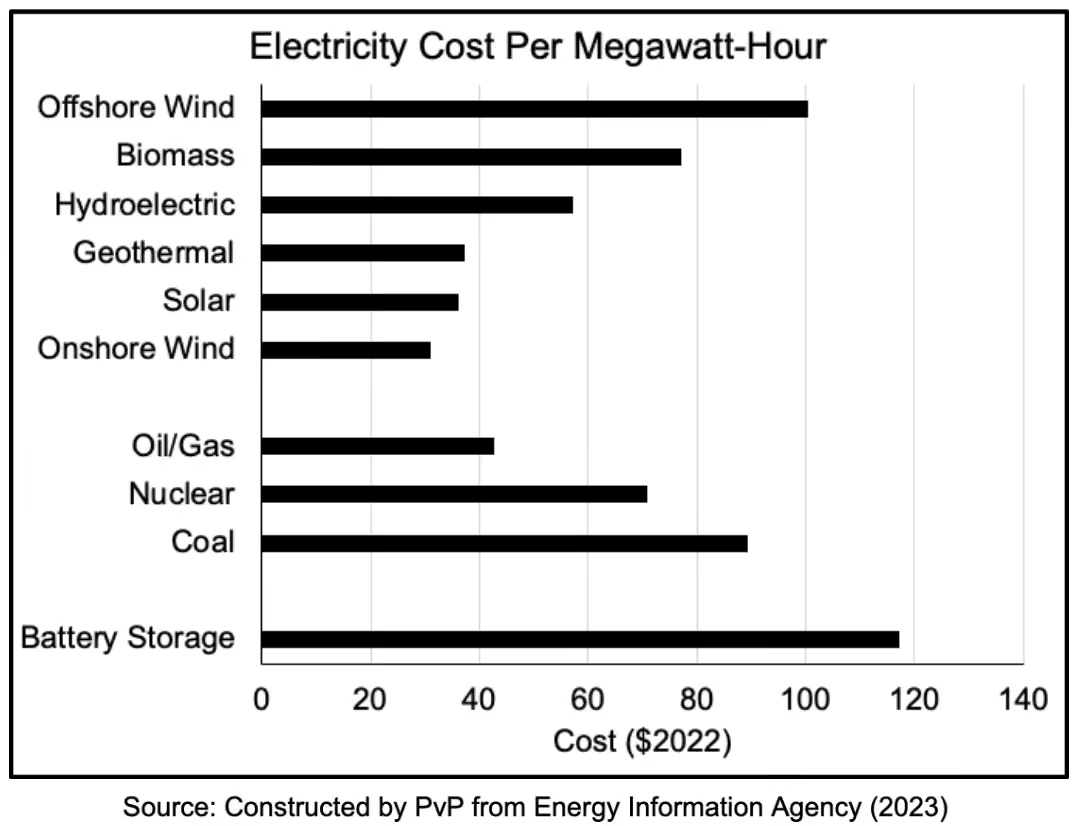
Comparing the costs of renewable and fossil fuel systems is complicated. Estimates usually calculate the cost of building and operating different kinds of power plants, estimate how much energy each type of plant will produce, and calculate the cost per megawatt hour. (A megawatt-hour is the amount of electricity needed to run a typical US house for about a month.) The figure below shows the current cost estimates constructed by the U.S. Energy Information Agency for the various renewable and fossil fuel systems mentioned earlier.
For example, a new solar electricity system can generate electricity at about $35 per megawatt-hour. Onshore wind systems are even cheaper, at about $30 per megawatt-hour. Both of these costs are lower than those of nuclear fission systems (about $70 per megawatt-hour), coal-fired power plants ($42), or oil or natural gas plants ($90).
Data showing that some renewable systems are cost-competitive with fossil fuels and nuclear power leads many to advocate a country-wide transition to renewable energy production. Unfortunately, the decision is not that simple. As mentioned previously, a major consideration is that these estimates potentially require significant federal funding and related tax credits to reduce the cost of energy generated by renewable systems, both for utility providers and consumers of electricity. Without these subsidies, costs would rise substantially.
A mass transition would also raise two other problems. The first is that these cost estimates are for ideally-located systems. Solar systems do best in areas with clear skies and lots of sun, such as the Southwest United States, while wind systems do best in areas with strong average wind speeds, such as the Midwest and Texas. Geothermal systems are limited to areas with large temperature differences at different levels belowground. Hydropower requires deep, fast-running rivers. Thus, the actual cost of a country-wide transition would likely be much higher than these estimates because some systems will not work as well as others or because expensive transmission lines will be needed to move electricity from one part of the country to the other.
The second problem is that these cost estimates are for additions to the existing energy infrastructure, one where renewables play a significant but not dominant role. With current systems, if cloud cover remains over a solar panel array for a significant amount of time or the wind stops blowing at a wind turbine farm for an extended period, the amount of lost electricity is relatively small on a comparative scale to all sources of electric power generation today, and fossil fuel plants can increase their generation to compensate.
However, if renewables were the country’s main or only source of electricity, utilities would need to invest in many storage systems, such as batteries and other storage technology, to ensure they had enough stored energy to ride out any gaps in electricity production to avoid planned brownouts and uncontrolled blackouts. As the previous figure shows, the current cost of energy storage systems per megawatt-hour is very high. Utilities might need several megawatt-hours of storage for each megawatt-hour of renewable power. When these costs are added to renewable systems, they are not cost-competitive with fossil fuels. The 2022 Inflation Reduction Act is funding research on cheaper storage systems, but none are currently commercially available today.
Finally, each type of renewable system has unique disadvantages. Hydroelectric systems require building dams across rivers and releasing water in controlled amounts, harming fish and affecting recreational river use. Large solar systems take up considerable land, and in some cases due to construction have been recorded to leach unwanted chemicals back into the ground. Wind farms (particularly offshore) are sometimes opposed because they destroy scenic views and some speculate their construction and operation harm marine life. While there is no costless way to generate electricity, renewable systems in some ways concentrate these costs on a smaller portion of the population who live near these facilities which could be perceived as for the common good, whereas other non-renewable sources of electricity can potentially have a longer-term negative impact across a broader footprint, and again, rely on a limited supply of natural resources.
Even if it costs more, would a transition to renewables solve the problem of greenhouse gasses?
As discussed in our policy brief on Decarbonization, electricity generation is a large producer of greenhouse gasses but not the only producer. Even if the United States could switch entirely to renewable systems, it would still generate significant greenhouse gasses from air travel to cement production. As a matter of reference, for each new wind turbine it is estimated 600 cubic meters of concrete is needed for the base of each structure. A full transition to renewables would likely not move the United States to a “carbon neutral” state where the net amount of greenhouse gasses entering the atmosphere each year is zero. It will also be enormously expensive.
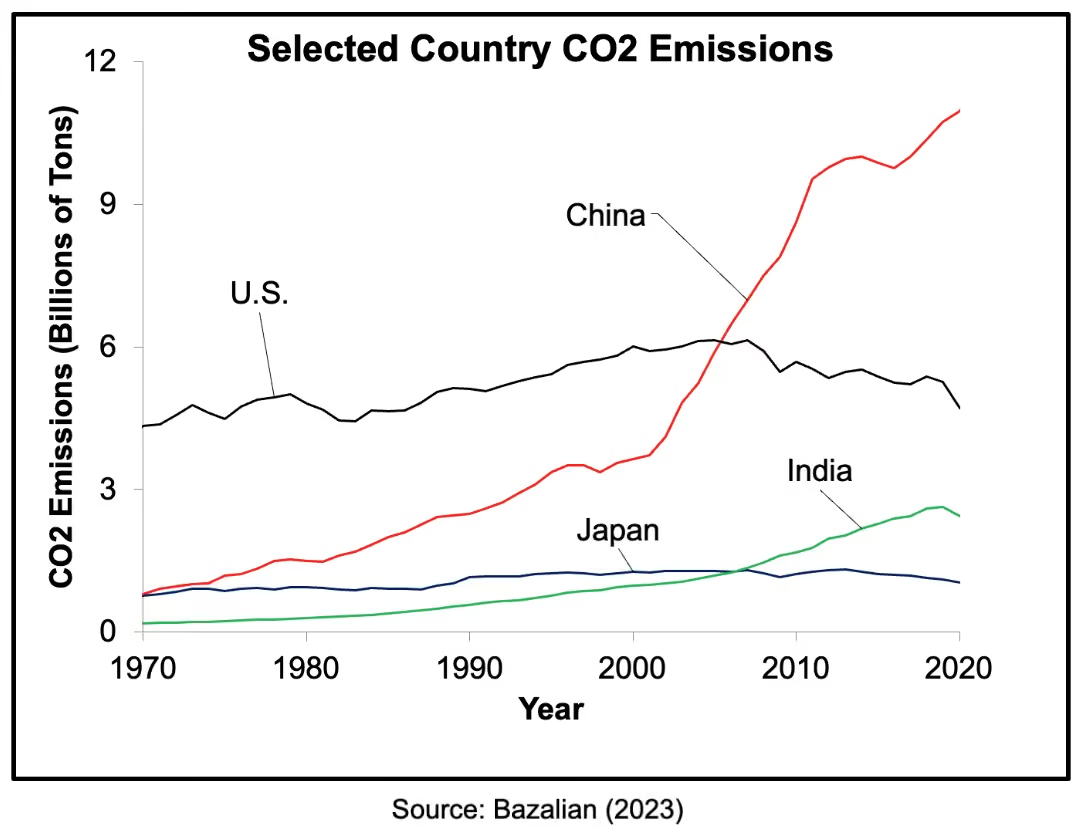
Also noted in the Decarbonization brief: the United States is a major producer of greenhouse gasses, but other countries, particularly China, India, and Russia, are also major producers. Less-developed African nations may also become major producers as they develop local industries and increase electrical production. Even if the majority of Americans thought the best path to Decarbonization was to transition to renewable energy systems, this move would have a minimal effect unless virtually all other developed and developing nations did so as well.
Decarbonization refers to transitioning a nation’s economy from relying on fossil fuels (coal, oil, and natural gas) to using clean (carbon-free) energy from sources such as solar, wind, hydropower, and nuclear.
Our brief on climate change discussed the logic behind decarbonization. Analysis of climate models ties higher global temperatures to increased emissions of greenhouse gasses such as carbon dioxide (CO2). These models predict that a large enough reduction in greenhouse gas emissions will eventually stabilize or could even reduce global temperatures.
How much CO2 is produced in the U.S. each year?
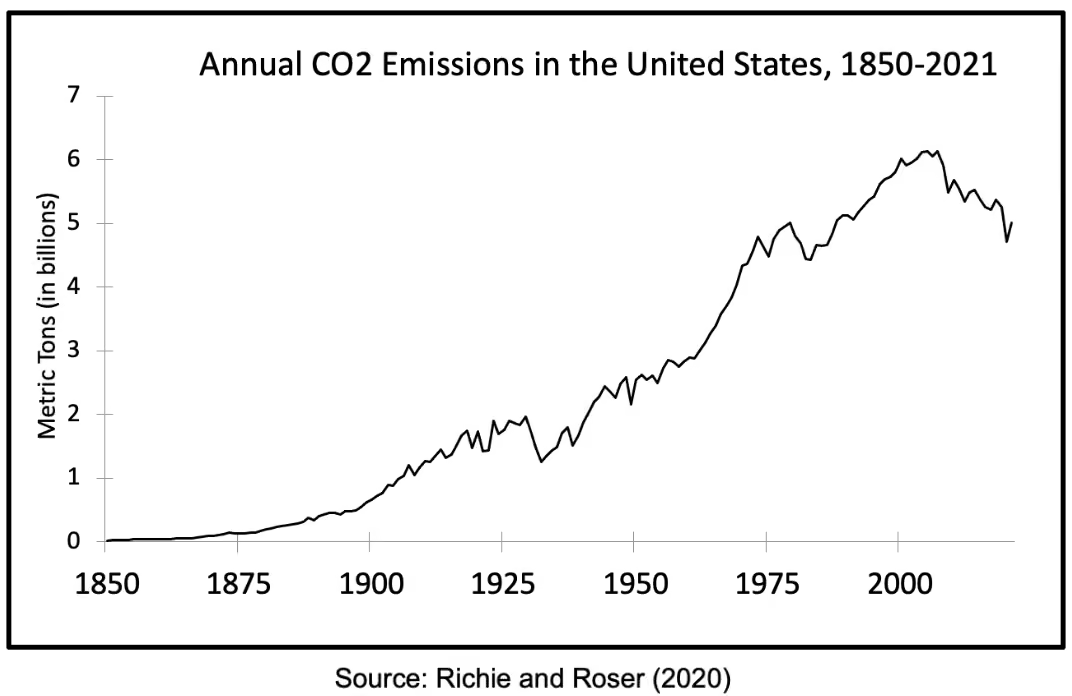
According to studies it’s believed the U.S. produced over 6 billion metric tons of CO2 in 2021. Some CO2 is used in industrial processes or injected into oil and natural gas wells to stimulate production. Reforestation projects also reduce CO2 emissions as trees use CO2 to grow and incorporate it into their trunks and branches.
The chart below shows the estimated annual net amount of CO2 released into the environment by U.S. individuals and businesses.
The amount of greenhouse gasses released by the U.S. has declined in recent years because of declining coal use to generate electricity and increased use of solar and wind power. However, as we discuss later, emissions from developing nations, including India and China, are increasing.
What activities produce greenhouse gasses?
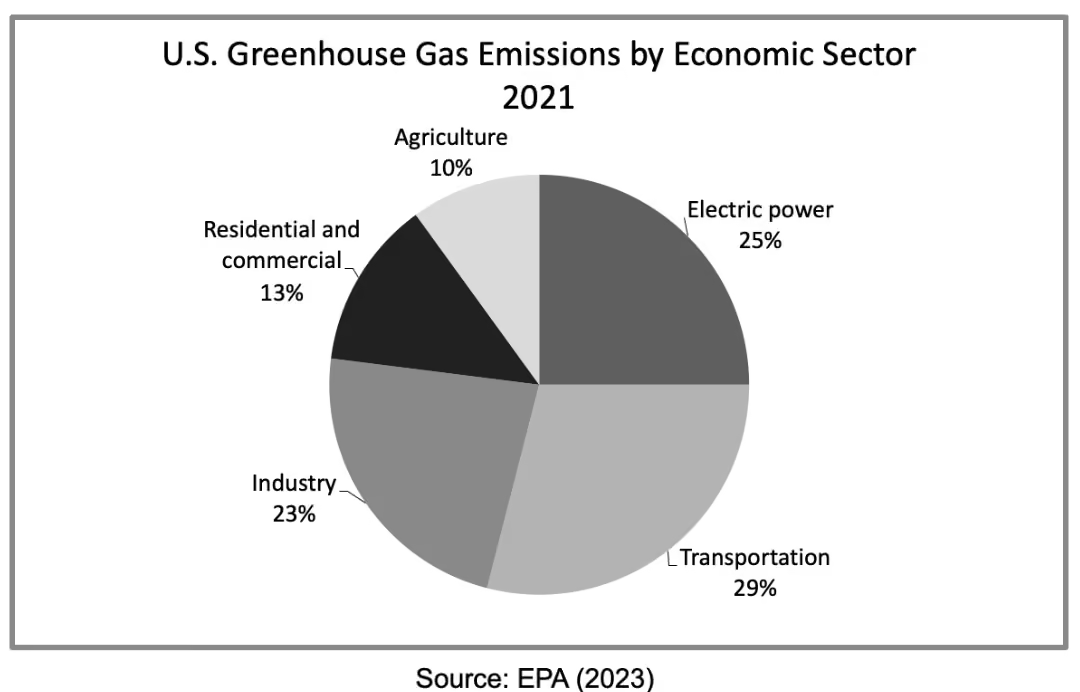
The chart below depicts the percentage of greenhouse gas emissions from different economic sectors in 2021.
The figure shows that transportation, including automobiles, aircraft, and trucks, is the largest producer of CO2. Electrical power generation is a close second, followed by industrial processes, including manufacturing. For example, one of the largest single contributors to CO2 emissions is the production of concrete and cement, which accounts for about 7% of total emissions.
The important message from this figure is that there is no one solution for decarbonization. Changing how cement is made will reduce CO2 emissions from these factories, but reducing CO2 emissions from automobiles will require a completely different approach.
How far can Americans decarbonize?
The official goal of the current U.S. government is to reach “net-zero” emissions by 2050. Net zero means that whatever greenhouse gasses are produced in the U.S. are offset by CO2 removed from the environment by carbon sequestration, including biological activities such as tree planting. For details, see our brief on carbon sequestration.
Is this goal achievable? The answer depends on how much Americans are willing to pay and how much they are willing to change their lives. Some changes are already underway. Utilities are reducing emissions by closing coal-fired power plants and replacing them with renewable systems (wind, solar, and hydropower). Some factories are installing scrubbers that capture CO2 as it is produced so it is not released into the environment. Increased use of electric (and hybrid) cars and trucks also reduces total CO2 emissions.
Larger reductions to reach net zero will require more substantial and costly changes. For example, it is possible to eliminate greenhouse gas emissions from electricity generation by transitioning to renewable systems. However, as discussed in our brief on renewables, this transition will require a large investment in energy storage technologies such as batteries, mining of natural resources such as Lithium, and comes with other implications in areas like global trade and national security as other countries rely on fossil fuel exports from the U.S. and neighboring countries. Similarly, mandating electric vehicles to reduce emissions further will require building charging infrastructure nationwide and in individual homes. For details, see our brief on EV infrastructure.
Some changes are impossible with current technology. For example, our system of intercontinental air travel relies on jet engines that burn fossil fuels. There is currently no alternate fuel that can power large aircraft across long distances.
Given the practical impossibility of eliminating CO2 emissions, the net zero goal will require large-scale carbon sequestration. However, as discussed in our carbon sequestration brief, current systems that remove CO2 from the air are expensive, complicated, and have limited capacity. Moreover, plans to plant billions of trees to capture carbon dioxide require substantial land and may not capture enough carbon.
For all of these reasons, achieving net-zero CO2 without new technological breakthroughs will likely require substantial changes in our everyday lives—traveling less, using less electricity to heat and cool our homes, or driving an electric car.
It is also unclear whether achieving net zero is mandatory to address climate change. Climate models confirm that increased CO2 levels are causing global temperature changes and other effects, but they are less precise in their predictions about what will happen if we achieve this goal or substantially reduce emissions but do not eliminate them entirely.
Finally, decarbonization will affect local economies in communities with large-scale coal, oil, and natural gas production. For example, over 60% of U.S. oil is produced by three states: Texas, New Mexico, and North Dakota. Moreover, nearly 74% of coal production is in five states: Wyoming, West Virginia, Pennsylvania, Illinois, and Montana. Decarbonization would likely increase unemployment and lower economic growth in these states.
Can America decarbonize on its own?
It could – but doing so might have little effect. While the U.S. is a major producer of CO2, its emissions are only a fraction of the world’s total. The figure below compares the U.S. to three other major emitters: China, India, and Japan. As the figure shows, emissions by the two developed countries, Japan and the U.S., have been stable over the last 50 years. In contrast, emissions from China and India are rapidly increasing due to population growth and industrialization.
The problem is this. Even if the U.S. gets to net zero, this effort will have minimal effect on global temperatures unless all other countries which are major producers of CO2 do the same. In addition, in much of the developing world, emissions are not stable – they are increasing. As a result, it will be much harder for countries like China and India to achieve net zero. Many developing countries oppose a global net zero goal because they cannot afford investments in clean energy technologies.
In sum, decarbonization is both a difficult engineering and political achievement. Substantial CO2 reductions will require massive investments, technological breakthroughs, and a high level of international cooperation.
What evidence is there that the climate is changing?
The Intergovernmental Panel on Climate Change (IPCC) reports that the Earth’s average temperature has risen by 1.1 C (1.9 F) over the last 100 years. The figure below shows average temperatures in North America over this time. The clear trend is toward warmer temperatures.
Other indicators of climate change include melting glaciers and polar ice caps and a resulting rise in sea levels. Changes in precipitation and increased frequency and intensity of extreme weather events, such as hurricanes and heat waves, are also cited as evidence of climate change.
All these claims are the subject of intense analysis and debate. It is not easy to track temperature changes over time. For example, a portion of the network of scientific temperature recorders are in rural areas. Over time, these rural areas develop into cities, suburbs, or industrial areas. As a result, the data may reflect increased temperatures simply because developed areas are warmer than rural areas due to heat released by structures.
Similarly, some studies have documented increased extreme weather events in recent years. However, it is impossible to determine whether a particular hurricane, flood, or forest fire was caused by climate change. In addition, when data is tracked regarding the severity of such storms, much of this data is based on threats to life and property. As areas across the globe become more developed, populations increase as does the cost of such storms due to an increase in physical improvements (buildings, bridges, etc.) in these areas. Furthermore, we do not know what would have happened in a hypothetical world where temperatures had remained stable over the last century.
Moreover, serious storms are relatively rare. One recent study predicted that over the next 100 years, there will be an increased likelihood of two severe hurricanes hitting the same spot on the east coast of the US during the same season. However, the probability of this outcome is still low, about 1 percent.
Is climate change the result of human action?
The most-cited evidence for human action being the cause of climate change is the observed correlation between atmospheric carbon dioxide (CO2) and temperature increases. CO2 is a greenhouse gas – it limits the amount of heat that can escape from the surface of the Earth. As we discuss in our policy brief on decarbonization, CO2 is produced by industrial processes, electrical power generation, transportation, and other human activities. Studies show that an increase in CO2 levels began during the Industrial Revolution. Levels have increased with higher population and development worldwide.
Critics of this approach note that global temperatures have moved up and down throughout history. At one time, the Earth was so warm that the polar ice caps melted, raising sea levels by several hundred feet. At another time in history, temperatures dropped enough that glaciers covered most of the planet. Given these changes happened without humans, why connect the much smaller changes in recent years to human activity?
However, the argument for connecting human activity to climate change goes well beyond the fact that CO2 levels and temperatures have moved together. These conclusions are based on models of global weather that account for inputs like sunlight, biological processes, and the composition of the atmosphere. These models are incredibly detailed. For example, they account for the principle that higher CO2 levels stimulate tree growth, removing carbon dioxide from the atmosphere and reflecting heat away from the ground. Through satellite imagery, several universities and scientific groups have documented a ‘greening effect’ across the globe over the past 30 years.
At the same time, climate models have their limits. For example, while increased CO2 stimulates tree growth, the amount of CO2 captured by trees depends on what kinds are grown and whether they are cut down and burned. As a result, predictions made by these models have some uncertainty. They give a range of values for future temperatures rather than a precise number.
Additionally, when shifting the conversation of the potential positive impacts of increased CO2 away from trees to man-made crops like rice, wheat, soy, peas and sorghum, all used in mass food production, it’s plausible an increase in concentration of CO2 could signal a reduction in vitamins and nutrients like iron, zinc and protein found in these crops.
One of the central findings from climate models is that increased global temperatures result from greenhouse gas emissions. Most analyses also conclude that these changes are not the result of other sources of greenhouse gases, such as animal and plant life or natural processes like volcanoes. For example, one study analyzed the atomic structure of atmospheric CO2, concluding it results from human activity rather than biological or geological processes.
Why do many scientists believe these findings? In part it is because the models incorporate known findings, such as how CO2 affects plant life. In addition, climate models generate other testable predictions. For example, one alternate hypothesis for increased global temperatures is that the Sun has become slightly hotter. If this change had occurred, it likely would cause larger temperature shifts at the Earth’s poles compared to the Equator. Data shows that the opposite is happening (temperature changes at the Equator are larger than at the poles), which is the expected result of increased global CO2 levels.
Why is climate change such a controversial topic?
Climate change is both a scientific matter and a values question. Scientists can test predictions drawn from climate models, identify limitations, and build and test better ones. Over the last generation, this process has produced an increasingly better understanding of how global temperatures are changing and how these changes might affect human life. As we have discussed, these analyses have their limits. However, it is difficult to justify ignoring this evidence entirely.
At the same time, scientific research cannot tell us how to respond to climate change. People may have differing views on the nature of the problem or the viability of proposed solutions. For instance, transitioning to a low-carbon economy will produce job losses in some sectors, such as coal mining. It will require significant investment in new technologies, such as solar cells and wind turbines. This transition may seem worthwhile for people in coastal communities vulnerable to flooding and who are not concerned about potential implications to marine life. But people far away from coasts, or who live in a community sustained by fossil fuel production, may see this transition as undesirable.
Another example are proposals to ban the sale of gasoline-powered automobiles. As we discuss in our brief on EV Infrastructure, this transition will require significant new infrastructure at home and on the road to charge these vehicles, and has other complications, including the environmental impact of mining for battery raw materials, disposal of key components that are not biodegradable and increased demand for electricity. And in fact, many recent studies are suggesting that hybrid vehicles may actually be a more viable path longer-term.
For many people, it is a real question of whether the costs and drawbacks outweigh the benefits of a reduction in CO2 levels. Even if changes are implemented, they may not have the intended outcome. Furthermore, efforts made by Americans will have little effect if other countries do not take similar measures. Nothing in the science of climate change tells us how to think about these issues. It is up to each of us to decide how we believe they should be addressed.
Here are links to our other climate change briefs.
The Terrorist Screening Dataset (TSDS) is maintained by the Federal Bureau of Investigation’s National Counterterrorism Center. It contains the names of over a million individuals identified by U.S. intelligence agencies as known or suspected terrorists. It was developed after the 9/11 attacks to make it easier for intelligence agencies to share this information with federal, state, and local law enforcement agencies as a way of preventing future terrorist attacks. An individual is added to the TSDS only if there is a “reasonable suspicion” that they are a known or suspected terrorist.
One important point is that the TSDS only identifies individuals as known or suspected terrorists. It does not include information on whether they threaten the U.S.. For example, the TSDS includes the names of individuals who are members of FARC, a terrorist organization operating against the Colombian government. The FARC has never organized an attack in the U.S. and, in fact, no longer conducts terrorist operations in Columbia.
Another problem with using the TSDS to flag suspected terrorists is the possibility of a false positive. In this situation, an individual’s name matches an entry on the TSDS but is a different person with the same name. There have been cases where someone has been arrested because of a false positive and later released when the discrepancy was realized.
What evidence is there for terrorists entering the U.S. from Mexico?
The Department of Homeland Security data for 2017 – 2023 is shown below.
Source: Customs and Border Patrol (2023)
Encounters at ports of entry are cases where someone entering the U.S. at a Border Patrol facility is detained because a passport check shows they are on the TSDS. Encounters between ports of entry are cases where someone tries to enter the country illegally but is apprehended by law enforcement and later identified as being on the TSDS.
As the figure shows, both kinds of encounters are on the rise. As we discuss further in our Policy Brief on Border Security, there has been a sharp increase in border crossings in recent years. For more details, see the brief linked in the Further Reading section.
The increase in TSDS encounters between ports of entry is particularly concerning, as these individuals are trying to enter the U.S. without having their identity checked. The encounter data is reassuring at one level, showing that many terror suspects are being identified and detained. However, DHS data for 2023 also shows hundreds of thousands of “getaways” – encounters between ports of entry where an individual evades arrest. While many of these getaways are undoubtedly ordinary people who are escaping political persecution or economic hardship in their home countries, the concern is that potential terrorists are using this entry method to evade detection.
How high is the risk?
Does the sharp increase in TSDS encounters outside ports of entry imply an increased risk of a domestic terrorist attack? It is impossible to be sure, however, a concern is that as the number of illegal entrants rises, it might be easier for a would-be terrorist to enter the country undetected.
A detailed study of border security and terrorist attacks over the last 30 years confirms the need for vigilance but also suggests that analyses based on TSDS data need to be placed in context:
There do not appear to be any cases of a person on the TSDS who entered the country illegally and was later indicted for planning or carrying out a terrorist attack.
No Americans have been killed by terrorists who entered the country illegally. (Of the 19 individuals who participated in the 9/11 attacks, all entered the U.S. legally using passports and visas.)
There are cases where the TSDS has flagged individuals not planning attacks against the U.S.. For example, 25 of the 27 people flagged by Border Patrol TSDS checks in 2022 were Colombian citizens and likely members of the FARC. Why they were trying to enter the U.S. is unknown, but it is unlikely that they were planning a terrorist attack.
The increase in the number of Border Patrol encounters with individuals on the TSDS is part of a larger problem with maintaining border security given the large number of individuals seeking to enter the U.S.. However, the issue of would-be terrorists entering the country is a different problem, one that requires scrutiny of all entrants, not just asylum applicants.
The TSDS data also raise a fundamental question about border security: how much is enough? There is no doubt that the number of illegal border crossings by individuals on the TSDS could be reduced through increased surveillance of the border in between ports of entry or even by deploying military assets to secure the border. The fact remains, however, U.S. records indicate that no illegal entrant has ever been directly linked to a terrorist attack on U.S. soil. This suggests that while greater border security would reduce some of the underlying challenges with immigration, these measures may still have little impact on preventing a terrorist attack in the future.
What does the Second Amendment say about the right to bear arms?
The Second Amendment to the Constitution states that “a well-regulated militia, being necessary to the security of a free State, the right of the people to keep and bear Arms, shall not be infringed.” This language within the Amendment has been debated – is the right to bear arms intended for militias or all people? Do these rights pertain to all firearms, or only certain kinds? Can firearm ownership be restricted, as other civil liberties are, or are guns a unique situation in American constitutional law?
Have interpretations of the Second Amendment changed over time?
Yes. During the 1800s and 1900s, the Second Amendment was interpreted according to the ‘collective right’ model of gun ownership. In this model, the Supreme Court interpreted the 2nd Amendment as protecting an individual’s right to serve in a collective militia and to own a gun for that purpose, but not for the purpose of individual protection only.
This interpretation began to change in the 1960s, with some legal scholarship suggesting the individual right interpretation, and maybe responding to high-visibility gun-related events like the assassination of JFK. Beginning in the 1970s, some legal scholars began to interpret the amendment as a protection against the potential for U.S. federal government overreach itself, sometimes called the ‘insurrectionist’ model. At the same time, individuals and groups supporting broad gun rights brought lawsuits against state and local regulations.
The Supreme Court has ruled only five times on the Second Amendment – once in 1886, and four times since 2008. In 2008, the Supreme Court ruled in District of Columbia v. Heller that the Second Amendment protects an individual’s right to own a gun even when unconnected to a militia. In this ruling, the Court also held that these rights are not absolute, confirming that there is room for laws that restrict gun ownership.
In 2010, the Supreme Court ruled in McDonald v. City of Chicago that the Second Amendment applies to state and local governments as well as the federal government. The City of Chicago had passed a law limiting the possession and carry of a handgun within city limits. The Supreme Court ruled that this ban limited individuals’ constitutional right to self-protection under the Second Amendment as interpreted in the Heller decision.
In 2016, the Supreme Court ruled unanimously in Caetano v. Massachusetts that individuals have a constitutional right to forms of “bearable arms” beyond just those that would have been available at the time of the writing of the Second Amendment. This case related to the possession of a stun gun.
Finally, in 2022, the New York State Rifle and Pistol Association, Inc. v.Bruen Supreme Court decision changed the test of whether state and local laws violate the Second Amendment. The ruling found that New York’s gun control laws requiring a person to show proper cause to obtain a license to buy a firearm was in violation of the 14th Amendment, which in part makes the 2nd Amendment applicable to the states. The Court held that a citizen need not demonstrate cause to exercise their right to self defense by purchasing a firearm, and that open carry of a firearm cannot be restricted except in instances where it incites fear and intimidation.
What gun ownership restrictions exist in the U.S. today?
Congress has passed a handful of laws to tax the sale of firearms and to establish regulations for the ownership and use of firearms. The National Firearms Act (NFA) of 1934 requires the sale of certain types of firearms (including sawed-off shotguns, machine guns, and silencers) be registered with the Secretary of the Treasury. The Gun Control Act of 1968 narrowed the definition of who could own, manufacture, or sell a gun.
States and local governments can also create ownership restrictions. For example, states can determine whether background checks or permits are required for handgun purchase, who can or cannot buy a gun based on the person’s past, age restrictions, and what will be required for licenses and training. Since 2008, many state and local gun laws have been upheld as constitutional, including laws restricting the concealed and open carry of loaded guns in public; bans on assault weapons, large capacity magazines, and silencers; prohibitions on dangerous people possessing guns; firearm design safety standards; safe storage requirements; waiting period laws; and private-sale background checks and licensing laws.
In some states, local governments have jurisdiction to regulate gun carriage and usage. For example, the City of New York issues its own handgun, rifle, and shotgun permits separately from the New York State government. To own or carry a firearm in the City, these municipal permits are required in addition to state permits.
The chart below shows state regulations of handgun carry. Twenty-six states, in black, do not have permit requirements for carrying handguns in public, and twenty-four states, in gray, require permits to open- or conceal-carry a gun.
What are current proposals for changing gun rights?
States have widely varying approaches to gun control legislation. In 2021, a trend of enacting so-called “constitutional carry” laws picked up across the U.S., mostly but not exclusively in more conservative jurisdictions. In these states, no permit is required for a person of legal age (usually 18 or 21) to purchase a handgun or openly carry it in public. In some instances, additional restrictions apply, such as a permit requirement for concealed carry or purchasing restrictions based on criminal history. Currently, 26 states have no permit requirement for concealed carry, and an additional 13 require a permit for concealed carry.
Some states, such as New Jersey, require residents to file for a permit and complete additional steps in order to carry a concealed handgun. This process typically takes between 30 to 120 days. An individual must undergo a national background check, a firearms safety class, pass a field safety test including safe handling, loading and unloading, unholstering, and minimum marksmanship skills, and not possess certain disabilities. In the case of New Jersey, state law also restricts such possession in certain places, including zoos, public parks, public libraries, museums, bars, healthcare facilities, schools, and childcare facilities.
The federal Bipartisan Safer Communities Act, signed into law on June 25, 2022, narrows some definitions of who is allowed to purchase, own, or sell a firearm, including minors with histories of mental health issues, and dating partners with histories of domestic violence.
How is freedom of the press protected in the Constitution?
Freedom of the press is guaranteed under the First Amendment. The Constitution states that “Congress shall make no law respecting an establishment of religion, or prohibiting the free exercise thereof; or abridging the freedom of speech, or of the press; or the right of the people peaceably to assemble, and to petition the Government for a redress of grievances.” The First Amendment also applies to the state governments through the 14th Amendment.
Although the First Amendment only references Congress, the Supreme Court has clarified that the scope of protection for the press from undue censorship includes any government agency, whether at the local, state, or federal level. This protection allows publishers to distribute information or opinions without government interference, prior constraint, or prosecution. While all branches have a hand in protecting the freedom of the press, the Supreme Court, through the power of judicial review, decides when the freedom of the press is being infringed.
Why is press freedom important?
The Founding Fathers believed the right to criticize the government and vote out incapable leaders were essential to self-governance. To exercise these rights, the public must have access to accurate and diverse sources of information. In this way, a free press is vital to holding elected officials and government institutions accountable. Additionally, freedom of the press makes elected officials aware of the public’s preferences on different issues.
Freedom of the press is also vital to setting the political agenda in a country. The media can educate citizens about new political topics and bring said issues to the forefront of the political agenda. A free press can also help strengthen confidence in government transparency and trust in government.
What are the potential drawbacks for society having a free press, and how is it protected?
An uncensored media can encourage the spread of factually inaccurate, intentionally deceptive, incomplete, one-sided, and otherwise dangerous information that could harm the public interest. For example, during the COVID-19 pandemic, information regarding the virus’s origin, motivations behind the public health response, scientific data about the virus and its spread, and vaccine safety were widely disseminated across social media platforms, as well as through books and other published material available for purchase through online sellers.
The government’s discretionary role can be complex at times, either in its effort to encourage greater visibility for certain sources of information deemed relevant and in the public’s best interest while censoring, suppressing, or otherwise limiting information due to the perceived potential of spreading misinformation. The challenge, like any decision involving a complex set of problems that encompass a varied degree of information, data, and scientific discrepancies and beliefs, is the government’s role in determining whether such information is, in fact, accurate or otherwise relevant and in the best interest of the public, and protected under free speech.
As the government’s responsibility comes with a certain level of subjectivity, in some instances, the process in which information and data were considered protected under free speech caused harm, and in other instances, content that was considered misinformation but later determined to be plausible or relevant to the safeguard of the public’s overall health and well-being was suppressed. Both cases can ignite distrust in the government and public health entities. Such distrust can inhibit the government’s ability to serve the public, as well-intentioned policies are more likely to face backlash and resistance in the future.
Similarly, a free press can harm the security of the United States by publishing secret information about military operations or diplomatic efforts. While the government can prosecute reporters and editors for revealing secrets, these prosecutions are extremely rare, as they open the government to claims that it is simply trying to prevent the disclosure of embarrassing information.
What exceptions, if any, exist to this freedom?
Freedom of the press is not unrestricted. The Supreme Court has agreed that, in certain situations, the government is permitted to restrict the freedom of the press. Current law prohibits the publication of libel, slander, obscenity, pornography, classified information, fighting words, and trade secrets.
For example, Dominion Voting Systems recently sued Fox News for defamation. Dominion’s technology is used to tabulate votes in many state elections. In their case, Dominion claimed that Fox News made false statements on air about Dominion engaging in election interference. Ultimately, Fox News settled the lawsuit, paying Dominion $787.5 million and admitting to making false statements about Dominion on air.
Prior restraint is when the government prohibits the media from publishing secret information. In deciding cases of prior restraint, the courts must consider when the importance of security outweighs the freedom of the press and the right for the public to be informed. The government must demonstrate a compelling state interest whenever using prior restraint. In most instances, the courts have determined prior restraint to be unconstitutional. In the 1971 case of New York Times v US, the Supreme Court allowed the publication of the Pentagon Papers, documents that contained top-secret information about the Vietnam War.
The publication of obscene material and pornography are other areas in which there are ill-defined limitations on the press. The Supreme Court uses a test (the Miller Test) drawn from the case of Miller v California in 1973 to decide whether something is obscene and can be restricted. The three requirements of the Miller Test are:
Whether the average person applying contemporary community standards would find the work, taken as a whole, appeals to the prurient interest.
Whether the work depicts or describes, in a patently offensive way, sexual conduct specifically defined by the applicable state law.
Whether the work, taken as a whole, lacks serious literary, artistic, political or scientific value.
That test has been used to restrict the press in many cases. For example, the Federal Communications Commission (FCC) can regulate language on television.
How has the exercise of press freedom changed over time?
One of the first challenges to freedom of the press was the passage of the Alien and Sedition Acts of 1798, making it illegal to print or say anything malicious about the government. This legislation was unpopular and expired before the courts could rule on the constitutionality of the action.
Issues related to freedom of the press did not come to prominence again until the 20th century. The Espionage Act of 1917 significantly affected freedom of the press. This legislation was intended to prevent the transfer of sensitive information regarding military and national defense secrets to enemy nations. However, the Act was used to target political opponents of President Wilson, who opposed the war, preventing 15 antiwar publications from being distributed via mail. The list of prohibited publications included Masses magazine, a prominent socialist, antiwar publication at the time.
Subsequently, federal courts have established stronger protections for the media.
In 1927, the Supreme Court addressed the issue of making false claims in Whitney v California. Justice Brandeis established the counter-speech doctrine, arguing that the correct response to “false speech” was to have “more speech,” meaning the spread of correct information rather than government prohibitions.
In the 1964 New York Times v. Sullivan case, the Supreme Court held that one cannot be sued for defamation or libel by a public government official unless it can be demonstrated that the author knew the claims were false or in reckless disregard for the truth. This ruling solidified the ability of citizens to criticize government officials.
In the 1971 New York Times v. United States case, the court ruled that the government could not use prior restraint to prevent the publication of the Pentagon Papers, which contained classified military information.
Section 230 of the Communications Decency Act of 1996 protects social media companies from being found liable for publishing content posted by users.
How is freedom of speech protected in the Constitution?
The First Amendment in the United States Constitution establishes freedom of expression, which covers verbal and nonverbal behaviors that express a person’s opinion, point of view, or identity. The Amendment states, “Congress shall make no law…abridging the freedom of speech”. Essentially, this provision prevents the government from making laws that restrict speech. While this amendment addresses Congress directly, courts have interpreted the Amendment to apply to the entire federal government. Additionally, Courts have ruled that the Due Process Clause of the 14th Amendment protects First Amendment rights from interference by state governments.
Why is freedom of speech important?
The Supreme Court has called freedom of speech, “the matrix, the indispensable condition, of nearly every other form of freedom”. The idea is that free speech lays the foundation for other constitutional freedoms, such as freedom of assembly, freedom of religion, and a free press. Freedom of speech is considered a fundamental human right because it enables people to express their thoughts and ideas without fear of retaliation, censorship, or legal sanction. Free speech in democratic societies fosters open public discourse and cultivates an enlightened citizenry. Moreover, free speech allows for societal change by providing a platform for protest and affording minority voices an opportunity to be heard. The absence of freedom of speech would make it easier for the government to censor and control ideas.
What are the potential drawbacks of free speech?
The potential drawbacks of freedom of speech include the spread of harmful, false, or offensive ideas. Hate speech, such as displaying symbols of past oppressions or wearing offensive language, is legal. Harmful speech, such as speech that incites violence or targets hatred toward other groups, poses a challenge for democracy. More generally, free speech means we may be exposed to ideas or expressions we disagree with or do not want to hear.
For example, in 2017, two groups protested an initiative by the town of Charlottesville, Virginia, to remove Confederate monuments (one in support and the other in opposition). Each group claimed that they were exercising their free speech rights. A second example occurred in 1977 in Skokie, Illinois, home to many Holocaust survivors, when a neo-Nazi group wanted to march through Skokie. The group claimed that the march was a matter of free speech.
The exercise of speech rights can become problematic when doing so creates a potentially hostile environment or when speech involves calls for violence. In the case of Charlottesville, while there were no widespread calls for outright violence, a car driven through a crowd of anti-monument protesters resulted in the death of one individual. Courts have ruled that governments can restrict speech if violence can reasonably be foreseen.
There are some arguments that intentionally hateful speech, such as the Skokie case, should be regulated. The power to sue for defamation may protect an individual from inaccurate attacks on their character. Still, there is no protection from hate speech that harms a person’s character and dignity.
The Charlottesville and Skokie examples frame the debate over limits on free speech. On the one hand, most people would approve of suppressing some especially offensive views. On the other hand, the ability to express opinions freely is fundamental to democracy. The government’s power to restrict hateful speech might also allow officials to silence valid criticisms of policy or even limit the ability of opposing political parties to contest elections.
What are the limits on free speech?
Over time, Supreme Court rulings have shaped our understanding of free speech. The Court has applied a standard called “strict scrutiny” to cases concerning freedom of speech, the highest standard of judicial review in which limitations on free speech are permissible only if they serve a compelling state interest.
Even with this requirement, several limits on speech have been established by laws and judicial decisions. These limits identify some exceptions to freedom of speech, such as obscenity, defamation, fraud, incitement, true threats, and speech that is a part of criminal conduct. Laws implementing these restrictions have been found to meet the standard of strict scrutiny.
Speech rights are also affected by where people choose to express them. For example, governments can require people who want to protest in a public space to get a permit. Authorities can also regulate noise levels at the event. Protesters are not allowed to limit access to businesses or to accost people walking by an event. Organizations and businesses have additional powers to limit speech by their employees during work hours or if they use their affiliation while speaking. Moreover, there is no right to protest on private property.
In some cases, the courts have applied the “direct incitement test,” in which threatening speech is protected unless that speech aims and is likely to cause “imminent lawless action.” This test was first created in Brandenburg v. Ohio when a Ku Klux Klan leader made a threatening speech at a cross-burning rally in 1964 that was later televised. In 1969, the Supreme Court overruled a state law prohibiting such speech, stating that speech cannot be suppressed simply because it sounds dangerous.
How has the exercise of free speech changed over time?
The Supreme Court’s willingness to protect freedom of speech has ebbed and flowed along with national security interests. During World War I, Charles Schenck was arrested for encouraging people to resist the draft. In the 1919 Supreme Court case Schenck v. The United States, the court created the “clear and present danger test.” This test allowed the government to suppress speech deemed dangerous, such as yelling “fire!” in a crowded theater. In 1940, Congress passed the Smith Act that made it illegal to advocate for the violent overthrow of the government. This Act was used during the Red Scare, a movement against communism in the early 1950s, to arrest suspected communists in the United States. In 1951, the Supreme Court upheld the conviction of members of the Communist Party under the Smith Act, stating it did not violate the First Amendment.
Later cases have shifted in favor of protecting free speech. In 1969, the Brandenburg v. Ohio case created the direct incitement test and vastly expanded protections for free speech. The court’s willingness to uphold free speech is perhaps best exemplified in the 2011 case of Snyder v. Phelps. The facts of the case involved an incident where members of the Westboro Baptist Church protested the funerals of military members who died in the Middle East in 2006. The protest signs had vulgar language and stated that the deaths were punishments by God. Despite vast public outrage over the protests, the Supreme Court ruled in favor of the Westboro Baptist Church because the protesters were on public land and remained peaceful.
Other Supreme Court decisions have established protections for speech that involves behavior rather than words. For example, in the 1986 Johnson v. Texas decision, the Court ruled that flag burning, as an expression of opinion, was constitutionally protected speech.
The total estimated student debt today in the United States is estimated at $1.7 trillion as of 2022. The average individual borrower has approximately $30,000 in student loan debt, and approximately 48 million Americans have federal student loan debt. As the chart below shows, the bulk of the debt is owned by people between 25 and 49 years old.
Why is student loan debt so large?
Today, college student debt is the second highest source of debt, surpassed only by home mortgages. Why? First, more young people are choosing to go to college today than in the past. In 1980, 49.3% of high school graduates enrolled in college or university enrollment. By 2021, the percentage has increased to 61.8%.
The other factor is the cost of attending college. The figures below uses data collected by the College Board (and reprinted in a Brookings Institution publication) to show that while the sticker cost of both private and public universities have changed, the net cost (average cost paid by students after university scholarships, financial aid, and grants) has not changed substantially over the last two decades. (The figure’s data controls for inflation, with costs expressed in 2020 dollars – unadjusted costs have increased because of inflation.)
A second factor contributing to the cost of attending college is that federal grants have remained largely unchanged during the last decade and that financial aid is increasingly directed to low-income students. The result of all of these factors is a greater demand for student loans to finance college education.
Who makes student loans?
Student loans come from two sources: loans issued by the federal government, and loans issued by private loan companies. Currently, the vast majority of student loans (92%) are those issued by the government, in part because they offer a lower interest rate to borrowers and do not charge interest until graduation. Private lenders are typically banks, credit unions or other lending institutions.
What proposals exist for student loan forgiveness?
One way to address student debt is through debt relief, either universal relief or a plan that targets certain borrowers. Full debt forgiveness would cost the same amount as borrowers owe today – approximately $1.6 trillion.
Debt forgiveness has both pros and cons. Particularly during the COVID pandemic, loan forgiveness was seen as a method for stimulating the economy. A targeted plan could reward graduates for working in public service (for example, as teachers or nurses) or in distressed communities. The federal government sometimes forgives other debts, such as business loans made during a national emergency.
On the other hand, forgiving student loan debt would significantly increase the national debt. Forgiveness would also benefit individuals who have no trouble paying back their student loans. And finally, proposals for debt forgiveness raise a fairness issue, in that the government is compensating college graduates without providing equivalent compensation to people who did not attend college or who paid loans back without assistance. None of the proposals being discussed in Washington address any of these issues.
Early in 2021, one proposal would forgive “$10,000 of debt for individuals earning less than $125,000 income (and $250,000 income for a married couple) in the 2020 or 2021 tax years, and $20,000 for recipients of Pell grants” (federal grants to pay for college). This proposal would cost approximately $373 billion. While this plan would lower overall debt levels and relieve about 30% of borrowers from any future payments, it would not address ongoing debt accumulation. This proposal was later held to be unconstitutional by the Supreme Court.
In addition, the current administration has implemented existing policies to forgive $127 billion in loans for some groups of borrowers, as shown in the table below.
What are the rules governing classified information?
The classification system is primarily governed via a series of executive orders issued by the president. The current system was first started by Executive Order 10290, issued by President Truman in 1951. It has then been expanded and modified several times, with the most recent change made with Executive Order 13526, issued in 2009, which revised standards for declassifying information.
Classified documents are critical to maintaining national security, upholding foreign relationships, and protecting intelligence operations. A document is not properly classified unless it meets two requirements: 1) its unauthorized disclosure could reasonably be expected to cause identifiable or describable damage to national security, and 2) it pertains to one of 8 designated topics, including military plans and weapons systems, foreign government information, intelligence activities, and other national-security-related information. For example, information about how gold is stored at Fort Knox has been classified for nearly a century.
What are the levels of classification?
Classification levels are determined by how much damage could be caused to national security if the information was made public. Anything that threatens “exceptionally grave damage to national security” is considered Top Secret. Information that could cause “serious damage” is classified as Secret. Information that could cause some damage but not grave levels of damage is classified as Confidential.
The number of currently classified documents is difficult to assess. This number is quite large because of the broad definition of classified information. Some sources estimate that 50 million federal documents are currently classified at some level.
What does it take to access classified information?
Classified information is generally only accessible to those whose job relies on the information, also called a ‘need-to-know’ basis. The higher the security classification, the stricter this principle is.
All government officials granted access to classified information have signed non-disclosure agreements and passed a background check that aims to determine several things about the individual: that they are loyal to the United States, are reliable and stable, and have no allegiance to foreign governments.
As of 2017, 1.2 million individuals had access to top-secret information, and another 1.6 million had access to all other levels of classified information. In addition, another 1.2 million are eligible for access but do not have active access to classified information. Those with access include military personnel, government contractors, federal agency employees, and high-level agency heads and officials.
Presidential records are governed by the Presidential Records Act of 1978, which establishes that all presidential papers – documents created while the president and his staff are in office – belong to the United States. Presidential papers are turned over to the National Archives for organization and retention, and non-classified papers are made public after twelve years.
Who has the authority to classify and declassify?
The individual who creates a classified document chooses the classification level to which the document should be assigned. Documents may be classified by the President, the Vice President, agency heads, and individuals designated by the President or agency heads.
By law, Presidents have the authority to classify and declassify information. The Information Security Oversight Office has developed formal procedures for declassification in compliance with classification rules established by Executive Order 13526, issued in 2009. However, documents remain classified until a formal order is issued and recorded. A President or former President’s assertion that they declassified a document is not enough to establish this fact.
Former Presidents have no authority to classify or declassify information. Former Presidents may have access to classified information they created, reviewed, signed, or received during their term in office. This access is facilitated by the Archivist of the United States, who sends documents to a former President on request.
Records are declassified automatically after at most 25 years unless they contain national security information that is still relevant. The National Declassification Center, established by Executive Order 13526 in 2009, handles the declassification of records that have historically important value.
What does it take to violate classification laws? Does this happen?
Most violations of the laws governing classified documents involve the unauthorized removal or retention of such documents. Examples include an authorized employee keeping classified documents in their home (intentionally or otherwise) because homes are not considered secure locations for classified documents. Violations could also include transmitting or communicating classified information to others, like press members, or, in the most extreme cases, giving classified information to a foreign government.
There are many examples of government officials being prosecuted for mishandling classified information. Sandy Berger, a former National Security Advisor, removed classified documents from a National Archives reading room. The violation was a misdemeanor at the time, and the Court ordered a fine, community service, probation, and revoking of security clearance for three years. Retired General and CIA Director David Petraeus was convicted for sharing classified information with a biographer, receiving a suspended sentence and a fine. Other government employees and contractors have received substantial prison sentences for mishandling classified information.
For government officials, decisions to prosecute for mishandling classified information often consider a defendant’s knowledge of whether a violation has been committed and how they responded to inquiries regarding classified information. Both Berger and Petraeus, for example, initially lied to investigators about their actions. Although there have been exceptions, individuals are generally not prosecuted if they promptly report that they possess classified documents and return them immediately.
How Is K-12 education funded in the United States?
Funding for K-12 education in the United States is shared between the federal, state, and local governments, with state and local governments providing the largest portions. The federal government provides roughly 10% of all K-12 school funding (about $800 billion in 2021), while on average, local and state governments share the remaining 90% roughly equally.
How do states fund K-12 schools?
The map below shows the variation in total spending across states for 2023: the state spending the most money per student was New York, which spent nearly $25,000 per student, and the state spending the least money per student was Utah, which spent just $8,000. The average spending per student across the country is $15,000 per student.
All states contribute a portion of local education costs. Typically, these subsidies involve a flat amount per student plus more funding for students with additional needs, like English as a Second Language (ESL), low-income, and at-risk students. However, the size of the state subsidy varies considerably. For example, in California, over 60% of school funding comes from the state, while in Ohio, the percentage is around 40%. State funding comes from taxes on individual and business income, while local funding is usually based on property taxes (taxes on home and business property).
What are the pros and cons of using property taxes to fund education?
No system of school funding is perfect. When funding schools from state income taxes, the system is considered progressive, meaning wealthier individuals typically pay more as a percentage of their income than individuals earning less. A state funding system may also allow funds to be targeted towards poorer districts and those having a higher percentage of disadvantaged students. Relying on state funding has historically been politically unpopular, as taxpayers are funding schools in other communities that their children will not use. By contrast, property tax-based systems tend to be more regressive, meaning it is very likely wealthier individuals pay less as a percentage of their income than those earning less money, however, properties with higher values do generate greater tax revenue. Property taxes also offer a stable revenue source yearly, as property valuations may not change much, even in a recession. Property tax systems are also popular among people who oppose having their taxes pay for schools in other communities.
Funding schools using property taxes can disadvantage poorer communities, as they may not have the tax base to fund their schools adequately. One study by the Economic Policy Institute calculated the amount of per-student spending needed by different school districts to bring student test scores to the national average. Highest-poverty districts required the most funding, $18,231 per student, versus only $8,313 in the lowest-poverty districts. (The higher funding for highest-poverty districts is intended to remedy existing skills disparities.) Actual spending in the highest-poverty districts was only $13,096 per student, only about 70% of the required amount. In contrast, per-student funding in the lowest-poverty districts was $10,239, about 20% more than needed. Neither state income nor property tax funding addresses the fact that many taxpayers feel they disproportionately pay into the school system based on having fewer or no children.
Does spending on education matter?
Generally speaking, it does. As shown below in the figure that compares 2021 state-level spending with the percentage of 8th-graders who scored “proficient” or higher on the 2021 National Assessment of Educational Progress test, there is a clear relationship between spending per pupil and educational achievement.
Students in low-income districts, in most cases, are the ones who typically require more funding to overcome socioeconomic barriers to student success. In other words, the current system of funding school districts means that students who need funding the most do not always receive adequate funding to improve test scores. In addition to overall funding, other variables can impact test scores and students achieving desired learning objectives. Some topics that have been the focus of public debate include allocating administrator, teacher, and faculty salaries, further investments in professional development and project-based / experiential learning, restructuring teacher tenure, and other aspects of home, community, and school life.
How is the federal government involved in K-12 education?
The federal government has a significant but limited role in K-12 funding, most notably through the Elementary and Secondary Education Act of 1965 (ESEA). ESEA established the Title I funding system for low-income school districts. As shown in the chart below using 2018 data, the average funding for Title I varies across states, ranging from just above $150 per student to nearly $500. For a school that qualifies for Title I funds, the average grant per student is about $1300.
In the modern era, the Every Student Succeeds Act of 2015 vastly limited federal involvement in K-12 education and gave back wide discretion to the states. Today, the federal government’s role in education funding and regulation is focused more on subsidies to public higher education rather than K-12 education, although, as noted earlier, the various federal K-12 education programs provide about $80 billion a year to K-12 schools and school districts.
Federal funds also flow to local school districts for support for disabled students and for free and reduced-price lunch programs. The School Lunch Program provides free or reduced lunches for students according to their family’s income level. In 2022-2023, for example, students from a family of three are eligible for free lunch if their family income is less than $29,939. Approximately 19.6 million children received free or reduced-price lunches in the 2020-2021 school year.
What are the main provisions of the Espionage Act?
The Espionage Act of 1917 is a United States federal law enacted shortly after the U.S. entry into World War I. It was intended to prevent the disclosure of information that could interfere with military operations or aid the country’s enemies.
The main provisions of the Espionage Act include:
It is illegal to obtain or disclose information related to national defense with the intent or reason to believe the information will be used to harm the United States or aid a foreign entity.
The Act makes it a crime to spy, to aid spies, or to mishandle national defense information.
Violations of the Espionage Act can result in heavy fines and imprisonment.
The Espionage Act, while originally aimed at countering spying and sabotage, serves to protect sensitive national defense information. This aspect is crucial in safeguarding national security and maintaining the U.S.’ strategic advantages. By criminalizing the unauthorized disclosure of such information, the Espionage Act is a deterrent against potential national security breaches.
Do you have to help a foreign government to be prosecuted under the Espionage Act?
No. Supreme Court rulings and Congressional amendments have interpreted the Espionage Act to prohibit actions beyond direct releases of government defense information to benefit foreign nations or factions. An individual can be prosecuted under the Espionage Act if they release classified information to the public or the news media if it is found that they intended or had reason to believe that the release of the information would lead to injury to the United States. Efforts to release information do not have to be successful to trigger prosecution. Proof of intent to release sensitive information is enough to be prosecuted under the Espionage Act. It is also illegal to harbor or conceal an individual who has committed or intends to commit an offense under the Espionage Act.
Who has been prosecuted under the Espionage Act?
Cases under the Espionage Act have ranged from accusations of trading/giving classified information about the US military and state of national defense to other nations to releasing classified information to the media and mishandling of classified information.
Individuals have been prosecuted under the Espionage Act for facilitating the transfer of sensitive military/ information to foreign governments. Julius and Ethel Rosenberg were both found guilty under the Espionage Act in 1951. The married couple was found guilty of conspiring to give secret information about the US efforts to develop the atomic bomb to the Soviet Union. John Walker, a former navy officer, was convicted of spying for the Soviet Union in 1985 and sentenced to 25 years in prison. He leaked classified information regarding naval warfare technologies to the USSR and attempted to recruit others to do the same.
However, other individuals have been tried under the Espionage Act for the unauthorized transfer of information to individuals or media outlets. Samuel Morison was a Naval Intelligence Analyst who leaked satellite pictures of a Soviet aircraft carrier. Morison argued that the release of the information was protected under the First Amendment. However, the Supreme Court ruled that he had violated the Espionage Act. Morison was sentenced to 2 years in prison but was pardoned in 2001.
More recently, Edward Sowden, a government employee and contractor, released classified information about government surveillance programs and was charged under the Espionage Act. Another recent high-profile violation of the Espionage Act involves a 21-year-old airman in the Massachusetts National Guard named Jack Teixiera. Teixeira is currently charged with two counts under the Espionage Act for sharing classified information in an online forum.
Additionally, government employees have also been charged for the mishandling of classified information. For example, retired General and CIA Director David Petraeus accepted a plea deal for a misdemeanor conviction and a fine for sharing classified information with a biographer. There have been more than a dozen similar cases over the last decade, many of which resulted in a prison sentence.
Historically, prosecutions under the Espionage Act have focused on the people who hold or have released classified information without permission. However, individuals or organizations that publish classified information are also subject to prosecution under the Espionage Act. The threat of prosecution has been used in the past to persuade reporters and editors to postpone the publication of some stories or to withhold certain details.
What are standardized tests? Why do students take them?
Standardized tests are assessments administered to students and adults under controlled and regulated conditions to assess an individual’s knowledge, skills, and aptitude. These tests require all test takers to answer the same or selected questions from a bank of possible questions. These tests also have a standard manner of scoring that allows for scores/performances to be compared to the other individuals who took the same test.
As the figure below shows, standardized tests consume a significant portion of the school year – for high school students, about ten days a year out of a total school year of about 180 days. This estimate excludes additional class time to prepare for the exam.
Standardized testing was created for two primary reasons: to provide a quantitative measure of a student’s academic performance and to evaluate the performance of teachers, schools, and school districts. Using these tests helps establish a consistent benchmark for the level of achievement that should be met at each grade level, ensuring the same criteria are used for all students. In this way, standardized tests can be used to rank students for assignment to honors classes or to flag students who might benefit from additional resources.
To evaluate the performance of teachers, schools, and school districts, individual test results are averaged to measure overall student performance. The goal is to identify which schools or teachers are especially effective in helping students learn. These results can be used to identify effective teaching techniques and learning environments that can be transferred to other schools. The other goal is incentivizing teachers and administrators to teach well, especially if school funding and teacher pay are tied to test results.
What is the federal government’s role in standardized tests?
At the federal level, the U.S. Department of Education collects standardized test data and gives each state a “report card” on the academic performance of local schools. Congress mandates that this report card be issued every two years for each state. The state governments each choose the specific assessment to be administered in reading, math, and science, meaning that the standardized tests used in a particular year vary across states. Local school districts must administer these tests to receive federal education funding. The results of these tests are aggregated into a “state report card” by the National Assessment of Educational Progress. Underperforming schools can lose some federal education funding.
Do mandated standardized tests work as intended?
The evidence is mixed. One problem is that federal policies designed to reward well-performing schools do not provide strong incentives to teachers and administrators. The federal government provides about 8% of K-12 school funding, so the consequences of cutting this assistance are small. In any case, cutting funding for a school with problematic test results may make it harder for them to hire good teachers, modify curriculums, and enhance their learning environments to improve test results.
The incentives are also small at the state level. The largest source of school funding in most districts is local property taxes. Thus, state governments have only modest rewards and punishments they can use in response to test results. Some states tie standardized test results to teacher pay so that teachers with high-performing students receive bonuses. Research on the effects of incentive-based teacher pay suggests connecting teacher pay to standardized test performance can result in higher test scores.
At the same time, there are two critiques of using standardized tests in this way. One is that standardized tests may not be a good measurement of student performance, progress, or gaps in knowledge. If so, we may not be measuring actual achievement by working to improve standardized test scores. Other critics contend that standardized tests are neither objective nor accurate as non-academic factors, including access to health care, food insecurity, or poverty-related stress, can negatively impact test performance. As a result, schools with a disproportionate number of poor students may be penalized for low test scores, even though teachers are doing a good job and students are learning.
An additional problem is a reliance on standardized tests to distribute funding or teacher bonuses may lead teachers to curve test scores or “teach to the test” – which may emphasize a narrow range of test-taking skills, devote excessive class time to practice exams and de-emphasize important areas of knowledge that are not included on the standardized tests. In extreme cases, some teachers and administrators have even been convicted for stealing test answers and distributing them to their students.
Vocational education, also known as technical education, often offers a direct pathway to a career, seeking to equip students with practical skills, knowledge, and formative experiences necessary to succeed in a specific trade, craft, or profession. This approach is distinct from classroom instruction focusing on subjects such as reading, writing, mathematics, and science. Many students use vocational education to immediately enter the workforce when they graduate from high school.
At the secondary level, high schools offer curricular programs designed to teach skills such as automotive repair or information technology. At the postsecondary level, technical institutes, community colleges, and trade schools often provide vocational education. These institutions offer programs in fields such as healthcare, computer technology, food service, and skilled trades like electrical wiring or plumbing. Many vocational education programs also require students to have work experience in their field before being certified.
Most programs offer a combination of academic instruction and hands-on training in various fields. Some schools integrate vocational education throughout the curriculum so that most or all students receive academic and vocational training, helping them transition from school to work.
Why pursue vocational education?
Some individuals are drawn to vocational education because they are interested in a specific hands-on field. In addition, vocational training programs offer a direct pathway to employment. These programs often provide hands-on training and practical skills directly applicable to specific jobs. For others, the appeal of vocational education lies in its focus on practical skills and its orientation towards work rather than study. This approach can be particularly appealing to individuals who are not interested in traditional academic education. Additionally, many students do not have the academic or financial capability to attend a four-year college. Vocational school serves as an alternative that provides a stable career option.
An additional factor is that students pursuing vocational education can avoid taking on debt to pursue a four-year college degree. Data from the National Center For Education Statistics shows that the average graduate from a private college has about $8000 in debt – because only a fraction of graduates have debt, the average debt of those who take out student loans is considerably higher, particularly for careers involving graduate degrees. By completing a free vocational training program in high school, students can avoid these costs. Even if loans are used to pursue vocational education as a post-secondary option, these debts are likely to be lower because vocational training programs are shorter than a traditional four-year degree.
Does vocational education work?
Research has shown that individuals who decide not to pursue a traditional university degree program and complete vocational education programs have higher employment rates and earn higher wages than those who go into a specific trade out of high school and do not complete a vocational education program. These benefits accrue to students who complete programs that lead to employment in skilled trades (electrician, plumber, carpenter) or information technology.
Starting salaries for skilled trades are close to the average for entry-level positions requiring a college degree. The first chart uses data from the US Bureau of Labor Statistics (BLS) to show average salaries for different degrees. As you can see, the average salary for jobs requiring a bachelor’s degree is about $70,000, and for an associate’s degree, it is about $51,000.
The second figure also draws on BLS data to show average entry salaries for graduates of selected vocational training programs. These range from a low of about $47,000 for auto mechanics to over $70,000 for an aircraft mechanic. Thus, vocational training provides comparable salaries to the average bachelor’s degree without the cost and time commitment of a college education.
What are the drawbacks of vocational education?
One of the main criticisms of vocational programs is that they track students into a career at an early age. Such tracking can limit the future opportunities available to these students and make it difficult for them to change careers later in life. Critics also argue that vocational education can perpetuate social inequality by steering disadvantaged students into potentially lower-paying jobs.
A second critique is that vocational curricula are not always up-to-date with the rapidly changing labor market needs. This issue is particularly true in fields like computing, where new developments can quickly render existing skills and knowledge obsolete. Critics also argue that vocational education can lead to a narrow focus on specific job skills at the expense of broader academic, cognitive, and business skills, like accounting, finance, and operations, that can help support an individual managing or owning a successful business in the trades. Others, however, suggest that these skills can be learned while working in the business itself.
Are there new models for vocational education?
One new approach to vocational education is the integration of work-based learning into vocational programs. Work-based learning is when individuals act as apprentices to learn skills on the job. This approach provides students with real-world experiences that complement their classroom learning and help recruit needed talent from trade businesses looking to employ smart, motivated, and hard-working individuals who simply decided that taking a traditional college degree path wasn’t for them. Another new approach relies on online learning platforms or advanced technologies like virtual reality.
In the words of Supreme Court Justice Louis Brandies, the idea of a “right to privacy” is the right to be “left alone” by the government. The legal questions around the Constitutional protection of the right to privacy in the United States center on how much privacy citizens are afforded from government intervention and where our ‘zones of privacy’ extend.
There are two primary categories: the privacy of personal information and the privacy of autonomy in decisions made within some personal contexts. Legal scholars approach these categories by thinking about two concepts: privacy of tangible and physical space and privacy of the intangible world of personal decisions and thoughts.
What is the constitutional basis for the right to privacy?
The Constitution does not explicitly mention a right to privacy, although its themes appear in many of the Constitutional Amendments. The 1st Amendment protects freedom of association. The 3rd Amendment protects against the government using personal homes as lodging for soldiers during peacetime. The 4th Amendment’s protection against unreasonable searches and seizures provides protection against government overreach into our personal spaces. Similarly, the Due Process clauses in the 5th and 14th Amendments to the Constitution provide protection against undue government interference in our personal lives. Finally, the 9th Amendment’s emphasis on how the Constitution’s guarantees are not limited to the rights that are specifically spelled out.
How has the right to privacy evolved?
The right to information privacy was first articulated by Brandeis and Warren in 1890 when an exciting but potentially invasive technology was becoming widely used – the camera. As the figure shows, privacy rights have been refined by many Supreme Court decisions from the 1940s up to the present day. In particular, privacy rights were clarified in the 1965 case Griswold v. Connecticut, where the Court ruled that marital decisions like the use of contraceptives are considered private and legally protected by the Constitution and could not be made illegal by state or federal laws.
In 1973, privacy rights were extended to decisions of pregnancy termination in the Roe v. Wade decision, where the Court ruled against a Texas law prohibiting abortion. The 2022 Dobbs v. Jackson Women’s Health Organization ruling allowed states to make abortion illegal at any stage of pregnancy on the basis that abortion is neither a “fundamental right” nor is it “deeply rooted in the Nation’s history and tradition.” Even so, the concept of a right to privacy remains.
While privacy rights are usually discussed in terms of the Griswold and Row decisions, the figure below shows that the Supreme Court has mentioned privacy rights in hundreds of cases over the last 60 years. These cases deal with issues such as acceptable clothing in the workplace and at schools as well as the right to die and mandatory school attendance.
Does the right to privacy cover personal information?
To some extent. On one hand, while publishing personal information could be considered an invasion of an individual’s privacy, the Supreme Court has regularly supported the freedom of the press over the right to privacy, when the information is publicly available and legally obtained.
On the other hand, several federal laws protect individuals’ private information from public release in order to protect individual privacy. The federal Privacy Act of 1974 set standards for and prohibited the release of private information about an individual, like social security numbers or health information, by a federal agency. On the other hand, the USA PATRIOT Act of 2001 expanded law enforcement’s legal search and seizure activities in order to protect national security. These include “sneak and peek” search warrants, which allow law enforcement to side-step normal Fourth Amendment procedures.
What are the limits on privacy rights?
It is important to understand that the right to privacy extends only to interference by the government rather than from private companies. Today, private companies primarily collect and manage private data, and attempts to extend the right to privacy into this sector have been limited. For example, federal law protects the privacy of some personal information, like private health information, but is not all-inclusive.
Moreover, while Americans’ health data is given additional protections, there are limits on the right to privacy here as well. Mental health professionals, for example, are obligated to report to law enforcement or other authorities on clients who they believe are a danger to themselves or others.
Where did the Equal Protection Clause come from? What does it say?
The Equal Protection Clause is found in the 14th Amendment to the Constitution. It states that states cannot “deny to any person within its jurisdiction the equal protection of the laws.” The 14th Amendment was ratified in 1868 as a legal response to how state law should treat newly freed slaves. Equal Protection means that federal and state governments cannot discriminate against individuals based on factors such as their race, sex, nation of origin, or disability status. A government agency, for example, cannot decide against hiring an individual just because they are a woman, or because they are black, or young. The discrimination could be explicit, like a law stating that schools should be separated by racial group, or implicit, like the action of a zoning commission denying a zone change request because of fear of racial integration.
Who is protected under the Equal Protection Clause?
Under the language of the Amendment, anyone has the legal right to claim that they have been discriminated against by the government. This is sometimes called the “class of one” doctrine – an individual might have a unique situation that meets the tests for a ruling in favor of their case under the Equal Protection Clause.
The fact that an individual or group claims to have been treated unfairly does not mean discrimination has occurred. A hiring decision, for example, may have been entirely based on an individual’s qualifications and experience. And even if discrimination occurs, an individual or group must be able to prove that protecting their rights is more important than the end goal of the government policy that they claim violates their right.
How are equal protection claims decided?
When an equal protection claim is made, the government must justify its decision, showing that discrimination did not occur or, if it did, that there was a good enough reason for the actions. The level of justification depends on the kind of discrimination being claimed:
In cases involving claims of discrimination based on race, ethnicity, national origin, and (under certain circumstances, religion), courts require that the government prove a compelling interest for the discriminatory policy or action to remain (often called strict scrutiny).
For claims based on gender and sexual orientation, the government must meet a lower standard, proving an important government interest (intermediate scrutiny).
In all other cases that do not fall into these categories, the government must prove that this policy or action was a rational way to achieve a valid interest (rational basis).
So, for example, if a group of older airline pilots sued the government for age discrimination because Federal Aviation Administration Rules mandate retirement at age 65, the case would be decided using the rational basis standard. The government would have to show a valid interest (aviation safety) and establish that mandatory retirement was a rational way to maintain safety, such as by citing studies showing that older pilots have slower reaction times and less stamina than younger pilots.
On the other hand, if the retirement was decided under a strict scrutiny standard, the government would have to show that mandatory retirement was the only way to keep aviation safe – and would likely lose because the pilots could argue that a policy of regular testing of older pilots could accomplish the same goal.
How has the application of the Equal Protection Clause changed over time?
The standards used to interpret the Equal Protection Clause are constantly evolving as different cases are decided and as individuals with different interpretations of the Clause become judges or retire. For example, historically, racial discrimination has been interpreted to mean actions that are harmful to minorities. For example, the 1954 Brown v. Board of Education Supreme Court decision ended the “separate but equal” practice of segregated schools for whites and blacks in many states by citing the Equal Protection Clause.
Beginning in the 1970s, a series of Court decisions centered on whether race can be used as a criterion for college admission. The most recent case was Students for Fair Admissions v. President and Fellows of Harvard College. (A similar case involved the University of North Carolina at Chapel Hill.) In both cases, a group of Asian Americans argued that policies intended to support admissions of African-American applicants to these universities had the effect of lowering admissions of Asian Americans. The Court held that using race (any race) as an admissions criterion violated the equal protection clause. In this ruling, the Court took a ‘color-blind’ approach to racial equality, arguing that equality under the law meant treatment in the same manner, regardless of historical privilege or not. Current policies that disadvantaged applicants who were not black were just as suspect as past policies that disadvantaged black applicants, even though the intent of the newer policies was to address past discrimination against blacks.
Eminent domain allows a government (federal, state, or local) to seize private property only if it can show that the taking is necessary to serve broad public interests. For example, a seizure of land is allowed only if doing so helps the government provide public goods such as railroads, highways, or schools. A common example of eminent domain is taking land to build national parks, like Yellowstone National Park. Eminent domain is used in smaller cases, such as when a local government seizes part of a person’s front yard to widen a public road for public safety.
What is the legal basis for eminent domain?
The Fifth Amendment of the U.S. Constitution contains the Takings Clause, which asserts that private property can be taken for public use if the owner is given “just compensation.” The requirement for just compensation is a vital component of eminent domain. Generally, the standard is that any compensation should reflect fair market value.
Federal courts have interpreted the Takings Clause to permit the government to seize property if it can show that doing so will contribute to an increase in the general public welfare. Originally, this clause was only applied at the federal level. However, in 1987, the Supreme Court expanded the exercise of eminent domain when it ruled that the Fourteenth Amendment implied that the clause is applicable at the state and local levels.
What legal challenges have been directed at eminent domain?
A series of court cases have defined what is allowed and not allowed under eminent domain, including how to determine just compensation and what activities meet the public use requirements. Generally, just compensation means the fair market value for the entirety of a property being seized, as well as compensation for damages to any remaining private property. The government agency involved in the decision is responsible for surveying the land and appraising the fair market value. This appraisal is then the basis for a just compensation offer. Fair market value is often determined based on the sale of similar properties. If a price cannot be agreed upon with the owner, the government agency may initiate a condemnation lawsuit, which is a procedure to settle real estate disputes. If the property owner finds the compensation estimate to be insufficient, they may challenge the estimate in court. In the 1982 Loretto v. Teleprompter Manhattan CATV Corp decision, the Supreme Court ruled that the government must provide just compensation even if the land area is small and the land seizure will not significantly affect the owner’s economic interests.
Regarding public use, the Supreme Court has held that the government can appropriate land if it will increase general public welfare. For example, the Berman v. Parker decision (1954) permitted the District of Columbia to transfer ownership of buildings to private developers for renovation. This case held that the government can appropriate private property even if it is transferred to private individuals rather than a public agency. In Kelo v. City of New London (2005), the Supreme Court also ruled that the federal government could use eminent domain to expropriate private land for development by private individuals or companies. However, in response to the Supreme Court’s decisions, many states modified their eminent domain policies to say that private economic development was not enough to justify eminent domain.
What restrictions exist on eminent domain?
There are few restrictions on using eminent domain beyond the requirements to provide just compensation and demonstrate that seized property furthers public well-being. For example, the government has the right to seize a person’s home to build a park so long as the park furthers public welfare and the owner is paid at a fair market value.
States are allowed to place additional restrictions on the use of eminent domain. For example, some states have established additional rules concerning processes for communicating with property owners. The California state courts have also ruled that the state must notify property owners at the beginning of the eminent domain process and present owners with an assessed land value.
What are the benefits of eminent domain?
Eminent domain has played a vital role in developing the country’s infrastructure. The takings clause has been used to facilitate the development of transportation services (including roads and railroads), supply water, and construct public buildings. For example, in United States v. Great Falls Manufacturing Company (1884), the Supreme Court allowed the state to use eminent domain to construct an aqueduct that provided several cities with drinking water. States have also used eminent domain to support urban renewal by improving underutilized or environmentally compromised land. Additionally, eminent domain has been used to support energy development, such as by allowing companies to engage in fracking or extend oil pipelines.
What are the arguments against eminent domain?
Some legal observers have argued that federal and state governments have abused their eminent domain power. Specifically, the criticism is that eminent domain is being used to transfer property from one private owner to another under the justification of improving general welfare. Moreover, the public use justification has been expanded to allow the government to take land if the seizure results in increased tax revenues or employment.
Critics have also argued that government assessments of a property’s value fail to capture its emotional or cultural significance to a community. Furthermore, eminent domain has been identified as contributing to transforming city neighborhoods from low-value to high-value real estate. Many cities have condemned the residences of low-income individuals under the economic development justification. However, the government’s assessed values of low-income, owner-occupied housing in economically prosperous communities often do not account for the difficulty of finding affordable, alternative housing in that area. The result is that low-income residents must relocate to even poorer areas of the city or out of the city completely. Additionally, some argue that just compensation should start with fair market value and then add other costs, such as relocation and litigation.
The American bureaucracy is a wide set of federal agencies, typically housed in the executive branch, responsible for executing the policies passed by Congress. These agencies range from the Central Intelligence Agency (CIA) to the Environmental Protection Agency (EPA) to smaller agencies like the Arctic Research Commission. Decisions about implementation are made by civil servants, career government employees who are experts in their field.
Bureaucratic power is the influence and authority that these government agencies have to implement policies, make decisions, and carry out the functions of government. In theory, Congress could eliminate bureaucratic authority by specifying exactly what bureaucrats should do. In practice, because many details of a new policy are not well-understood at the time it is enacted by Congress, and because most bureaucrats tend to know more about the details of a policy than elected officials, bureaucrats have considerable authority over public policy.
How is bureaucratic power different from legislative power?
The US Constitution mandates that the legislative branch (Congress) makes laws and the executive branch (the bureaucracy) implements them. However, the Administrative Procedure Act (APA) of 1946 gave agencies bureaucratic discretion, or the power to develop rules and regulations that have the force of law. These rules make up the Code of Federal Regulations (CFR), which are enforceable just like federal statutes. For example, if Congress passes a law to promote the employment of veterans as wildfire fighters, the agency responsible for administering that law, the Department of Veterans Affairs, must determine program aspects like how to inform veterans of the program and who will be eligible.
Bureaucratic agencies have also been granted quasi-judicial authority. The APA allows bureaucratic agencies to set up administrative courts to settle disputes about their implemented rules. These courts (sometimes called the “hidden judiciary”) are separate from the judicial court system. Approximately 2,000 administrative law judges preside over hearings like Social Security requests, immigration cases, and labor disputes. Policy can also be developed through adjudication, which is the process of settling disputes about the effect of policy through administrative courts.
What is the process used to develop regulations?
Federal agencies interpret new laws and carry out old ones using the federal rulemaking process established by the APA in 1946. Agencies notify the public that a new rule needs to be made and provide a summary of the proposed rule. This proposed rule is then opened for public review (printed in a publication known as the Federal Register). Then anyone (citizens, lobby groups, companies) has 90 days to submit a comment on the proposed regulation. These comments are also printed in the Register. The agency then revises the proposed rule into a final rule. This final rule is published for public view. After the final rule is published, it becomes federal law.
How many regulations are developed each year?
Major rules are rules that would have a large impact on the economy and consumers or make it more difficult for US businesses to compete with overseas businesses. Between 1997 and 2018, an average of 71 major rules were issued per year. Minor rules are rules that do not meet this threshold. Minor rules could be small adjustments to current policy. In 2018, 3,368 total rules were published.
Can elected officials control the bureaucracy?
One way for Congress to monitor the bureaucracy is by regularly monitoring the outputs and actions of agencies (‘police patrol oversight’). Alternately, Congress can set up processes by which citizens and interest groups can monitor agencies and call for Congress or the courts to address the issue (called ‘fire alarm oversight’ by scholars). This ‘fire alarm oversight’ means that monitoring the bureaucracy falls more heavily to interest groups and citizens, who alert Congress when action needs to be taken. Congress can also intervene in the rulemaking process. The 1996 Congressional Review Act gives Congress oversight over major rules, including the ability to overturn a rule. Lastly, Congress influences the bureaucracy through the federal budget. Because Congress establishes the funding for all bureaucratic agencies, they can influence policy execution by increasing or decreasing an agency’s funding for the coming year or directing how funds are spent.
The President primarily influences the bureaucracy through the power to appoint roughly 4,000 leaders in most bureaucratic agencies. In general, presidents typically appoint individuals who align with their vision for how the bureaucracy should implement policy.
Why don’t Congress and the President eliminate bureaucratic discretion?
Reducing bureaucratic discretion likely means reducing the value of policy experts. Although there are downsides to this delegation of authority, including potential partisan influence over policy, neither Congress nor the President has the information capacity to replace the information benefits of bureaucratic discretion. Unless Congress were to expand its staff, or gain access in some other way to resources that can provide similar expertise and knowledge to replace the policy experts in the bureaucracy, the way legislation gets implemented would likely be less informed or effective than it currently is.
Due process rights are set out in the U.S. Constitution. The Fifth Amendment stipulates that the federal government must follow due process. The Fourteenth Amendment puts the same obligation on states. The central protections of due process are that individuals are guaranteed certain liberties and, second, that the government must follow clear, transparent, and fair procedures before depriving a citizen of life, liberty, or property.
The concept of due process traces its origins to King John’s Magna Carta, which provides that no freeman will be seized, dispossessed of his property, or harmed except “by the law of the land,” an expression that referred to customary practices of the court. The phrase “due process of law” first appeared as a substitute for the Magna Carta’s “law of the land” in a 1354 statute of King Edward III that restated some of Magna Carta’s guarantees. The due process clause in the Fifth and Fourteenth Amendments of the U.S. Constitution is based on these principles.
Due process comes in two categories: procedural and substantive. Procedural due process refers to the rules that describe how government actions are carried out. For instance, as we discuss in our policy brief on eminent domain (linked in further reading), if the government wants to take a citizen’s property to build a park, they have to pay the market value for the land and allow the citizen to go to court to stop the action. Similarly, when someone is arrested, the government cannot simply put them in jail for a long time; rather, they must hold a trial and let a citizen jury or a judge determine the suspect’s guilt or innocence. Substantive due process, on the other hand, includes a range of rights, including the right to privacy, to marry (including same-sex marriage), to use contraception, and a parent’s right to make decisions about their children’s lives. Gender transition therapy, surgery, and affirmation care (both mental health and non-medical intervention) have been a recent focus of public debate related to parental rights.
How Are Due Process Claims Decided?
The right to due process is upheld chiefly through federal, state, and local courts. Judges protect due process by ensuring that individuals receive fair notice, an opportunity to be heard, and a fair and impartial hearing. If there is evidence that due process has not been conducted, the courts can and often will throw out an entire case. Additionally, by interpreting and applying the Fifth and Fourteenth Amendments, the courts safeguard individuals’ due process rights.
There are limitations on due process. This right does not mean the government cannot do things citizens oppose. For example, as we discuss in our Eminent Domain Brief, the government can confiscate a citizen’s property if it provides fair market compensation and can show that doing so serves a public purpose. In addition, the courts have acknowledged that certain rights are not absolute and may be restricted under specific circumstances. For example, while police officers are required to advise suspects of their right to remain silent and to have a lawyer present during questioning (the so-called Miranda rights), the courts have allowed a public safety exception, where law enforcement may question a suspect without informing them of their rights when there is an imminent danger to public safety.
What Are The Drawbacks To Due Process?
One notable drawback is the potential for longer than expected and expensive legal proceedings. Due process involves extended legal procedures, often resulting in delays and increased costs for individuals and for the government. Another drawback arises from inconsistency in the application of due process. Different courts or adjudicatory bodies may interpret and apply due process principles in varying ways, leading to inconsistent outcomes. Such inconsistency can erode public trust in the fairness of the legal system.
Additionally, the emphasis on procedural fairness in due process sometimes overshadows substantive justice. The procedural rules may require courts to focus on formalities and technicalities rather than addressing the underlying merits of a case. For instance, a person accused of a crime might be acquitted due to a procedural error, even if there is compelling evidence of guilt.
Is Due Process A Right In Other Countries?
Due process exists in most countries, although the procedural rights given to individuals and the specific rights protected under substantive due process vary across nations. In some countries, such as China and North Korea, due process is guaranteed by constitutions but does not exist.
One way to measure the strength of due process rights in a country is with the V-Dem (Varieties of Democracy) Liberal Democracy scale. Each country is assigned a value between 0 and 1 (higher means more due process) based on the judgment of expert scholars. The figure above shows the due process scale values for members of the G7 (Canada, France, Germany, Japan, Italy, United Kingdom, and the United States), three authoritarian states (China, North Korea, and Russia), and three Scandinavian countries (Finland, Norway, and Sweden). As the figure shows, the G7 nations have roughly the same due process rights, with the Scandinavian countries somewhat higher and the authoritarian countries much lower.
The First Amendment to the Constitution guarantees freedom of the press, meaning that the government cannot stop the media from reporting a story except under very special circumstances discussed below. However, the government can regulate media organizations as businesses, particularly broadcast media, who require a license to use a particular frequency to transmit their programming.
In the United States, the allocation and monitoring of frequencies is handled by the Federal Communications Commission (FCC). Radio, television, and satellite stations must apply for a permit to broadcast from the FCC and reapply every four years.
As part of its licensing agreement, a broadcast station is required to abide by certain rules, including those covering local community issues and concerns. In addition, the FCC requires television and radio news providers to provide equal airtime to opposing major-party political candidates. FCC rules make it illegal for broadcast news providers to censor political ads paid for by political candidates. According to regulation, the FCC also cannot charge political candidates more for an advertisement than they charge a non-political candidate customer. These rules exist with the intent that a station cannot choose one candidate or side of the aisle to air and ignore the other.
Are Internet News Sources Regulated The Same Way As Print and Broadcast Media?
Digital news sources are not regulated by the FCC because they do not use public airwaves. Several laws exist to regulate content online, but intermediaries, like Google or Twitter, usually cannot be held liable for content published or purveyed on their platforms. For more details, see our policy brief on Section 230, linked in the Further Reading section.
What Are The Limits On Media Ownership?
Ownership of broadcast companies is also restricted by the FCC to increase the number of news sources available to the public. The FCC limits cross-ownership of more than two broadcast television organizations in the same market. These limits are designed to maintain multiple sources of news in the same region so that local, state, and national news is not just available from one source. Broadcast news companies can broadcast to up to 39% of the nation’s households among their combined news stations.
Even with these limits, ownership of TV and radio stations is highly concentrated. Five national companies, Sinclair, Nexstar, Gray, Tegna, and Tribune, own nearly forty percent of all local TV stations, and the percentage is increasing yearly. Of these, Sinclair network stations alone reach nearly 40% of Americans. These companies are often called “network news” organizations because one company owns a network of individual local stations that broadcast both local and national news. In 2018, the FCC removed a rule that said that all local television, cable, and radio stations had to have a main studio located in or near the area the station serves. This made it easier for national conglomerates to buy local news stations and develop programming at a single central studio.
Similar concentration levels exist for newspapers: in 2021, seven companies owned 57% of daily newspapers. Some broadcast companies also own newspapers.
Does Ownership Matter?
In a 2019 study of 743 local television news stations across the country, researchers found that as local television stations were purchased by right-leaning national networks, the news they covered became more right-slanted than those that remained locally-owned. Network-owned stations also focused more on national rather than local news. Similarly, a 2010 study of daily newspapers found that the firm that owned a newspaper impacted the ideological slant of that newspaper’s reporting.
When Can The Government Stop Publication Of A Story?
The idea that the government could prevent publication or broadcast of a story is called “prior restraint.” A series of Supreme Court decisions have determined that prior restraint is allowable, but only under very limited circumstances. One of the most prominent cases in this area was the leak of the Pentagon Papers (a series of classified reviews of Vietnam War policy) to the New York Times and Washington Post by Defense Department contractor Daniel Ellsberg in 1971. The United States government sued the two newspapers to stop them from publishing the papers. The Supreme Court decided that freedom of the press was more important to the public interest than the government’s proof that publishing the papers would put the nation at risk in this case. This decision set the high burden of proof precedent in today’s prior restraint cases.
Can a Media Source Be Held Liable For What They Publish?
Freedom of the press and the high bar for prior restraint does not mean that news organizations cannot be held liable for their stories. For example, the US government can take legal action against a news media company that has published classified information. News organizations can also be sued for libel (defamation). However, the legal standard for public figures, including elected officials (that a news organization acted with “actual malice”) is difficult to prove.
What Informal Means Do Politicians Have To Control Media Coverage?
Public officials can attempt to privately coerce media organizations to shape news coverage even when no formal regulations exist. Called jawboning, this can be done by threatening regulation or action against a company if they do not comply with the informal request or by promising access to a future story in return for favorable coverage
What Is The Digital Divide and Why Does It Matter?
The digital divide is usually defined as whether an individual has a broadband (high-speed) internet connection in their home or owns a smartphone. These devices are necessary to fully access the modern Internet and use it to learn about public policy, read and watch news stories, buy and sell things, even find a job or apply for government benefits.
The digital divide disproportionately impacts lower-income families and those with fewer educational resources, impeding access to information, economic opportunities, and personal growth. These households often face a lack of reliable internet access. Consequently, children struggle to complete school assignments and gain necessary digital literacy skills, while adults encounter barriers to job opportunities, healthcare information, and government services.
Low-income, homebound older adults show a significant internet usage gap compared to the general population, influenced by factors like exposure, affordability, medical conditions, and disabilities. Advanced digital skills are increasingly necessary for older adults to access essential services, such as the electronic market for social services and health care. The COVID-19 pandemic has amplified these disparities, making remote work, distance learning, and telehealth services essential, thereby exacerbating the challenges faced by those without reliable internet access.
How Does Internet Access Vary Across The United States?
In 2021, about 77% of adults living in urban areas and 79% in suburban areas reported having a broadband internet connection at home, compared to 72% of those in rural areas. This digital divide in rural and urban America is lower than in the past as rural areas have closed the gap. Internet access in rural areas has increased substantially since 2016, when only 63% of rural residents reported having home broadband. However, some differences remain due to the higher cost of infrastructure investment in rural areas and lower population densities, making it less profitable for companies to provide broadband services.
The digital divide is larger for age, income, education, and race. For example, 63% of seniors (65 or older) reported home broadband access compared to 88% of adults aged 30-49 and 95% of those between 18-29.
Regarding income, over 92% of households earning $75,000 annually have home broadband, in contrast to 56% of those earning less than $30,000. Those earning less than $30,000 are also less likely to have a smartphone; 76% of people who make less than $30,000 have smartphones, as opposed to 96% of those who make $75,000 or more. The figure below shows how these disparities have evolved over time.
The digital divide for education levels is also substantial. In 2021, over 94% of those with a college education had broadband access compared to only 59% for those with a high school education or lower.
Racial disparities are also evident in these surveys, with 79% of white adults, 71% of Black adults, and 66% of Hispanic adults having home broadband. Additionally, white adults are over 10% more likely to have a computer or laptop than Black or Hispanic adults. Notably, there is no significant difference in smartphone ownership between racial groups.
What Efforts Have Been Made To Narrow The Digital Divide?
Federal and state governments have launched numerous initiatives to bridge the digital divide. One of the key efforts at the federal level is the Broadband Technology Opportunities Program (BTOP) initiated by the Federal Communications Commission (FCC). Initially funded with over four billion dollars, BTOP aims to increase broadband access nationwide, particularly in unserved and underserved areas. Another significant FCC program, the Connect America Fund (CAF), receives annual funding of approximately $4.5 billion to expand access to voice and broadband services in regions where they are unavailable. The outcomes indicate these programs have had a positive impact on rural areas. Research on the CAF Phase-II suggests the program has had an overall positive effect on employment rates. However, the impact of these programs varies substantially by region, indicating that while progress has been made, the digital divide remains a complex issue that is influenced by a variety of regional and local factors.
Is The Digital Divide Larger Or Smaller In Other Countries?
About two-thirds of the world’s population uses the internet. Europe has the highest internet use with 89% of the public having access, followed by America and the Commonwealth of Independent States (CIS), former Soviet states in Eurasia. The lowest internet usage is in Africa, at 40%. The digital divide varies among industrialized countries due to economic, demographic, and infrastructure factors. For instance, countries like South Korea and Sweden, with advanced digital infrastructure, have near-universal internet accessibility.
The Formal Sources Of Presidential Power: Constitutional And Statutory
The formal powers of the president are constitutional, statutory, or a combination of both. Constitutional powers are derived from the provisions of the Constitution. An example of a constitutional power is the President’s role in the legislative process. After both Houses of Congress enact a law, the President is given the option of signing the law (in which case it goes into effect) or vetoing it. If the President issues a veto, the law is dead unless the House and Senate re-enact it by 2/3rds majorities.
The Constitution also makes the President Commander in Chief of America’s armed forces. However, Congresses’ control of the federal budget gives them some influence over military operations, and the War Powers Act (enacted in 1974) gives congressional majorities the power to force the President to withdraw American forces from combat. And, while the President can order secret military operations without warning Congress, current law requires the President to promptly inform congressional leadership about these operations.
The Constitution’s vesting clause makes the President the head of government and the head of state. The head of government is the leader of the executive branch, and the head of state is the symbolic and political representative of the country. The constitution also gives the President the administration of the executive branch, which includes the cabinet. The President also has the power to grant pardons.
The President’s statutory powers are derived from laws enacted by Congress. One such presidential power is the ability to issue orders to declassify documents, plans, and other information. Legislation also gives the President the authority to declare national emergencies. This power was used during the COVID pandemic to order national lockdowns and compel protective equipment manufacturers to increase production rates.
Other statutory powers include the implementation of laws, nominations and appointments, and the negotiations of treaties and executive agreements. The President can appoint individuals to about 8,000 positions, including high-level positions like Supreme Court Justices and agency heads. However, many of these appointments require Senate approval. Additionally, in response to the Vietnam War, Congress passed the War Powers Resolution in 1973 to limit the President’s power to get the country involved in wars. The President often avoids Senate approval and consent by entering into executive agreements, which do not require Senate approval like a treaty. The President’s statutory power has mostly grown over time, usually because of wars or times of emergency.
What Are Executive Orders?
An executive order is a declaration by the President that has the effect of law. Executive orders enable the President to set policy without going through Congress. However, Congress can reverse an executive order by enacting appropriate legislation.
Most executive orders deal with relatively minor matters, such as allowing federal employees to work a half-day on the day before Christmas. As the figure below shows, all Presidents issue numerous executive orders.
However, some executive orders implement sweeping policy changes. For example, in 2014, President Obama used an executive order to establish the DACA (Deferred Actions for Childhood Arrivals) program that allowed undocumented individuals brought to the United States as children by their parents to obtain work permits and freedom from deportation. Similarly, in 2017, President Trump issued an executive order to limit travel to the United States from six predominantly-Muslim countries.
What Are The President’s Informal Or Unwritten Powers?
Although the Constitution sets out the responsibilities of each branch, the ambiguity of the text has allowed for the expansion of presidential powers. For example, the Constitution does not refer to unilateral power. Still, Article II endows the President with “executive power” and the responsibility of ensuring that “laws be faithfully executed.” This vagueness has allowed Presidents to execute unilateral powers in various circumstances.
The use of unilateral, unwritten powers is not unique to any President. All U.S. Presidents have issued at least one executive order except for William Henry Harrison, who died in office before he could. President Lincoln’s Emancipation Proclamation in 1863 was an executive order that declared all enslaved people free in the rebellious states. In 1942, President Franklin D. Roosevelt issued an executive order that forced people of Japanese heritage in the Western states into internment camps during WWII. In 1948, President Truman used executive powers to desegregate the military. The use of unilateral action is not unique to any party either. In recent history, President George W. Bush used an executive order to create the Department of Homeland Security in response to the 9/11 attacks, and as mentioned earlier, President Obama used an executive order to create DACA to protect unauthorized immigrants who were brought to the U.S. as children from being deported. President Biden has issued nearly as many executive orders as President Trump had at this point in his presidency.
Similarly, while the President requires the approval of the Senate to enter international treaties, they can unilaterally enter international “agreements” that have arguably the same effect as a treaty. For example, while the United States currently complies with the requirements of the Paris Agreement on Climate Change, this treaty has never been submitted to the Senate for approval. As a result, each new President can decide whether to respect or ignore the agreement.
What Are The Constraints On Presidential Power?
This brief describes the broad extent of power given to America’s Presidents. However, Presidents are not Kings or Queens. Their authority is limited in multiple ways, from the need for congressional action to implement presidential decisions, the ability of other branches of government to constrain or veto presidential initiatives, and the fact that the President holds their power only after winning an election.
Congressional consent is needed most clearly when a presidential decision requires funding to take effect. A President might commit the United States to land people on Mars, but the program will only come into being if members of Congress enact sufficient funding for it.
Members of Congress can also override presidential vetoes of enacted legislation, as well as the ability to pass resolutions that reverse a President’s executive orders or other unilateral actions. Such events are relatively rare, but that is because Presidents consider how Congress will react to different decisions and generally avoid making decisions that members of Congress will overturn.
Presidential actions can also be overturned by action in the federal courts. For example, in June 2020, the Supreme Court ruled that the Trump administration could not end the Obama-era DACA policy mentioned earlier. (For more details, see our policy brief on Judicial Powers linked in the Additional Reading section.)
The final check on presidential action is public opinion. Particularly in their first term, Presidents are keenly aware of the need to maintain and build public support as they seek reelection. In their second terms, public opinion remains important as Presidents work to ensure that their party controls the presidency after their departure.
What is the primary power of the federal judiciary?
The core power of the federal judiciary is vested in judicial review. This authority allows courts to determine the constitutionality of actions taken by the executive and legislative branches. A person or group can sue Congress or the President if they believe either has overstepped their constitutional authority or infringed on the public’s constitutional rights. After such a case has moved up through the federal judicial system (through appeals), the losing party may submit a writ of certiorari to the Supreme Court of the United States (SCOTUS) asking them to hear the case. If four of the nine justices approve the writ, the case will be heard. Once SCOTUS has made a decision, that decision is the law of the land in the United States.
Why does judicial review exist?
The principle of judicial review acts as a protective mechanism for constitutional rights and sustains a system of checks and balances within the government. The primary objective is to ensure that neither the executive nor the legislative branches of government surpass their constitutional boundaries or infringe upon individual liberties. The courts also use judicial review to decide whether individual rights are infringed by businesses, people, and other organizations. Of note, the power of judicial review is not granted to the courts in the Constitution. Rather, the Supreme Court gave itself the unique power to decide the constitutionality of laws in the 1803 Supreme Court case Marbury v. Madison. Outgoing President John Adams appointed several judges in an attempt to pack the courts, or in other words increase the number of justices on a court in an attempt to sway the outcome of decisions, before his political rival Thomas Jefferson took office. When Jefferson took office, he ordered Secretary of State James Madison not to deliver the commissions. One of the appointees, William Marbury, sued Madison for not delivering his appointment. Chief Justice John Marshall ruled in favor of Madison and, in his opinion, ruled the law unconstitutional, granting the courts the power of judicial review. Since this decision 220 years ago, the power of judicial review has not been contested.
How often does a federal court decide a law is unconstitutional?
The frequency with which a federal court declares a law unconstitutional fluctuates considerably. This variability is influenced by several factors, including changes in societal values, shifts in the political climate, alterations in the composition of the judiciary, and the number of cases questioning the constitutionality of laws. Nearly all SCOTUS decisions set a precedent that future courts must use to interpret future cases. Such precedents are rarely overturned. Since 1789, only 0.5% of SCOTUS opinions have been reversed. The tendency to reverse precedents has slightly increased since 1953 but is still below 1% of all decisions.
SCOTUS did not wield the power of judicial review as heavily early in the court’s history, focusing instead on building legitimacy over time. The court has since become more willing to exercise this power, although the use of judicial review is still relatively rare. For instance, SCOTUS has invalidated acts of Congress on average around once a year since 1789. SCOTUS is even less likely to overrule an executive action.
What are the limits of judicial review?
The limits on judicial review include the hierarchical structure of the judicial system, the appeals process, and the judge appointment procedure. The hierarchical structure of the system and the requirement for cases to pass through multiple layers of review can impose practical restrictions on challenging laws and policies. Going through multiple layers of legal challenges takes a lot of time and resources. It can be difficult for someone to navigate this process and take the time necessary to go through the system.
Additionally, the appointment process for judges can shape the ideological composition of the judiciary and impact the exercise of judicial review. The ideological or partisan preferences of judges may shape their approach to constitutional cases. Furthermore, delays or challenges in filling vacancies on the bench can affect the judiciary’s ability to address constitutional issues in a timely fashion. These limits highlight the importance of considering the structural and procedural aspects of the judicial system when examining the scope and effectiveness of judicial review.
Moreover, the executive and legislative branches of government can check the judiciary’s power. The President is responsible for nominating judges, and the Senate must confirm the President’s nominees. The congressional checks on the court can be broken into two categories: court curbing and decision reversals. Court curbing is when Congress passes legislation attempting to change the structure or functioning of the Supreme Court, such as by adding judgeships, changing appropriations, or other attempts to affect the court in this way. Decision reversals are used to modify the legal result or impact of specific decisions. Both of these checks are rare, but decision reversals are most common between the two and have increased along with SCOTUS scrutiny of acts of Congress. Finally, Congress has the power to impeach and remove judges. Congress has only impeached 15 federal judges over time, convicting 8 of them. Only one Supreme Court Justice (Samuel Chase) was impeached (in 1805), but he was not convicted.
In the Federalist Papers, Founding Father Alexander Hamilton referred to the Courts as the weakest branch of government. What did he mean?
In Federalist 78, Alexander Hamilton wrote that there was little to fear from the judicial branch, calling it the weakest branch because it had no force of will. Hamilton argued that the judicial branch only has the power to judge and must rely on the other two branches to adhere to any judgments. Hamilton highlights the executive’s power of the sword and the legislature’s power of the purse, pointing out the lack of either in the judiciary. Further, James Madison argued in Federalist 51 that the legislative branch is the dominant branch in a Republic. The judiciary relies on the other branches’ cooperation and the public’s respect for its decisions.
Do other countries have similar judicial systems?
Many countries have courts that perform judicial review. For instance, Germany’s Federal Constitutional Court can review legal acts. The world’s most prominent legal systems are civil and common law. The former relies on a comprehensive legal code containing all country laws. This system is used by most of Europe and South America. The latter relies on the precedents established by the courts or the legislatures for future decision-making. The United States, Great Britain, and Australia all use the common law systems.
How many news sources does the average American regularly consult for information about government and public policy?
The average American watches over four hours of television daily. In 2020, over 15% of the American electorate watched an average of 8 hours or more of MSNBC, CNN, or Fox News per month. Over 1 in 4 Americans consume at least 1 hour of partisan media a month, which is roughly equivalent to 30 separate 30-second TV commercials per week. The average partisan visits about 3 different online news sources a week.
What media sources are widely-used? Which ones are less-used?
Major broadcast and cable news are still the most widely used sources of political information. A YouGov poll in 2022 found that 39% of U.S. adults used either cable or broadcast news, including their websites, for political news. The next highest were social media at 32% and national newspapers, including their websites, at 23%. News consumption across platforms indicate print and radio are the least used platforms.
Over the past few decades, news media has shifted from primarily print and broadcast productions to primarily digital platforms. Digital media consists of both news websites and apps as well as social media platforms. 86% of adults say they get news on digital devices, more so than TV, radio, or print. While social media is a significant source of digital news, two-thirds of adults say they also access news websites, news apps, and search engines.
The rise of digital media has generated different modes of behavior across age cohorts. Over 71% of young adults aged 18-29 consume news information primarily through digital devices compared to only 48% of those aged 65 and above. Moreover, the younger cohort behaves differently when online.
While most age groups utilize news websites to obtain information, younger Americans (ages 18-29) are more likely to use social media for political news information rather than other digital sources like news websites, search engines, and podcasts. 42% of young adults use social media as their main source of information whereas only 28% of young adults utilize actual online news websites. Among the users of online news sites, Americans visited Fox News and CNN the most with 16% and 12% respectively of US adults citing those two media moguls as their primary source of information.
How much does the public trust the media?
Americans expressed doubts about the media or “the press” even before the days of social media. Trust in media institutions as a whole has dramatically decreased over the past 50 years. In fact, for the first time since 1972, the percentage of respondents who have a great deal or fair amount of trust in mass media is lower than the percentage with no trust at all in mass media. Trust in mass media is 34% among Americans, while those with no trust at all climbed to 38% in 2022.
Trust in the media differs by partisanship. Republican trust in the media plummeted to new lows during the 2016 election, while Democrat trust simultaneously reached new heights. Trust has remained about the same for the two parties since, but independents have experienced declines since 2018.
Additionally, U.S. adults under the age of 30 now trust information they gather from social media sites almost as much as from national news outlets. The trust in social media sites is significantly lower among every other age group. Local news is the most trusted news source among all age groups.
Do most Americans seek out a wide range of news sources, or only those they are likely to agree with?
Americans are increasingly consuming partisan news. Fox News and CNN are the most cited sources of political media by Americans. Additionally, few Americans consume news that crosses with the other political opinion, meaning they are more comfortable with their own partisan echo chambers. For example, someone who watches MSNBC will not likely watch Fox News and vice versa. However, both Republicans and Democrats split their news consumption between the extreme of their political spectrum and moderate, mainstream sources. This means partisans also engage in non-partisan news.
The strength of an individual’s partisanship influences their motivation to engage the media. Strong partisans are more motivated to seek out political information, despite its possible skew, than weaker partisans. The former also prioritize consuming political media over entertainment-based media. One implication of this trend is that the media is not as responsible for producing partisans as some assume; strong partisans seek out aligned media, not the other way around. Additionally, strong partisans are more likely to consume news when their preferred side seems to benefit from an event.
What are the differences in the news consumption habits of Republicans and Democrats?
Both sides consume biased news information. However, studies have found that democrats lean on social media more than republicans with 55% of the former consuming information from social media compared to 40% of the latter. More specifically, democrats access social media for political news at a higher rate than Republicans; although, the younger age of the average democratic voter may explain some of this variation as younger people are more likely to use social media for news regardless of party.
Over 93% of individuals whose main news source is Fox News identify as a Republican. Similarly, nearly 95% of those who rely on MSNBC identify as a Democrat. The partisans on both sides selectively consume news that aligns with their views, cutting out any news from the other party. One significant difference is that Democrats seek news from a wider array of mainstream news sources, such as MSNBC, CNN, the New York Times, and NPR. In contrast, Republicans largely rely on a single mainstream news source, Fox News. This difference, however, may be tied to the programming of many mainstream news sources as they tend to share political views which slant left-leaning towards Democrats. The low levels of trust in traditional media sources, primarily with conservatives, may have likely contributed to the increasing number of alternative, hyperpartisan news outlets such as Brietbart and the Daily Wire. In fact, the United States has the largest number of right-wing online-only news sources.
Nielsen ratings have indicated that following the departure of Tucker Carlson from Fox News, far-right conservative cable news networks such as One America News and Newsmax have experienced significant increases in viewership. Fox News is still the overall leader in viewership, but it has dropped among the 25-54 age demographic. Immediately following Carlson’s departure, Fox fell below both CNN and MSNBC for that demographic for their 8 o’clock primetime hour that Carlson used to hold. Meanwhile Newsmax had an audience growth for the 8 o’clock hour of about 25% from the same time the previous week. While Fox News is still the overwhelming favorite cable news source among Republicans, there has been significant growth in alternative far-right news outlets. There may be consequences for the availability of reliable information for both Republicans and Democrats, especially considering that an uptick in “fake news” was consumed by both parties during the 2016 election.
Over the last generation, the number and variety of media sources has greatly expanded. How have Americans responded to this change?
One benefit of social media is that it provides short and quick anecdotes about complex issues. However, although social media has made information more accessible, it has also oversaturated the market with misinformation. Moreover, social media posts are often not able to portray the complexity of current political issues due to character/word length and image count restrictions, meaning that critical details may be lost or purposely not included.
Podcasts are another growing area for media consumption. Much like social media, podcasts have risen in popularity over the last decade. Almost half of Americans have listened to a podcast in the last year and 20% say they listen to a podcast every day. Most podcast listeners report learning about some news from podcasts, but only 20% listen to a podcast connected to a news organization. Despite so few Americans listening to news-anchored podcasts, 87% say they expect the news they hear on podcasts to be accurate. As a reflection of their growing popularity, investments in podcasts have increased over the last few years. For example, Spotify invested $200 million dollars in the Joe Rogan Experience podcast, which is consistently the most listened to podcast worldwide.
There have been calls for government regulation to limit misinformation and hold new media sources, like podcasts and social media, to the same standards of liability as traditional media sources. Congress has held multiple hearings with tech industry leaders to gather information about potential regulation. The spread of partial and misinformation related to elections, COVID and other major events has led to a new heightened attention to social media regulation. Potential policy changes include regulation by the government and improved content moderation by platforms. Policy surrounding new media has yet to play out but walks a fine line of freedom of speech and liability issues.
How does media usage vary between well-informed and less-informed citizens?
The ability of partisan media to influence the political opinions of news consumers depends on who is actually consuming the media with strong partisans more open to messages in the media that resonate with their political beliefs. Similarly, consumers of social media may be more susceptible to false information or receiving a limited perspective on the situation at hand. Americans who get most of their information from social media tend to have less education as well as a lower household income. Moreover, people who primarily use social media are less politically knowledgeable and more likely to have heard conspiracy theories. During the 2020 Presidential election, those who relied on social media as their primary source of information were the least likely to be following news coverage of candidates.
Researchers have identified two distinct types of media misinformation. Overt media bias is when a news organization deliberately misrepresents events or data in order to shape public opinion. Instances of overt bias are rare. Often, bias is more subtle, like a news organization choosing only to report stories that make one side of the political aisle look good. Such bias is often called partisan or ideological slant, and is more common. Even more subtle forms of bias exist. Slant can also make its way into media coverage by framing, or how a story describes events. Framing involves selectively gathering facts (accurately reported, but including only a portion of relevant information) to promote a particular interpretation of an event.
People who study media bias think about it as a three-legged stool: distortion bias is when the media purposefully misrepresents facts, content bias is when a news organization gives more attention or coverage to one political side of the aisle than the other, and decision-making bias is when a journalist or editor is influenced too much by their personal preferences.
One way to measure distortion bias is by looking at the ideological position of news media in the language used and comparing that to language used by politicians, specifically members of Congress. If the commentary, storyline and word choices used match those of conservative members of Congress, these newspapers could be labeled conservative-leaning and vice versa. One way to measure content bias is to study variation in the intensity with which topics are covered by news media, which political figures are spotlighted or featured as guests, and the tone when these topics are written about. Decision-making bias can be measured by focusing on differences in story content across reporters.
Just How Biased Is The Media?
Excluding high-profile mainstream news outlets which are of common conversation in today’s society, most studies find that relatively few media outlets are consistently, overtly, biased. Most organizations are considered centrist, modestly leaning to one side of the aisle or the other. Comparing the content and activity of regional broadcast news and newspapers to the ideological profiles of elected officials and Supreme Court justices tells us that most news organizations are in the middle of the ideological profiles of politicians. A study of newspapers found that newspapers tended to lean to the left on social issues and to the right on economic issues, but that an average of the ideological positions of newspapers fall in the middle of the left-right spectrum. Some news media organizations, however, have clear ideological or partisan slants. For example, Fox News is considered a right-leaning news organization, and CNN and MSNBC are considered left-leaning.
National surveys find that compared to the general public, a higher percentage of reporters are politically liberal (or Democrats). A 2013 study of journalists found that 50% identified as independent, while 28.1% identified as a Democrat, 7% identified as a Republican, and nearly 10% identified as another party. However, the political leanings of reporters in many cases reflect their local community, so highly Republican areas have a higher percentage of conservative reporters, and highly Democratic areas have more liberal reporters.
Insofar as bias exists, it may reflect market forces. Reporters and editors also face strong incentives to write stories that attract an audience. Television broadcast news organizations rely on advertisements for revenue, which means the more viewers you have, the more revenue you make. Advertisers spent an estimated $504 billion on advertising at ABC, CBS, and NBC evening news programs alone in 2020. Under these conditions, media outlets face strong incentives to alter coverage to attract an audience. In this way, overt bias and slant reflect the opinions of the American public, and the fact that most people look for media coverage that is consistent with their ideological or partisan beliefs.
Does My Choice Of Media Sources Affect What I Learn About Politics And Policy?
How people think about politics, candidates, and policy issues can be influenced by how news stories are written and what news media organizations decide to cover. Researchers have found that viewing news stories that match up with a person’s already-held political beliefs or opinions can make that person hold their beliefs more strongly. Similarly, researchers have documented that individuals tend to consume news that aligns with their partisan identity, and rarely consume political news that does not align with their political beliefs. News audiences with the most extreme political opinions often choose to consume partisan-slanted media, which can lead to audiences holding more extreme positions on issues.
What Can Americans Do To Find Better Media Coverage?
Deliberation, discussion, and exposure to information and alternative arguments are important in receiving the best media coverage. The best way to recognize outright bias and more subtle slant is to think about how they may be at play in any news article you read or program you watch. The best way to guard against framing by news organizations is to read articles about the same topic from multiple sources and see how the authors and organizations approach the topic differently.
To ensure access to fair, complete, and accurate political information in the long-term, Americans can read and support (pay for) media outlets, particularly at the local level. The work journalists do, sometimes connected to network news, but often found in local newspapers, local radio news, and local television news, helps us keep elected officials accountable by providing information about complex topics and situations from different viewpoints. Considering journalism as a resource essential to a healthy, thriving democracy, might help to ensure we can consume information from multiple sources that are less driven by national market forces.
What Are The Main Approaches For Managing The Economy?
There are two main theories of economic policy making. One school of thought, labeled here as the Keynesians (after the economist John Meynard Keynes), believes that governments can and should use fiscal and monetary policy to move things closer to the Goldilocks ideal. The other school of thought, labeled here as Laissez Faire (a French phrase meaning “let it be”), argues that efforts to control the economy do more harm than good, and that the economy works best when it is allowed to operate with minimal government intervention.
Keynesians believe that aggregate demand, or the total money spent by households, businesses, and the government, is the driving force behind the economy. Keynesians argue that low demand leads to high unemployment and low economic growth. To increase demand, Keynesians propose policies such as deficit spending – spending more than the amount collected in taxes – and reductions in interest rates. The aim is to increase demand, which in turn will lower unemployment, increase economic growth, and reduce inflation.
The other common economic school of thought is called Laissez Faire or Monetarists, whose principal proponents include economists Fredrick Hayek and Milton Friedman. Adherents to this school of thought believe that growth, unemployment, and inflation are all driven by changes in the money supply. Followers of the school believe that the government should intervene as little as possible in the economy. They argue that poor economic conditions such as low growth, high unemployment, or high inflation are self-correcting, and that government efforts to mitigate these problems only cause more harm. For example, if the government engaged in deficit spending to stimulate demand, this action could increase inflation without affecting growth or unemployment. For monetarists, the government’s most important job is to keep the total amount of money in circulation expanding at a slow, constant rate.
Which Approach Is The Main Driver of U.S. Economic Policy?
Modern American economic policy involves a combination of Keynesianism and Monetarism, an approach often referred to Neoliberalism. In recent years, the federal government has acted aggressively to stimulate the economy during the financial crisis of 2008 and the COVID-19 pandemic. These efforts sent money directly to individuals and businesses, and paid for large infrastructure, healthcare, and education programs designed to increase economic growth, address income inequality, and increase quality of life in American communities. On a more limited basis, there has also been an emphasis on less government regulation of businesses, few regulations on trade, and efforts to control government spending.
How Do Other Nations Determine Their Economic Policies?
Economic policies in other nations resemble the US in that they combine Keynesian and Monetarist measures. However, the specifics vary across nations. For example, the European Union initially followed austerity measures during the 2008 financial crisis, which aimed at reducing public spending and fiscal deficits. However, in response to the COVID-19 pandemic, the EU implemented large-scale fiscal stimulus packages and increased government spending to support economic recovery. In countries like Germany and South Korea, a more balanced approach has been adopted, combining free-market principles with strong social welfare systems and targeted government intervention in strategic industries.
How Much Control Do Policy-Makers Have Over Economic Conditions?
Economic activity fluctuates over time — these patterns of economic activity are called the business cycle. The cycle consists of periods of economic expansion where Gross Domestic Product (GDP) increases and contractions where GDP decreases. GDP declines generally happen when demand for goods and services fall due to reduced demand, increased unemployment, high inflation, or a combination. Economic theory suggests that expansion is the natural state of the economy and that recession only occurs when unexpected events, or economic shocks, disrupt these factors. Shocks can include war that increase oil prices or pandemics that shut down supply chains and increase unemployment.
The remedy, according to Keynesians, is government intervention to mitigate the impact of economic shocks. As noted earlier, the federal government acted to stimulate the economy during both the Financial Crisis of 2008 and during the COVID pandemic of 2020-2022. These efforts included tax cuts, direct payments to individuals and businesses, and increased levels of government spending on infrastructure and other programs. Such spending directly increases our national debt and can lead to inflation which was seen in late 2021 into the first half of 2023 in the United States.
Did these efforts work as intended? The record is mixed, reflecting how hard it is to determine the appropriate policy response to an economic shock. The figure below shows real GDP (controlling for inflation) in the US for 2020-2023. The Financial Crisis and COVID pandemic are noted on the chart.
As the chart shows, the Financial Crisis caused a noticeable decline in GDP from 2008 to 2009. Moreover, while GDP resumed its upward trend in 2009, the gap between actual GDP and the trend in place prior to the Crisis did not close until several years later. Thus, while the government’s stimulus measures may have prevented a sharper decline in GDP, it did not eliminate the economic damage caused by the Crisis.
In contrast, it is hard to see the decline in GDP caused by COVID – it is fairly small, and the gap between actual and trend is closed almost immediately. It is likely that the much larger amount of COVID assistance was effective in responding to the economic shock. However, the larger stimulus likely had a cost in the form of higher levels of inflation in 2021-2023 (for details, see our policy memo on Inflation listed in the Further Reading section).
Two insights can be drawn from the government’s responses to the Financial Crisis and the Covid pandemic. First, it is difficult to determine how much stimulus is enough – in the case of the Financial Crisis, one argument is that the government did not do enough to mitigate the impact of the shock. However, in the case of COVID, there is an argument that the stimulus was too large and generated unwanted side effects (inflation).
Second, the argument from believers in Monetarist/Laissez Faire policy-making that the economy would recover faster without government intervention are untested in the recent past. Policy-makers simply do not know what would happen. Even somewhat unsuccessful interventions such as during the Financial Crisis may have prevented a far worse outcome. Regardless, analyzing the cause and effect of government spending over time can help lead to better decision-making for our policy makers.
Last year, the US spent almost $800 billion on defense, or about 3% of Gross Domestic Product (GDP, a measure of the size of the US economy), with roughly equal amounts for the Army, Navy and Marines, and the Air Force.
It is important to remember that this budget does not take into account expenditures for active warfare; it is only the cost of maintaining the United States military during peacetime. For example, Congress spent around $2.3 trillion in ‘Overseas Contingency Operations’ in the 20 years since 9/11. The total also does not include military assistance to other nations, such as the over $30 billion in weaponry sent to Ukraine over the last two years.
What are the major components of defense spending?
Defense spending can be broken down into several major categories. Operations ($278.1 billion) maintains bases and military hardware and pays for fuel and other logistics. Personnel ($172.7 billion) includes pay for 1.3 million military personnel as well as 750,000 civilians who work for the Department of Defense. Procurement ($162.2 billion) pays for new hardware, from airplanes to office supplies. Research and testing ($136.7 billion) funds the development of new technologies and weapons systems.
How has the size of the defense budget changed over time?
The national defense budget makes up a significant portion of overall federal spending, though the specific amounts have changed over time. In general, the overall budget has increased dramatically since the 1960s. On the other hand, defense spending as a percent of GDP has dropped considerably in the same time frame.
How does America’s defense budget compare to its allies and principal adversaries?
The US spends more on national defense than any other country, including other large industrialized countries. In fact, America’s current military spending is more than the next 11 highest-spending countries combined. (One caveat is that official spending levels in authoritarian regimes may significantly underestimate actual spending.) However, as shown below, measuring defense spending in terms of GDP shows that US spending is comparable to its allies and adversaries. The US spending rate (3.5%) is most of the G7 countries, but below Russia (4.1%).
Why is defense spending so high when we’re not at war?
A large defense budget is crucial for preserving national security interests, both domestically and internationally. A large military may deter aggression by other countries. Cuts to the defense budget could weaken our military capacity and make it difficult to be at high capacity should a conflict arise. In addition, a large defense budget helps the broader economy by maintaining employment numbers and supporting the entire defense industry. Nevertheless, critics point out that high defense spending comes at the expense of using public funds to support domestic programs or infrastructure projects.
What are the options for cutting defense spending?
Cutting defense spending is a complex and politically sensitive issue. Policymakers could reduce personnel, equipment, global operations, or research and development spending. They could also reconsider US alliances. However, each option has serious potential consequences.
Reducing the number of personnel would lead to major cuts in defense spending. However, any significant cuts would increase unemployment and limit the capacity of the DoD to undertake its missions.
Cutting spending from the other major areas could result in reduced military readiness and a more vulnerable national security status. Research and development funding remains vital as the United States fights to maintain competition with China, which currently leads in the competition for emerging technologies. Weapons procurement is equally essential as we prepare for future engagements or assist partners during a conflict like Ukraine.
A final method to reduce the defense budget would be to reconsider our foreign commitments and overseas presence. Since WWII, the US has been heavily involved in many alliances, security agreements, and partnerships, each with its own financial obligations. Such commitments are arguably in our national security interest, but further deepen our defense budget and cannot be easily removed without angering partners. However, renegotiation or outright withdrawal might lead to significant cuts in defense spending.
The basis of international trade stems from comparative advantage: each nation concentrates on producing primarily those goods and services where they are the lowest-cost supplier (or leverage some form of unique, technical or related advantage), and import most everything else from other nations. In this way, trade increases efficiency and economic growth.
A nation’s comparative advantage depends on factors such as the skills held by its labor force, infrastructure, and natural resources. For example, while Vietnam has a comparative advantage in manufacturing due to lower labor costs, the United States specializes in service industries. By the logic of comparative advantage, the United States should export services such as management consulting and financial advising, while Vietnam exports textiles, machinery, and computer chips.
The downside of comparative advantage is that domestic industries might be outcompeted due to foreign competition, resulting in unemployment and economic hardship. Following this example, an American retail company might buy clothing from a factory in Vietnam because it costs less than buying the same items from an American clothing factory. (On average, manufacturing labor costs in Vietnam are much lower than in the United States). The American company’s imports keep the Vietnamese factory in business and allow it to sell products at a lower price – but it might put some American clothing factories out of business because they cannot match the cheaper prices of their Vietnamese counterparts. Additionally, in some instances the country importing such products or services could lack control over quality and availability of critical items like prescription medicines.
What Are The Main Options For America’s Trade Policies?
Generally, trade policy involves a choice between free trade and protectionism. A free trade policy encourages individuals and businesses to purchase the cheapest-possible products that serve their needs, regardless of where it is produced. For example, if an American company needed to purchase computer chips, it would buy from the producer with the lowest price, even if the producer was in another country.
Protectionism is the opposite of free trade. It focuses on restricting trade for the purpose of protecting a nation’s industries from foreign competition. Protectionist policies are generally implemented using tariffs. Tariffs are taxes that nations impose on imports to protect domestic industries from foreign competition. The tariff is added to the price of the import and is paid by importers and passed on to consumers. Some tariffs target raw materials, others focus on final products, and they vary in severity as well.
A protectionist strategy is attractive for two reasons. One is national security. For example, the United States might want to ensure that it had domestic sources of computer chips, so that the supply would be secure even in a time of war that disrupted supply chains. Protectionism also secures domestic jobs from foreign competition. That is, an American factory that produced computer chips could stay in business by selling chips to American consumers even if a foreign company could manufacture chips at a lower price because the price of the foreign company’s chips was increased by a tariff.
The downside of tariffs is that they increase the prices that consumers pay for imported goods and services. In addition, if one nation raises its tariffs, other nations may respond with their own tariffs, creating a situation where everyone pays higher prices than they would otherwise and negating the benefits of comparative advantage.
What Is America’s Trade Policy?
Since World War II, the trade policies of the US and other major industrialized democracies have generally moved towards free trade. As shown in the figure below, in 1930, the average US tariff on foreign goods was 60% of the wholesale price, but that number fell to 4% by 1989 and 1.6% by 2011. Some US tariffs have been increased in recent years, but in general, tariffs are much lower than they were two generations ago.
Lowering barriers to trade has increased US imports and exports as shown in the figure below (imports are the black line, exports are the red line). Both imports and exports are shown as a percentage of GDP (Gross Domestic Product, a measure of the size of the US economy). In recent years, imports have been about 15 percent of GDP, while exports are about 11 percent. The difference between imports and exports is the trade deficit (discussed below).
The US has also worked with other nations to create agreements to lower tariffs across most or all imports and exports. An example is NAFTA (North American Free Trade Agreement). NAFTA went into effect in 1994, eliminating tariffs between the US, Mexico, and Canada. In general, NAFTA has increased exports from Mexico to the US, motivated some US companies to build factories in Mexico to export products to the US, and lowered the price of Mexican and Canadian imports for US consumers.
The US is also a key player in building international organizations that regulate trade. The US Founded in 1995, the World Trade Organization (WTO), which is an international oversight organization that works to reduce trade barriers and implement the principle of comparative advantage. One hundred sixty-four nations are members of the WTO, and the organization helps to oversee trade agreements and settle disputes between member states.
What Are The Strengths And Weaknesses Of America’s Current Trade Policy?
The United States’ open economy and its dedication to free trade have significant benefits. Participation in agreements to lower tariffs and eliminate other barriers to trade means that US consumers can regularly buy a wider range of foreign goods at lower prices, raising their purchasing power. Lower tariffs also create new export markets for American corporations.
However, encouraging imports and exports has important disadvantages. The ability to import goods from countries that manufacture them for much cheaper prices poses serious issues for some American companies and their employees. As shown in the figure below, over the last two generations, the percentage of Americans who work in the manufacturing sector has declined from about 25 percent in 1971 to less than 9 percent in 2023.
At the same time, imports of manufactured goods from Mexico, China, and other nations have dramatically increased. These trends highlight the costs and benefits of free trade: while free trade lowers prices for many American consumers and creates new jobs in American industries that build exportable products, it hurts industries that lose business to cheaper foreign suppliers – as well as their employees and the local economies where these industries are located.
Is America Getting Taken Advantage Of In Its Trade With Other Nations?
The main argument for America getting taken advantage of in international trade is the size of the trade deficit – the difference between the value of goods imported and goods exported. The dark line in the figure below shows the value of the US trade deficit in billions of dollars. It shows that the US has consistently run a trade deficit since the early 1980s, amounting to almost a trillion dollars annually by 2020.
If we think of a country as a person, a trade deficit would amount to spending more money than is earned, which would be a problem if the disparity was large enough and continued long enough. At the national level, however, this logic does not always apply. Many economic analyses show that a trade deficit is a sign of economic strength, as well-off consumers spend more money to import goods from other nations, and foreigners invest money in well-run American businesses. And it is important to remember that despite running a sizable trade deficit for the last 40 years, America has had low unemployment, low inflation, and consistent economic growth for most of this time.
Another way of looking at America’s trade deficit is to separate trade in goods from trade in services, as shown in the two gray lines in the above figure. As the figure shows, while the US has an increasing trade deficit in goods, it also has an increasing trade surplus in services. Here again, the data suggests the value of free trade to the US, as American individuals and businesses import low-profit margin goods from other countries and export high-profit margin services to these same nations.
The other “taking advantage” issue from free trade is the consequences of this policy for the workers who lose wages and jobs because consumers switch to cheaper imports. There is no doubt that free trade makes these workers and their communities worse off, at least in the short run. Thus, trade policy is an example of a situation where even if a policy choice (free trade, protectionism, or some combination) may make a nation as a whole better off, there will be some winners and some losers in specific industries or communities.
What are the major components of discretionary spending?
Federal discretionary spending pays for much of what the government does outside of defense and entitlement programs. This spending is “discretionary” because the spending levels for these programs are set each year in the budget enacted by Congress. There is nothing preventing politicians from eliminating any or all discretionary spending – or increasing it to whatever levels they or their constituents want.
The chart below shows the major components of discretionary spending for the fiscal year ending on September 30, 2022.
The categories illustrate the wide range of activities performed by federal agencies:
Agriculture includes payments to farmers as well as food assistance to the poor.
General government programs pay for administrative staff as well as salaries for elected officials.
Science and technology programs include NASA (National Aeronautics and Space Administration) and other agencies such as NSF (National Science Foundation).
Commerce spending covers enforcement of tariffs and trade regulations as well as efforts to promote economic development.
Law enforcement funding pays for federal law enforcement including border control.
Transportation spending covers federal programs to build and maintain roads and bridges as well as the Federal Aviation Agency.
Community development programs pay for grants to local cities and towns throughout the United States.
Health spending funds the Centers for Disease Control and other public health initiatives.
International affairs programs include direct foreign aid to other nations as well as contributions to the United Nations and other international agencies.
Income security programs include the federal government’s contribution to state and local welfare agencies.
Natural resource and environment spending funds agencies such as the US Forest Service and the Environmental Protection Agency.
Education funding includes aid to elementary and secondary schools as well as universities and vocational programs.
How has discretionary spending changed over time?
The figure below shows that as a percentage of GDP (Gross Domestic Product, which measures the size of the US economy), federal discretionary spending has remained relatively constant over time, amounting to about 6 – 4% of GDP for the past forty years. In general, discretionary spending has stayed the same or even declined over this time.
The two exceptions to the overall flat trend in discretionary spending both involved a response to emergencies. In 2009-11, federal spending increased in response to the 2008 financial crisis, including subsidies to businesses and economic stimulus spending on roads, bridges, and other infrastructure. The more recent spike in discretionary spending involved expansions of health care programs and economic stimulus in response to the COVID pandemic.
What parts of discretionary spending are smaller than generally thought?
One of the most important features of the discretionary spending chart is the finding that federal spending in some areas is much smaller than commonly believed. Consider international assistance. Total funding (not including military assistance) amounted to $71 billion dollars in 2022 – just over one percent of total federal spending. This funding includes programs to deliver health care, strengthen education, build democracy, assist refugees, and increase economic development.
Similarly, funding for science and technology research throughout the federal government amounted to $37 billion dollars – about one-half percent of total spending in 2022. Slightly more than half of this funding was for NASA, but additional funds were for programs such as the Energy Department’s general science program and the research on crop yields funded by the Department of Agriculture.
How much of discretionary spending goes to “waste, fraud, and abuse”?
One common complaint about federal spending is that the government spends too much money on programs of little merit. One response to this claim lies in the list of specific programs discussed earlier. For each one, it is easy to identify large groups of people who favor the program or directly benefit from its spending. The point is not that such support justifies the spending, but that the federal government does very few things that no one (or very few people) want.
One systematic analysis of possibly-wasteful government spending comes from the non-partisan organization Citizens Against Government Waste, who publishes the Congressional Pig Book, an annual list of budget items that were spent without being included in an earlier authorization resolution, were not requested by the President, and were not competitively awarded. Typically these programs were added to the budget by individual members to serve largely local interests. The Pig Book may overestimate the amount of waste in the federal budget, as it is likely that some of these programs are strongly supported by the public and provide important benefits. Even so, of the nearly one trillion dollars of discretionary spending in the earlier table, the Pig Book flags only about $16 billion dollars as potentially wasteful spending, or only about two percent of total discretionary spending.
How does federal discretionary spending compare to spending by states?
While federal discretionary spending has declined over the last generation, spending by state and local governments has increased. The following chart shows state and local governments spending as a percent of GDP since 1970. Over this time, spending has increased from about 10 percent of GDP to almost 14 percent.
Can discretionary spending be reduced?
In principle, discretionary spending is the easiest kind of spending to reduce. And for entitlement programs such as Social Security or Medicare, the government is required to budget as much as needed to deliver the program’s benefits as mandated by law. The only way to reduce entitlement spending is to change the underlying laws that define what beneficiaries receive from the programs. Discretionary programs, in contrast, have no mandated spending levels – members of Congress can reduce spending as much as they want (or even eliminate programs entirely) by changing the annual appropriations bills that fund the federal government.
The question is, what programs are elected officials and their constituents willing to cut? The data we have shown here suggests that there are very few truly wasteful government programs that no one wants. Reducing spending will require true pain, where the government stops (or reduces funding for) programs that deliver benefits and receive public support. In this sense, cutting discretionary spending involves a benefit and a cost: lower spending, but also fewer government services.
One other important point made by these graphs is that discretionary spending is not the principal driver of overall federal spending or of the federal budget deficit. As we discuss in other policy briefs, the increases in recent years are driven by (a) tax cuts, (b) increased spending on entitlements and defense, and (c) spending on COVID-related assistance. In contrast, discretionary spending is not out of control; if anything, it has decreased in recent years.
An entitlement is a federal program that provides benefits to any American citizen who qualifies. Examples include Social Security, which sends payments to retired Americans, SNAP (Supplemental Nutrition Assistance Program), which helps low-income Americans pay for food, and Medicare, which funds health care for retired Americans and some non-retirees.
A key feature of an entitlement is that the government’s commitment to providing benefits is open-ended. For most federal programs, spending levels are set each year by appropriation bills that are passed by Congress and signed by the President. The government cannot spend more than the amount appropriated. With an entitlement, as long as the law that established benefits remains in place, the government must spend as much money as needed to provide these benefits to everyone who qualifies, regardless of whatever spending limits are in the enacted budget.
For example, one entitlement administered by the Medicare program pays for kidney dialysis for anyone who needs it. In recent years, the program has served about 500,000 people per year at a cost of about $6.5 billion. However, if an additional 300,000 people needed kidney dialysis in 2023, the Medicare program would have to pay for dialysis for all of them. Administrators could not restrict coverage to those people already receiving dialysis, limit the number of new participants, or announce they were only going to pay 80% of actual costs for everyone to limit costs. Until Congress and the President change the law, everyone would have to be covered.
What entitlements exist today?
The best-known example of an entitlement program is Social Security, which sends monthly checks to retired Americans. This program was created in 1935. People who have worked for at least 10 years qualify for partial Social Security benefits at age 62. The age to qualify for full benefits depends on birth year; for anyone born in 1960 or later, it is 67. The size of an individual’s benefit depends on their lifetime income. Americans contribute to Social Security through paycheck deductions. Currently, individuals and their employers each pay a 6.2% tax on income up to $142,000. Because payroll deductions do not pay for the entire cost of the program, the remaining benefits are funded through the federal budget.
Two other well-known entitlement programs are Medicare and Medicaid. Medicare pays for health care for seniors and the disabled, while Medicaid provides health coverage to the poor. Medicare coverage is guaranteed to anyone over the age of 65. Funding is provided through payroll deductions (individuals and their employers each pay 1.45% of income), through premiums paid by Medicare recipients, and from the federal budget. Other federal entitlements include unemployment benefits, welfare benefits, housing subsidies for the poor, and SNAP.
What do entitlement programs do?
Federal entitlement programs are intended to provide a safety net for individuals during recessions, personal crises (including health and mental health issues), and old age, ensuring that they can maintain a decent standard of living regardless of income. For example, Medicaid benefits were received by 62% of nursing home residents and about half of disabled adults. Without these payments, few of these individuals could afford to pay for skilled care. Similarly, 83% of children whose family income is below the poverty line receive Medicaid support for routine medical care as well as medical emergencies. Without the federal entitlement, most of these children would not have any health coverage.
Programs like SNAP, the child tax credit tax, and housing subsidies have been shown to reduce the number of households with children that are in poverty by more than 60%. Moreover, data shows that children in lower-income households that receive benefits from entitlement programs perform better in the labor market as adults. One of the most notable achievements of an entitlement program is how Social Security reduced poverty rates for seniors. As the figure shows, the actual poverty rate among American seniors (9%) would be over four times higher (38%) without Social Security benefits.
How much do entitlements cost?
Entitlement programs make up an increasingly large portion of federal spending, from about 30 percent in 1960 to over 60 percent in recent years. The figure below shows the estimated cost of several large entitlement programs for the current fiscal year (October 1, 2022 – September 30, 2023):
Health programs include Medicare, Medicaid, and the Child Health Insurance Program (CHIP). Income security includes programs such as unemployment benefits, TANF, and SNAP.
This chart illustrates the central issue with entitlement programs: while there is strong public support for most of the benefits these programs provide, providing these benefits is costly. An aging population, increased life expectancy, and increasing healthcare costs will continue to put further stress on entitlement spending over the next 30 years as the Baby Boomer generation begins to reach the age to collect entitlement benefits. As shown in the diagram below, Medicare spending is projected to double to $1.844 trillion by 2031.
Increasing lifespans and declining birth rates also create problems for Social Security. Older Americans are collecting benefits for a longer time, and there are fewer younger Americans paying into the program. Since 2010, the trust fund has been receiving less in payroll taxes than it has been paying out in benefits. Currently, this shortfall is being covered from reserve funds. If the program is not changed, the trust fund will be able to pay only about 80 percent of full benefits to recipients after 2035.
Controlling entitlement spending
There are three ways to reduce the growth of entitlement programs. First, benefits can be cut, either for current or future beneficiaries. Second, current or future beneficiaries can pay a greater share of the program’s cost. And third, eligibility requirements for an entitlement can be changed to reduce the number of people who receive benefits.
Proposed reforms to the Social Security program provide a good example of these strategies. Most studies identify a similar package of policy changes to close the gap between benefits and receipts:
Currently, the Social Security tax is collected only on the first $147,000 of an individual’s income. Reforms would increase this limit or eliminate it entirely.
Increase the age where a person is eligible for Social Security (currently 62) or can collect full benefits (currently 67 for those born in 1960 or later) by several years, to 65 for partial benefits and 70 for full benefits.
Change the formula used to adjust Social Security benefits for inflation (the current formula causes benefits to rise slightly faster than the actual inflation rate experienced by retirees).
More significant changes would limit the maximum size of Social Security benefits or move to a system where everyone receives the same benefit. Another proposal is to invest a portion of the trust fund in stocks and other securities. Doing this might increase the size of the trust fund but could also create larger problems paying full benefits during a stock market downturn.)
These proposals illustrate a central issue with entitlement reform: there are no easy solutions. Curbing increases in the cost of these programs involves pain in the form of higher taxes or lower benefits for someone, either current recipients, future recipients, or both. Conversely, if no changes are made, entitlements will capture an increasing share of federal spending, leading to higher taxes, increased budget deficits, or cuts in other government programs.
Section 230, part of the 1996 Communications Decency Act, shields the owners of internet platforms (such as internet service providers, website owners, and social media websites) from legal liability for content created and posted by users.
Section 230 was enacted to regulate the new communication environment created by the Internet. Before the Internet, it was not easy to put ideas before the public. You had to go through a content publisher (work for a newspaper or TV station or write a letter to the editor) or be a publisher yourself. Today, Internet sites feature content created by users, whether on message boards like Reddit, social media sites like Facebook, YouTube, Twitter, and Instagram, or consumer review sites like Yelp. The rise of these forums raised two questions. First, under what circumstances could or should websites be responsible for material posted by users? Second, under what circumstances could those websites be required to keep user-posted content they found objectionable?
Section 230 was designed to address these issues. Under Section 230, platforms must set up procedures to remove “material that the provider or user considers to be obscene, lewd, lascivious, filthy, excessively violent, harassing, or otherwise objectionable” and act in “good faith” when moderating content. As defined by the courts, examples of bad faith include banning users based on their political beliefs alone (such as a website owned or influenced by a particular political party banning posts published by the opposing party or posters that support the opposing party) or removing posts from competing companies (such as Facebook banning all ads for Twitter). The content-removal procedures in Section 230 are used frequently. The plot below shows the number and types of posts that Facebook investigated and removed from its website in the Fall of 2022.
How is Section 230 different from the laws that govern print or broadcast media?
Standard law defines book publishers, newspapers, and TV and radio broadcasters as having full control over their content. As a result, it’s the law’s intent that these companies are held liable for all content that they publish. If they publish false, obscene, or defamatory content, they can be fined, taken to court, or, in the case of TV and radio stations, even lose their broadcasting license.
Section 230 creates a different set of rules for internet hosts. Hosts don’t have to check everything posted on their websites – they only have to respond if someone complains. Section 230’s impact goes beyond social media websites. For example, the home rental site Airbnb was protected by Section 230 when hosts improperly listed their short-term rentals in communities where rentals were prohibited by local laws. The court found that Airbnb was not liable for the illegal listings, and the responsibility fell on the hosts for not following local laws.
One exception to Section 230’s provisions is that internet platforms are legally liable for posts that involve sex trafficking. They can be held responsible for revenge porn (sexually explicit images posted by a former partner without the subject’s consent). It is also illegal for platforms to post, promote, or publish nonconsensual sexual images, targeted harassment, and terrorist communications.
What are the arguments against Section 230?
Some opponents of Section 230 believe that it gives platform owners too much power to decide which posts are removed, limiting the free speech of users. Thus, when Twitter, Facebook, and other social media sites suspended then-President Trump’s accounts in early 2020, some conservative commentators argued that he was being removed because platform owners disagreed with his political views and claims about the 2020 election, not because his comments were dangerous or defamatory.
Another consequence of Section 230 is that platforms can take down content without allowing the poster to appeal their decision. Thus, former President Trump had little or no way to appeal the decisions that removed his access to Facebook and Twitter. The same is true when platforms refuse to remove content. People who claim they are victims of online harassment, defamation, and other harmful conduct have few options to appeal a platform’s decision that these posts are allowable. Similarly, if Airbnb removes a rental because they believe the owner has violated the site’s rules, there is no higher authority or forum where the owner can ask for redress.
Another complaint about Section 230 is that it does not do enough to punish, impose monetary fines, or otherwise require specific follow-on communications by internet platforms for distributing information that is later found to be misleading or false. For example, a Facebook post might falsely claim that a new drug can cure cancer. Until Facebook is notified about the falsehood and reviews it, the website is not responsible if people read the post, forgo conventional treatment, and take the drug instead.
How do other nations regulate the Internet?
In some cases, other nations place a higher level of responsibility on the owners of internet platforms to monitor the content posted to their websites and to remove illegal content. The European Union’s E-commerce Directive allows internet intermediaries that are “mere conduits” broad immunity similar to Section 230. However, this provision does not apply to most social media websites, who must promptly take down illegal content once they receive notice. In addition, under the EU regulations, platforms have some responsibility for monitoring information posted to their websites and removing false information or hate speech if no one complains. India’s Information Technology Act of 2000 requires the removal of illegal content within 36 hours of notice and only provides immunity to those who do not initiate content, modify content, or determine who sees the content.
What are the proposals for reforming Section 230?
Proposals for reforming Section 230 generally narrow the broad immunities that platform owners currently enjoy. For example, one proposal would make platform owners legally liable if their decisions about keeping or removing content deviate from the criteria stated in their written policies. For example, in the case of removing former President Trump from Twitter, the new standard would allow the former President to take Twitter to court, where a judge or jury would decide whether Twitter had acted appropriately.
Additionally, some propose bringing US law closer to the EU standard, altering the “knowledge” standard to a “should have known” standard. This change would hold platforms accountable if they do not review information for veracity even before someone complains. Thus, in the earlier example of a Facebook post about a fake drug, the new standard would make Facebook liable if people were harmed by the useless drug. The Santa Clara Principles, proposed by a group of academics, civil rights advocates, and tech companies, provide a set of guidelines for content moderation, including greater transparency in the moderation process and an appeals process for people who believe that a platform has acted incorrectly.
There are ongoing court challenges to Section 230. In the case of Force v. Facebook, the plaintiff argues that Facebook should be held liable for the sale of firearms on its platform, despite Section 230 immunity. Similarly, in the case of Biden v. Knight First Amendment Institute, the plaintiffs argue that social media companies should be held responsible for violating users’ First Amendment rights when they remove a post. If courts ruled against Section 230 immunity in cases like these, it could significantly change current policy by holding platforms accountable for a wider range of potentially harmful content on their platforms. This shift could pressure companies to moderate their content more closely, potentially limiting the free speech protections that Section 230 was designed to uphold.